
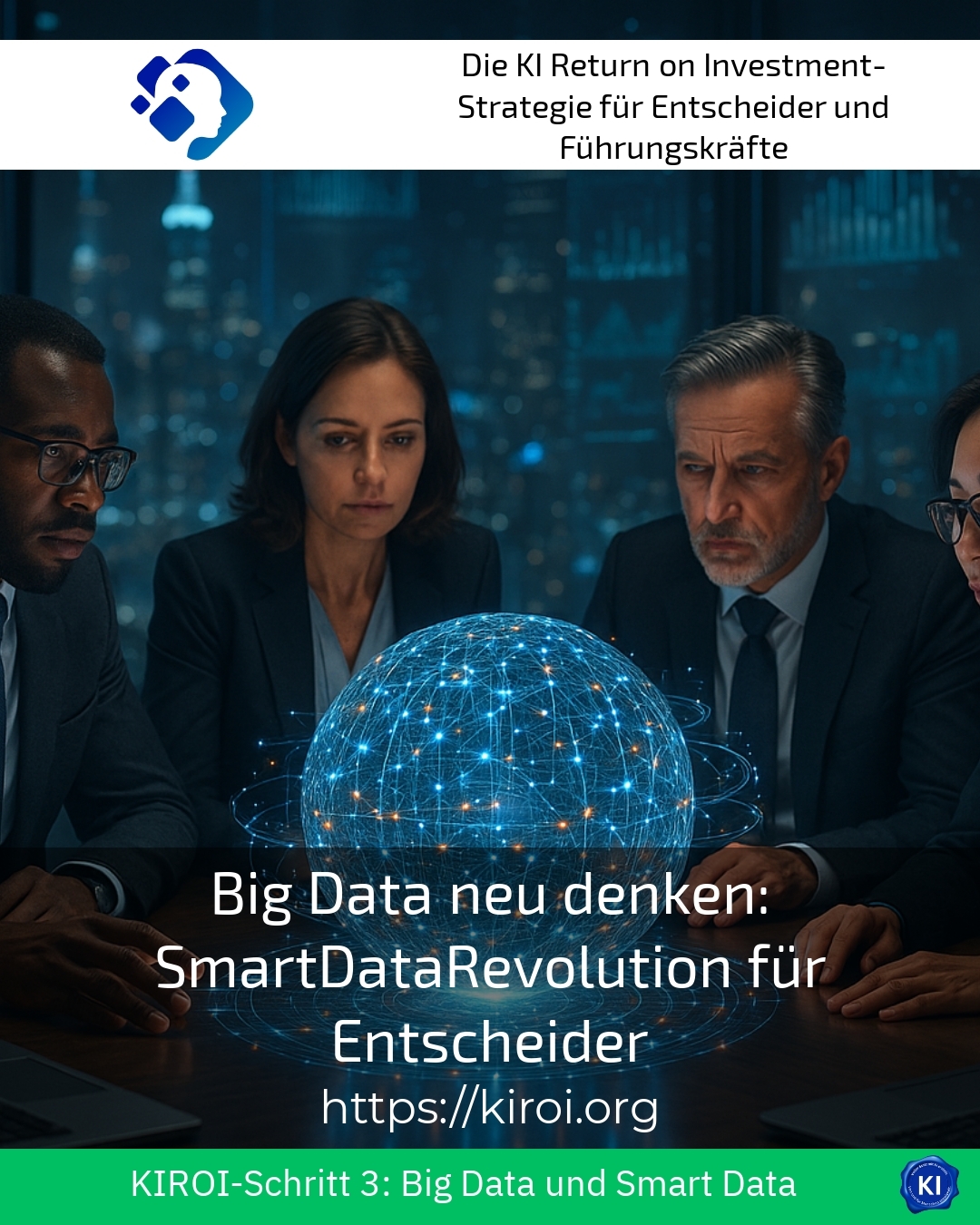
Imagine your business could extract the truly valuable insights from the flood of digital information. The SmartDataRevolution for Decision Makers fundamentally changes how leaders make strategic decisions today. While many organisations are still drowning in data, clever minds are already discovering a more elegant way. It's no longer about collecting and storing everything. Instead, intelligent selection is the priority. This paradigm shift affects all sectors of the economy. It fundamentally changes decision-making processes.
From the data mountain to a strategic resource
Many leaders are very familiar with this challenge from their daily work. Companies collect millions of data points from a wide variety of sources every day. Customer interactions, production processes, and market movements continuously generate new information. However, the sheer volume rarely provides a competitive advantage. On the contrary, it often leads to overload and wrong decisions. The real art, therefore, lies elsewhere. It consists of recognising relevant patterns and deriving impulses for action from them.
For example, a medium-sized logistics company used extensive tracking systems for years. The managers received hundreds of reports daily, yet delivery delays remained a recurring problem. Only focusing on a few, but meaningful, key figures brought about a change. A regional energy supplier experienced something similar. It initially analysed all of its customers' consumption data, but the flood of information overwhelmed the team. After a realignment, they concentrated on peak consumption, which allowed them to optimise load distribution [1].
This shift is also clearly evident in the healthcare sector. Hospitals process enormous amounts of patient data. The challenge lies in filtering out clinically relevant information. One hospital therefore implemented an intelligent early warning system. This focuses on critical vital signs. The results now support the treating physicians in time-critical decisions.
The Smart Data Revolution for Decision-Makers in Small and Medium-Sized Enterprises
Medium-sized businesses, in particular, will benefit significantly from this new approach. They often lack the resources of large corporations, yet they face similar challenges in information processing. The targeted selection of relevant data streams creates a decisive advantage here. This allows SMEs to react more agilely and quickly than their larger competitors.
A mechanical engineering company from southern Germany provides a clear example of this. The firm produces high-precision components for the automotive industry. Previously, every production parameter was meticulously collected. However, the evaluation overwhelmed the existing personnel. After switching to intelligent filtering, the team focused on quality indicators. The rejection rate subsequently fell by more than a fifth. At the same time, data storage costs were significantly reduced.
In retail, focused data analysis also enables remarkable improvements. Retailers can understand and react to customer behaviour more specifically. A fashion retailer used to analyse all purchase transactions. However, the insights remained superficial. After the realignment, the focus shifted to abandoned purchases. These provided valuable clues about optimisation potential in the sales process [2].
Best practice with a AIROI customer
A family business with a long tradition in the food sector faced a complex challenge. The company operates several production sites in Germany and supplies the retail trade. The responsible parties had implemented extensive data collection systems over the years. These generated several gigabytes of information from production, logistics, and sales daily. Nevertheless, actionable insights for strategic decisions were lacking. Management reported being paralyzed by information overload. As part of a transruption coaching, we supported the management team in realigning the company. First, we jointly identified the truly decision-relevant key figures. We reduced these to about twenty core indicators. Subsequently, we developed a dashboard for management. This visualizes the most important trends at a glance. Executives now report significantly faster and more well-founded decisions. Measurable improvements are particularly evident in production planning. Warehousing costs decreased while delivery capability increased. This success motivated the team to take further optimisation steps.
Understanding technological foundations
Technological capabilities are constantly evolving. Modern algorithms can now recognise patterns that human analysts would overlook. At the same time, they enable the pre-selection of relevant information. Leaders do not need to understand these technologies in detail. However, they should be aware of their potential and limitations. Only then can they make informed decisions about investments.
In the financial sector, institutions are already employing advanced analytical methods. Banks use intelligent systems to detect suspicious transactions. These filter out from millions of operations those that require investigation. Without this pre-selection, effective monitoring would be practically impossible. Insurance companies analyse claims with similar methods. They identify anomalies that could indicate fraudulent attempts [3].
The energy sector offers further clear examples of this approach. Grid operators continuously monitor the condition of their infrastructure. Sensors on transformers and lines provide constant measurements. Intelligent evaluation focuses on deviations from the normal state. This allows maintenance teams to intervene precisely where it is truly necessary. Predictive maintenance saves significant costs. At the same time, it increases supply security for consumers.
Implementing SmartDataRevolution for decision-makers in practice
Practical implementation first requires a clear strategy. Companies should ask themselves which decisions they wish to improve. From this, the necessary information can be identified. This process often requires a rethink among all stakeholders. Many organisations have developed a 'collecting' mentality over many years. Letting go of this is not always easy.
The pharmaceutical industry faces particular challenges in data utilisation. Clinical trials generate enormous quantities of patient data, and regulatory requirements are particularly stringent. Nevertheless, the advantages of focused analyses are also apparent here. One pharmaceutical company concentrated on specific biomarkers. This significantly accelerated the development of new therapeutic approaches. At the same time, data management costs decreased.
In the manufacturing sector, the new approach effectively supports quality assurance. An electronics manufacturer implemented a process monitoring system. Instead of analysing all production parameters, it now focuses on critical quality indicators. Deviations trigger an immediate warning to production management. This has significantly reduced reaction times to quality issues. Customer satisfaction has demonstrably increased [4].
Best practice with a AIROI customer
A service company specialising in technical building equipment approached us with a specific problem. The company manages commercial properties nationwide and monitors their technical systems. Sensors in the buildings continuously supplied data on temperature, air quality, and energy consumption. The sheer volume of this information was increasingly overwhelming the monitoring team. Important warning signs were frequently lost in the flood of data, meaning repairs often only took place after a complete system failure. As part of the transruption coaching, we supported the company in a fundamental realignment. Together, we developed a prioritisation system for the incoming data streams, distinguishing between critical and less urgent information. The monitoring team now receives only relevant notifications. This has led to an approximately one-third reduction in unplanned emergency call-outs. At the same time, customer satisfaction has noticeably improved. Employees report a significantly reduced workload, allowing them to concentrate on truly important tasks.
Cultural change as a success factor
Technology alone does not yet guarantee success in this transformation process. The cultural shift within the organisation is just as important. Leaders must find the courage to reduce data collection. This often goes against the instinct to hoard as much information as possible. The fear of missing something important is widespread. Nevertheless, the advantages of a focused approach clearly outweigh this.
This shift is particularly evident in human resources. HR departments traditionally collect extensive employee data, but analysis was often superficial. Modern approaches focus on a few key indicators that provide insights into employee satisfaction and turnover. One technology company drastically reduced its HR key figures, and the remaining indicators now deliver more meaningful insights [5].
Focus also leads to better results in marketing. Marketing departments have countless campaign metrics. However, the sheer volume of metrics often leads to confusion. Consequently, a consumer goods manufacturer focused on a few key metrics. These demonstrate the actual impact of marketing activities on sales. As a result, the efficiency of marketing expenditure improved measurably.
Embedding the Smart Data Revolution sustainably for decision-makers
The sustainable embedding of this new way of thinking requires continuous attention. Companies tend to collect more again over time. Regular reviews of the data landscape are therefore recommended. The question should always be at the centre of this. Which information actually supports our decision-making processes?
The tourism sector provides interesting insights for this. Tour operators gather data on booking behaviour and customer preferences. Intelligent analysis focuses on booking patterns and cancellation reasons. This enables better capacity planning. A cruise company significantly optimised its utilisation in this way. The findings flow directly into pricing.
New opportunities are also opening up in the education sector. Universities have extensive data on students. Analysis can provide indications of dropout risks. One university specifically analysed early warning indicators. Tutors were then able to support at-risk students earlier. This perceptibly reduced the dropout rate in certain degree programmes.
My AIROI Analysis
The transformation towards intelligent data utilisation is not a one-off project. Rather, it is a continuous process of ongoing development. Decision-makers across all sectors face the same fundamental challenge. They must extract truly valuable insights from the flood of information. The examples from various economic sectors illustrate the enormous potential. At the same time, they highlight the necessity of a cultural shift.
My observations from numerous consulting projects strongly confirm this assessment. Companies that find the courage to focus achieve better results. They make faster and more informed decisions. Their employees work more efficiently and are happier. The costs for data infrastructure often decrease significantly. At the same time, the quality of the insights gained increases.
The key lies in the right balance between gathering and selecting. Too little information leads to blind spots. Too much information leads to decision paralysis. Finding the happy medium requires experience and continuous learning. External mentors can provide valuable impetus in this process. They bring a fresh perspective to established structures.
The coming years will show which organisations successfully master this change. Those that cling to old collection habits will increasingly fall behind. The winners will be those who can distinguish the essential from the non-essential. This competence will become the central leadership task of the future. Decision-makers should therefore start questioning their data culture today.
Further links from the text above:
[1] Bitkom – Digital Transformation
[2] McKinsey Digital Insights
[3] BaFin – Publications on Financial Market Regulation
[4] Fraunhofer – Research, Production and Services
[5] DGFP – HR-Wiki
For more information and if you have any questions, please contact Contact us or read more blog posts on the topic Artificial intelligence here.









 Deutsch
  English (UK)