
Imagine your company is sitting on a mountain of information, yet no one knows what treasures lie hidden within. This is precisely where the fascinating journey begins with data intelligence from Big Data to Smart Data, which supports companies of all sizes in gaining truly actionable insights from the sheer volume of collected information. Many organisations today collect vast amounts of data without ever using it effectively. The real challenge lies not in collecting, but in intelligently filtering and interpreting. This article shows you how to successfully manage this transition.
The challenge of the data flood in modern companies
Every day, billions of new datasets are created globally in a wide variety of formats and contexts. Companies store customer information, transaction data, social media interactions, and sensor data. The sheer volume of available information continues to grow exponentially. At the same time, many executives report their teams are increasingly overwhelmed. Existing resources are often insufficient to meaningfully process these vast amounts of data. This results in digital data graveyards that occupy storage space but deliver no added value.
For example, a medium-sized manufacturing company collects machine data from hundreds of sensors. This information often remains unused in databases. An online retailer records the click behaviour of its visitors without deriving personalised offers from it. And a logistics company stores GPS data from its vehicle fleet but does not analyse it systematically. These examples illustrate the enormous potential that lies dormant in many organisations.
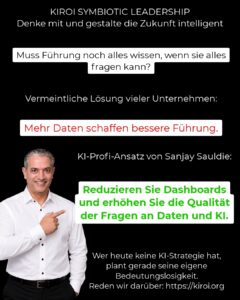
The transition with data intelligence from Big Data to Smart Data therefore requires a fundamental change in thinking. It is no longer about accumulating as much information as possible. Instead, the quality and relevance of the data are brought to the forefront. Companies must learn to ask the right questions of their data holdings. Only in this way can they gain valuable insights and translate them into concrete recommendations for action.
Intelligent data processing as a strategic competitive advantage
The systematic processing and analysis of information today gives companies decisive advantages over the competition. Those who use their data intelligently can recognise market trends earlier and react faster. At the same time, a sound data basis enables better decisions at all company levels. Managers no longer rely on their gut feeling alone. They base their decisions on reliable facts and comprehensible analyses.
In the manufacturing industry, companies use predictive maintenance to avoid machine failures. They analyse sensor data in real time and detect wear patterns early. This significantly reduces maintenance costs while increasing productivity. In retail, intelligent algorithms optimise inventory levels and reduce overstocking. And in healthcare, data-driven systems support doctors in diagnosing complex medical conditions.
However, this change requires significant investment in technology and skill development. Companies need robust data processing and storage infrastructure. At the same time, they must train their employees in the use of data-driven tools. Many organisations underestimate the cultural shift that accompanies this transformation. The willingness to make decisions based on data must grow at all levels.
Best practice with a AIROI customer
An international mechanical engineering company faced the challenge of making meaningful use of its extensive production data. Existing systems collected millions of data points daily from various manufacturing sites worldwide. Nevertheless, a unified approach to analysing and interpreting these valuable information stores was lacking. As part of an AIROI support project, we jointly developed a strategy for intelligent data utilisation. Firstly, we identified the most relevant data sources and defined clear quality criteria for the information collected. We then implemented processes for continuous data cleansing and enrichment. The company also established a central data governance team with clear responsibilities. After approximately six months, those in charge reported a significant improvement in the quality of decision-making in production planning. The average response time to quality issues decreased measurably because relevant information was now more readily available. The participants particularly welcomed the improved collaboration between the different departments and sites.
From raw material to treasure trove of knowledge with data intelligence from Big Data to Smart Data
The transformation process from unstructured raw data to actionable insights follows a systematic approach. First, companies must inventory and evaluate their existing data sources. In doing so, they often find that valuable information is scattered in silos and difficult to access. Integrating these diverse sources is therefore an important first step. Modern data platforms make it possible to consolidate information from the most varied systems.
The next step involves the cleaning and standardisation of the collected data [1]. Inconsistencies, duplicates, and erroneous entries significantly reduce the quality of any analysis. Consequently, companies are increasingly investing in automated tools for data quality assurance. These tools can identify anomalies and automatically correct them according to defined rules. At the same time, clear data standards lay the foundation for company-wide comparability and consistency.
For example, a financial service provider uses automated processes for customer data management. An energy supplier standardises consumption data from millions of households. And a telecommunications company harmonises network data from different technology generations. These examples show how different industries overcome similar challenges in data preparation.
Technological enablers of intelligent data utilisation
Modern technologies play a crucial role in transforming raw data into actionable insights. Cloud platforms today offer virtually unlimited computing power for processing large volumes of data. At the same time, they allow for flexible scaling according to specific requirements. Companies only pay for the resources actually used. This significantly lowers the entry barriers, especially for smaller organisations.
Machine learning and artificial intelligence fundamentally expand the possibilities of data analysis [2]. These technologies recognise patterns in large datasets that would remain hidden from human analysts. They make predictions based on historical data and continuously improve their accuracy. An insurance company uses such algorithms for fraud detection in claims. A pharmaceutical company significantly accelerates the development of new active ingredients with them. And a car manufacturer optimises its supply chains through more precise demand forecasts.
However, companies should not consider technological solutions in isolation. Success depends crucially on integration into existing business processes. User acceptance also determines the success or failure of such initiatives. Therefore, transruptions-coaching supports organisations in holistically designing their data strategy. We help teams to reconcile technical possibilities with functional requirements.
The human factor in data-driven organisations
Despite all technological advances, humans remain the crucial success factor in data utilisation. Algorithms can recognise patterns and reveal connections. However, the interpretation of results and the derivation of actions require human judgment. Leaders must learn to critically question and contextualise data-driven recommendations. They must not rely blindly on automated analyses.
At the same time, companies require employees with appropriate analytical skills [3]. The demand for Data Scientists, Business Analysts, and Data Engineers is steadily growing. However, many organisations struggle with a significant shortage of skilled professionals in these areas. Further education programmes and internal training are therefore becoming increasingly important. For example, a retail company is qualifying buyers for independent data analysis. A bank is training its customer advisors in the use of analytical dashboards. And an industrial company is upskilling production employees to become data specialists.
Best practice with a AIROI customer
A leading company in the consumer goods sector recognised the need to make its marketing activities more data-driven. Previously, existing customer data had only been analysed in a fragmented way and without an overarching strategy. The marketing department continued to make many decisions based on experience and intuition. As part of our AIROI support, we first developed a shared understanding of the relevant data sources and analysis possibilities. Subsequently, we implemented a pilot project for the segmentation and personalised targeting of specific customer groups. Employees received intensive training in handling the new analytical tools and methods. Particularly important was the imparting of fundamental knowledge on data interpretation and critical evaluation of analysis results. Following the pilot phase, the team reported significantly improved target group addressing and higher conversion rates. The initial skepticism of some employees gave way to growing enthusiasm for data-driven working methods. The company is now planning to expand the approach to other business areas and markets.
Ethical Aspects and Data Protection in the Intelligent Use of Data
With the increasing use of data, so too do the demands for responsible handling grow. Companies must strictly adhere to current data protection regulations and communicate transparently. The European General Data Protection Regulation sets binding standards for all organisations here [4]. Violations can result in significant financial penalties and reputational damage. Forward-thinking companies therefore invest specifically in their data protection compliance.
Furthermore, fundamental ethical questions arise when using algorithms. Automated decision systems can amplify existing biases if not carefully monitored. A lending institution must ensure that its scoring algorithms do not exhibit discriminatory patterns. A recruitment agency must guarantee that applicant selection is fair and transparent. And an insurance company must clearly explain how premiums are calculated.
These challenges require a holistic governance approach to managing data and algorithms. Companies are therefore increasingly establishing ethics committees and defining binding guidelines. The documentation of decision-making processes and algorithms is becoming more important. Regular audits check compliance with the defined standards and guidelines.
Success factors for sustainable transformation with data intelligence
Successfully transforming into a data-driven organisation requires a systematic approach on multiple levels. Firstly, every company needs a clear data strategy that is aligned with overarching business objectives. This strategy defines priorities, resources, and milestones for the coming years. Without this strategic foundation, data initiatives often remain isolated projects with no lasting impact.
Support from senior management plays a central role in success. Leaders must actively drive change and act as role models. They should demand and practice data-driven decision-making themselves. For example, a retail group introduced weekly data reviews at board level. A media company linked bonus payments to the use of analytical key figures. And a technology company made data literacy a component of all leadership development programmes.
Finally, sustainable transformation also requires the adaptation of processes and structures. Classic silo thinking must be overcome in order to be able to use data across departments. Agile working methods promote the rapid implementation of findings into concrete measures. Transruptions coaching supports organisations in successfully shaping the necessary structural changes.
My AIROI Analysis
The Transformation with data intelligence from Big Data to Smart Data represents one of the most important strategic challenges for many companies. From my experience in numerous support projects, I can report that success depends decisively on a holistic approach. Technology alone is not sufficient to achieve the desired results. The combination of a powerful infrastructure, qualified employees and a supportive corporate culture forms the foundation for sustainable success.
I particularly often observe that companies invest in technical solutions too quickly without clearly defining their goals beforehand. The question of concrete business benefit should be at the start of every initiative. What decisions do we want to improve, and what data do we actually need for that? This clarity prevents misinvestments and focuses limited resources on the truly relevant use cases.
Furthermore, many organisations underestimate the effort involved in change management and skills development. The introduction of data-driven working methods changes established routines and questions long-held practices. Employees need time and support to develop new skills and build confidence in the new methods. AIROI offers a proven framework to shape this transformation holistically and sustainably. We guide companies on their individual journey and provide impetus for the successful implementation of their data strategy.
Further links from the text above:
[1] Bitkom – Data Economy and AI Fundamentals
[2] Federal Ministry for Economic Affairs – Artificial Intelligence
[3] Federal Statistical Office – ICT in enterprises
[4] GDPR - General Data Protection Regulation
For more information and if you have any questions, please contact Contact us or read more blog posts on the topic Artificial intelligence here.










 Deutsch
  English (UK)