
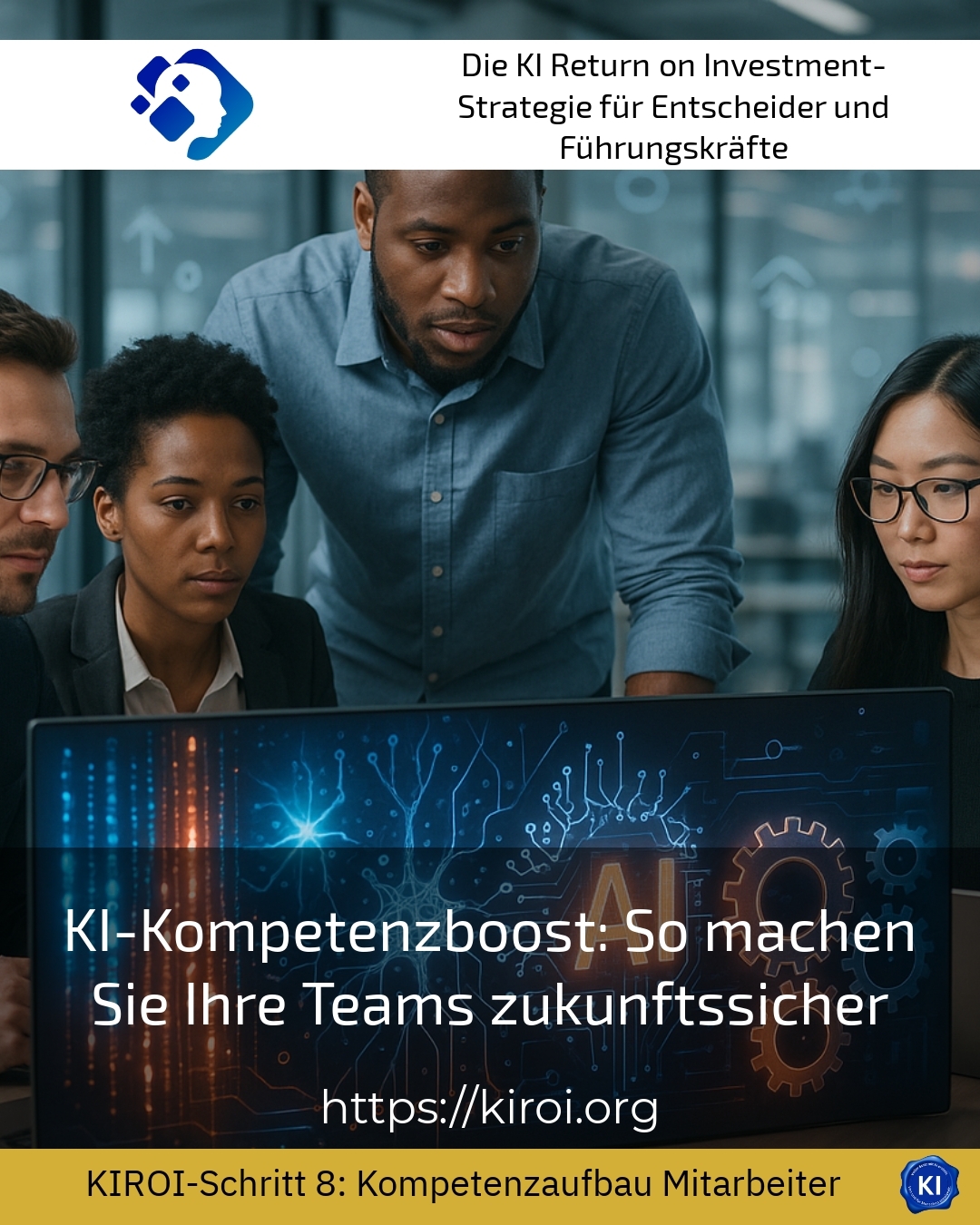
The digital transformation is fundamentally changing our world of work and presents teams with entirely new challenges. Those who do not act today will lose out tomorrow. The AI Skills Boost offers companies a unique opportunity to make their employees fit for the future. But how can this transformation be achieved in practice? What steps lead to success? And why do so many organisations fail at this task? The answers are more complex than many managers initially assume and require a fundamental rethink of the entire corporate culture.
Why the AI skills boost is becoming indispensable now
The pace of technological change is increasing exponentially. Companies frequently report uncertainty in dealing with new technologies. Employees often feel overwhelmed by the rising demands. At the same time, the pressure to work more efficiently and innovatively is growing. A mechanical engineering company in the SME sector, for example, experienced its experienced design engineers suddenly being confronted with automated design systems. Initial scepticism only gave way when targeted training measures clarified the potential of the new tools. A logistics company faced the challenge of retraining its dispatchers in intelligent route planning systems. Employees initially feared being replaced. However, through transparent communication and practical training, they realised that their expertise was still in demand. A mid-sized insurance company implemented chat-based customer advisory systems, with advisors learning to use them to support their daily work.
transruptions-Coaching supports companies with precisely these kinds of projects and provides valuable input. The focus is on the individual situation of each team. It's not about standardised solutions, but about tailor-made development paths. Managers often come with the question of how they can motivate their teams. Others are looking for ways to overcome resistance to change. Still others want to understand which skills will be particularly in demand in the future.
Best practice with a KIROI customer
A long-established family business in the manufacturing industry approached us because the workforce was increasingly unsettled by management's digitalisation plans. The employees had decades of experience in their respective fields and feared that their knowledge might become devalued. Together, we developed a multi-stage programme that first addressed their fears and then progressively built practical skills. The experienced specialists realised that their expertise was irreplaceable and that they could now use it even more effectively with new tools. Within six months, initial scepticism transformed into genuine enthusiasm for the new possibilities. The company reported a significantly improved atmosphere and an increased willingness to innovate. It was particularly noteworthy that it was the older employees who became pioneers of the change, as they recognised the added value for their daily work. This transformation impressively demonstrates the importance of sensitive support during such change processes.
The building blocks of a successful AI skills boost
Successful competency development is based on several supporting pillars. Firstly, an honest assessment of existing skills is required. Based on this, individual learning paths can be designed. For example, a pharmaceutical company systematically analysed the digital competencies of its research department. The results showed significant differences between individual teams and age groups. Differentiated training programmes with varying focuses were developed on this basis. An energy provider used this approach to prepare its network technicians for predictive maintenance systems. The technicians contributed their practical knowledge while simultaneously learning to interpret data-based forecasts. A retail chain developed a programme for its store managers on the use of intelligent inventory management solutions.
The second pillar is a learning culture that sees mistakes as opportunities for development. Employees must be able to experiment without fear of sanctions. Clients often report that it is precisely this fear of mistakes that blocks progress. An automotive supplier therefore created protected experimentation spaces for its teams. New technologies could be tested there without production pressure. This freedom led to surprising innovations and significantly increased self-confidence.
Practical approaches for boosting AI skills in everyday work
Theory and practice must be closely linked to enable sustainable learning. Abstract training sessions often prove ineffective because the transfer to everyday life is missing. Successful programmes therefore rely on application-oriented learning formats with a direct connection to daily work. For example, a media company allowed its editors to experiment with new research tools during their regular work. The learning curve was steeper than with classic seminars, and acceptance was significantly higher. A financial service provider integrated learning modules directly into the existing work processes of its clerical staff. Short practice sessions alternated with productive work, allowing what was learned to be applied immediately. An auditing firm developed a mentoring programme where technically proficient junior staff accompanied experienced partners.
transruptions-Coaching supports organisations in developing and successfully implementing such practice-oriented formats. The focus is always on the specific situation and the concrete needs of the respective team. The aim is to provide impetus and to sensitively guide the change process.
Best practice with a KIROI customer
An internationally operating consultancy firm was looking for ways to prepare its consultants for the use of intelligent analysis tools. Previous training measures had not yielded the desired results, and many employees were barely using the new tools. Together with the team leaders, we analysed the obstacles and identified several problem areas. The training sessions had been too abstract and had not been linked to real projects. Furthermore, there was a lack of time for practising and experimenting in everyday work. We then developed a programme that was directly linked to ongoing client projects. The consultants got to know and appreciate the new tools based on their current tasks. Accompanying reflection rounds enabled the exchange of experiences and joint problem-solving. After three months, the usage rate of the new analysis tools had tripled. The consultancy firm's clients benefited from deeper insights and faster results. This success shows how important the connection between learning and practical application is for sustainable skills development.
Overcoming resistance and fostering willingness to change
Every change encounters resistance, and that is completely normal and even healthy. These resistances often signal justified concerns that must be taken seriously. Prematurely overriding such signals can jeopardise the entire change process. A telecommunications company experienced massive resistance when introducing automated customer service systems. Employees feared job losses and a dehumanisation of customer contact. Only intensive dialogue formats and transparent communication about the actual goals resolved these blockades. A hospital encountered scepticism when it wanted to introduce diagnostic support systems. Doctors saw their professional authority questioned and reacted negatively. By involving renowned medical professionals as ambassadors, the mood gradually changed. An industrial group had to learn that different departments required completely different support.
Overcoming resistance requires patience and genuine interest in the concerns of those affected. Clients often report feeling unheard during change processes. This feeling of powerlessness reinforces defensive attitudes and blocks any progress. Successful transformations are therefore characterised by genuine participation and open communication.
Leaders as the key to boosting AI competency
The role of leaders in change processes can hardly be overestimated. They significantly shape the learning culture through their own behaviour. If leaders themselves do not show a willingness to learn, their teams will follow suit. A consumer goods manufacturer observed that digital transformation progressed where leaders actively engaged in learning themselves. This role model function proved to be a crucial success factor for the entire organisation. Consequently, a tourism company first intensively trained its leadership level in new technologies. Only then were the training programmes extended to the entire workforce. A construction company realised that its site managers significantly influenced the acceptance of digital planning tools.
Leaders must learn to navigate their teams through uncertainty and provide direction. This often requires a rethink of their own understanding of leadership and new skills. transruptions-coaching supports leaders in this personal development and provides impulses for new leadership approaches. Many clients come with the question of how they can simultaneously provide stability and drive change.
Best practice with a KIROI customer
A medium-sized insurance group approached us because their executives were overwhelmed by the dynamics of digital transformation. The managers were expected to simultaneously manage operational business and drive profound change. Many felt torn between these demands and were showing the first signs of burnout. We developed a support programme that strengthened both personal resilience and leadership skills. In one-to-one coaching sessions, we worked on individual development topics and limiting beliefs. Group workshops facilitated exchange between executives from different departments. The participants learned to take their own feelings of overwhelm seriously as a signal and to draw constructive conclusions from them. They developed strategies to authentically lead their teams through the change. After one year, the executives reported a significantly improved ability to deal with uncertainty. The employees in their teams showed a greater willingness to change and fewer stress symptoms. This example clearly shows that successful transformation must begin with the executives and that their personal development must not be neglected.
Ensuring sustainability and long-term impact
One-off training measures quickly lose their impact if they are not embedded in a continuous development system. Sustainable skills development requires long-term perspectives and regular refreshers of what has been learned. A chemical company therefore established a system of continuous learning loops for all employees. Monthly short workshops kept knowledge fresh and introduced new developments. A technology group set up internal knowledge platforms where employees could share their experiences. These peer-to-peer learning opportunities proved to be particularly effective and sustainable. A retail company introduced regular skills reviews to check the development status of its teams.
The integration of new competences into daily work is a key factor in long-term success. Theoretical knowledge must be practically applied to remain permanently available. Many organisations underestimate this aspect and are surprised by the lack of change. The structured transfer of learning into everyday work requires conscious design and consistent support [1].
My KIROI Analysis
The future viability of organisations depends crucially on how well they manage to prepare their employees for technological changes. The AI Skills Boost This is not a one-off project, but an ongoing task that deserves strategic attention. My experience from numerous support projects shows that technical training alone is not sufficient to bring about sustainable change. The human dimension, with all its fears, hopes, and resistances, must be taken seriously and actively addressed.
Organisations that are particularly successful are those that AI Skills Boost understood as cultural change and not just as a qualification measure. They create spaces for experimentation and reward a willingness to learn rather than perfection. Leaders play a central role as role models and enablers of development. The KIROI methodology offers a structured framework for these complex change processes and helps to avoid typical pitfalls. It combines technological and human aspects and takes into account the specific situation of each organisation. The examples presented here impressively show that successful transformation is possible if it is professionally supported. However, the most important success factor remains the genuine willingness to change at all levels of the organisation. Those who promote this willingness and provide the necessary resources will be able to successfully master the challenges of the future [2].
Further links from the text above:
[1] McKinsey – Developing Workforce Skills on a Large Scale
[2] World Economic Forum – Future of Jobs Report
For more information and if you have any questions, please contact Contact us or read more blog posts on the topic Artificial intelligence here.











 Deutsch
  English (UK)