
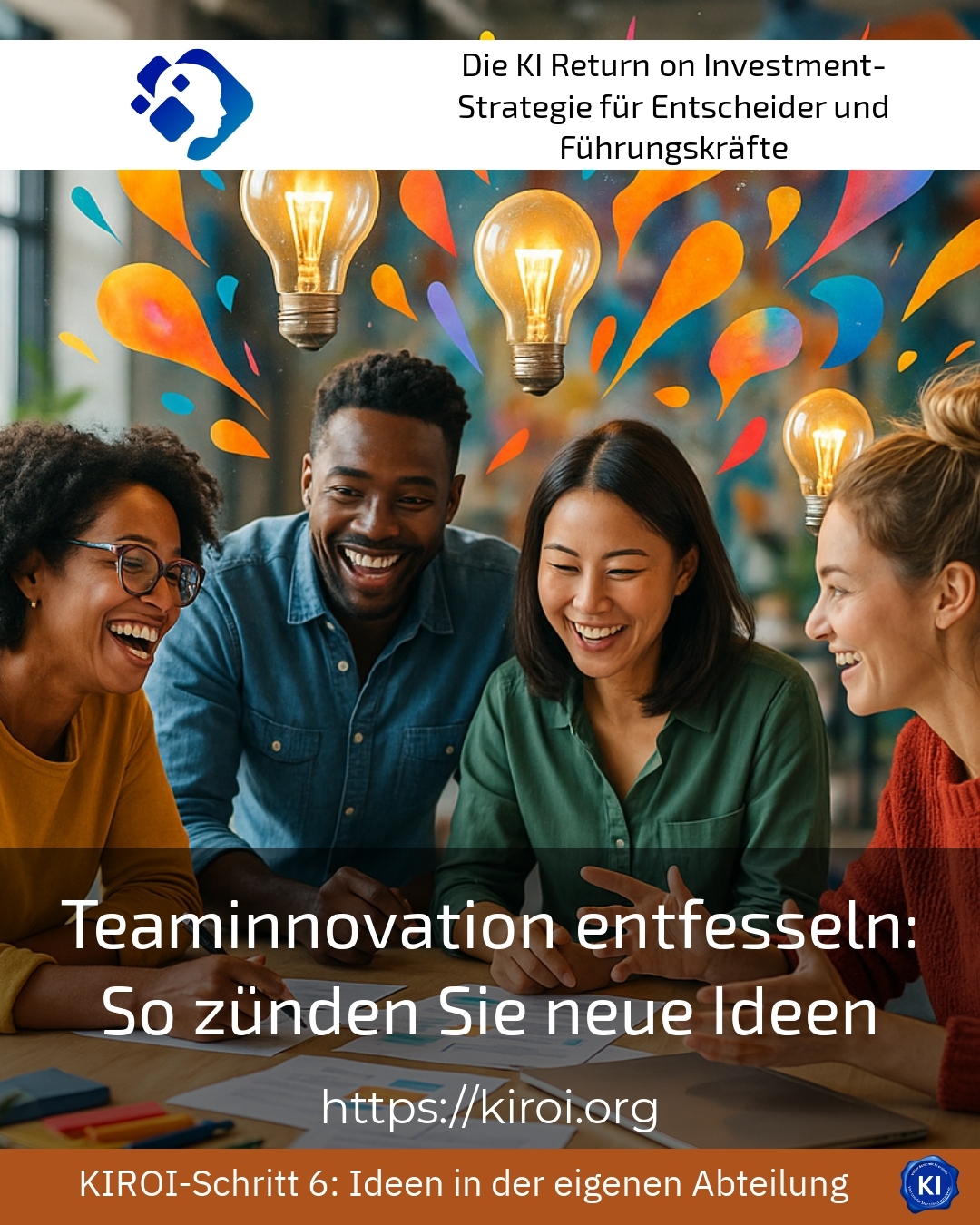
Imagine your team is sitting in a meeting room and suddenly an idea emerges that changes everything. This moment, when creative sparks fly and groundbreaking concepts materialise out of nowhere, can be deliberately brought about. Unleashing team innovation means not waiting for chance, but systematically creating the conditions for new ideas to flourish. Many leaders and project managers come to transruption coaching with precisely this concern, because they sense that more potential is slumbering within their teams. The good news is that there are tried-and-tested methods and approaches that can help unleash this potential.
The creative spark: Why teams need new ideas
In a world that is changing ever faster, optimising existing processes is no longer enough. Companies need fresh perspectives and bold ideas to remain competitive. Clients often report that their meetings are falling into routine and rarely generate surprising new ideas. In the long term, this stagnation leads to frustration among employees and missed market opportunities. That is why many organisations are looking for ways to revitalise their teams and establish a culture of curiosity.
The challenge lies in creating a safe space for unconventional thoughts. Employees must feel that their suggestions are welcome, even if they initially seem unusual. This psychological safety forms the foundation for any kind of collective creativity. For instance, a technology company has introduced weekly „Wild Idea“ sessions where no idea can be criticised. A financial services provider utilises anonymous digital boards to collect and evaluate suggestions. A medium-sized mechanical engineering firm organises quarterly hackathons where interdisciplinary teams work on future-oriented projects.
Best practice with a AIROI customer
An international logistics company approached transruptions-Coaching because its innovation rate had been steadily declining in recent years. Employees felt unheard by management and had become resigned, despite encountering opportunities for optimisation on a daily basis. As part of the support provided, a comprehensive analysis of existing communication structures was carried out to identify any blockages. This revealed that suggestions often got lost at middle management level and never reached the decision-makers. Consequently, a direct digital channel was established between operational teams and senior management, facilitating regularly moderated discussion rounds. Within six months, over two hundred improvement suggestions were received, forty of which have already been implemented. Employee satisfaction increased measurably, and staff turnover dropped by a remarkable fifteen percent, positively influencing the overall company culture.
Unleashing team innovation through structured creativity
Many people believe that creativity must be spontaneous and chaotic. However, this assumption often leads to innovation processes being left to chance. In reality, teams benefit from clear structures that simultaneously allow enough room for unexpected turns. Design Thinking, for example, offers a proven framework that combines systematic procedures with creative thinking. The method begins with a deep understanding of user needs and leads to innovative solutions through iterative prototypes.
Transruptions-Coaching helps teams to learn these methods and integrate them sustainably into their daily work. The impulses given aim to break down mental blocks and enable new perspectives. A retail company completely rethought its customer approach through guided workshops [1]. A pharmaceutical company developed a completely novel patient portal with external support. An energy provider used structured creativity techniques to conceive innovative tariff models that are both ecologically and economically convincing.
Igniting new ideas with the power of diversity
Homogeneous teams tend to produce similar solutions time and again because all participants bring comparable experiences and ways of thinking. True innovation, on the other hand, arises where different perspectives meet and enrich each other. The deliberate assembly of heterogeneous project groups can therefore make an enormous difference. This is not only about obvious characteristics such as age or gender, but also about professional backgrounds and personality types.
An automotive supplier has brought together engineers and designers and psychologists specifically to improve the user experience [2]. An insurance group has mathematicians and storytellers working together on product descriptions. A software company involves customers directly in the development teams and benefits from their unvarnished view of their own products.
Best practice with a AIROI customer
A medium-sized advertising agency faced the challenge that their campaign concepts were increasingly appearing interchangeable, leading to customer departures. Management recognised that the teams were too homogeneously staffed and were reproducing similar creative patterns. As part of the transruption coaching support, a comprehensive diversity programme was developed, going far beyond traditional characteristics and placing cognitive diversity at its core. New employees were consciously recruited from non-specialist fields such as anthropology, architecture, and even gastronomy, to bring fresh impetus. Additionally, existing teams were mixed up through regular rotations, creating new constellations time and again. The agency subsequently developed an award-winning campaign that utilised precisely those unexpected perspectives made possible by the new team composition. Turnover increased by twenty-eight percent in the following year, and several important new clients were acquired.
Spaces and Rituals: Unleashing the Environment for Team Innovation
The physical and virtual environment significantly influences how creatively a team can work. Monotonous office landscapes with endless rows of identical desks rarely encourage inspired thinking. Instead, innovative teams need flexible spaces that support different working modes: quiet corners for concentrated individual work, cosy seating areas for informal discussions, and generous areas for collaborative workshops. The design of these spaces sends a clear message about the type of work desired.
A consulting firm has redesigned its entire office floor based on the principles of creativity research [3]. A media company provides its teams with mobile whiteboards and prototyping materials. A telecommunications provider has set up virtual innovation spaces where remote employees can brainstorm together on digital Miro boards.
Alongside physical spaces, rituals play a crucial role in a company's innovation culture. Regular creative time, where employees are allowed to work on their own projects, has proven successful in many organisations. A technology giant grants its developers twenty percent of their working time for personal experiments. A consumer goods manufacturer holds monthly „Show and Tell“ events where teams present their latest prototypes.
A culture of error as a catalyst for new ideas
Innovation without mistakes is practically impossible, because every new path involves uncertainty. Teams that fear failure will always choose the safe route and never truly dare to innovate. Therefore, developing a healthy culture of mistakes is crucial for an organisation's ability to innovate. Mistakes should not be seen as blemishes, but as valuable learning opportunities that pave the way to better solutions.
A chemical company celebrates the „best mistake“ every month, rewarding employees who have gained important insights from setbacks. A fintech startup holds regular „Failure Fridays“ where failed projects are openly discussed. An industrial group has built an internal database where lessons learned from unsuccessful initiatives are documented and made accessible to everyone.
Best practice with a AIROI customer
A long-established family business in the mechanical engineering sector had maintained a strict zero-defects policy for decades, which was originally intended for quality assurance in production. However, this mentality had spread to all areas of the company, leading employees to avoid any risks. Innovative suggestions were hardly made anymore because nobody wanted to be held responsible for any potential failures. As part of the transruptions coaching support, a cultural change programme was initiated that empowered managers to deal constructively with mistakes. Workshops and reflection sessions helped to understand the distinction between avoidable production errors and unavoidable setbacks in innovation. The management led by example, publicly sharing their own professional mistakes and the lessons learned from them. Within a year, the number of submitted suggestions for improvement doubled, and several new product lines were successfully developed.
Digital tools to support collective creativity
Modern technologies offer numerous possibilities to support and accelerate creative processes in teams. Collaboration platforms make it possible to gather and develop ideas asynchronously, regardless of time zones or locations. Artificial intelligence can serve as a sparring partner, suggesting unusual connections or revealing blind spots. The art lies in using these tools in a way that complements human creativity rather than replaces it.
A global consumer goods company uses AI-powered trend analyses to identify promising fields for innovation [4]. An architectural firm uses generative design software to create hundreds of design variants in the shortest possible time. A research institute uses text mining to track down relevant scientific publications and link them to its own projects.
Transruptions-Coaching supports organisations in selecting and meaningfully implementing the right digital tools. The guidance covers both technical aspects and the necessary cultural changes. This is because the best software is of little use if employees do not accept it or use it incorrectly.
Sustainable implementation of innovation processes
Many innovation initiatives fail not due to a lack of ideas, but a lack of implementation into daily work. After initial enthusiasm, teams frequently revert to familiar patterns and creative impulses fizzle out. To prevent this, innovation processes need to be systematically embedded within the organisational structure. Clear responsibilities, measurable goals, and regular reflection loops help to maintain momentum.
A trading company has appointed a Chief Innovation Officer who reports directly to the board of directors. A healthcare provider is integrating innovation goals into regular staff appraisals and bonus systems. An educational provider quarters quarterly evaluates the progress of its creative initiatives and adjusts measures accordingly.
My AIROI Analysis
The ability to develop and implement innovative ideas as a team is increasingly decisive for the long-term success of organisations. My experience from numerous support projects shows that genuine Unleashing team innovation is not a one-off event, but a continuous process that requires conscious design. Companies that invest in their innovation culture reap not only better products and services, but also more motivated employees and a stronger employer brand.
Three key lessons repeatedly emerge: Firstly, teams require psychological safety to share nascent ideas and take risks. Secondly, innovative processes benefit from a combination of structure and freedom, neither too rigid nor too chaotic. Thirdly, patience and perseverance are needed, as cultural changes take time and do not happen overnight.
Transruptions-Coaching offers support precisely tailored to these challenges. The impulses we provide help teams to discover and sustainably utilise their creative potential. At the same time, we are aware that every organisation is unique and requires individual solutions. Those who are willing to break free from established routines and embrace new perspectives will often be surprised by the ideas that lie dormant within their own ranks. The first step is to consciously initiate this process and seek professional support to set the right course.
Further links from the text above:
[1] Harvard Business Review: Innovation Topics
[2] McKinsey: Featured Insights on Innovation
[3] IDEO Journal: Design Thinking Resources
[4] MIT Sloan: Artificial Intelligence in Business
For more information and if you have any questions, please contact Contact us or read more blog posts on the topic Artificial intelligence here.









 Deutsch
  English (UK)