
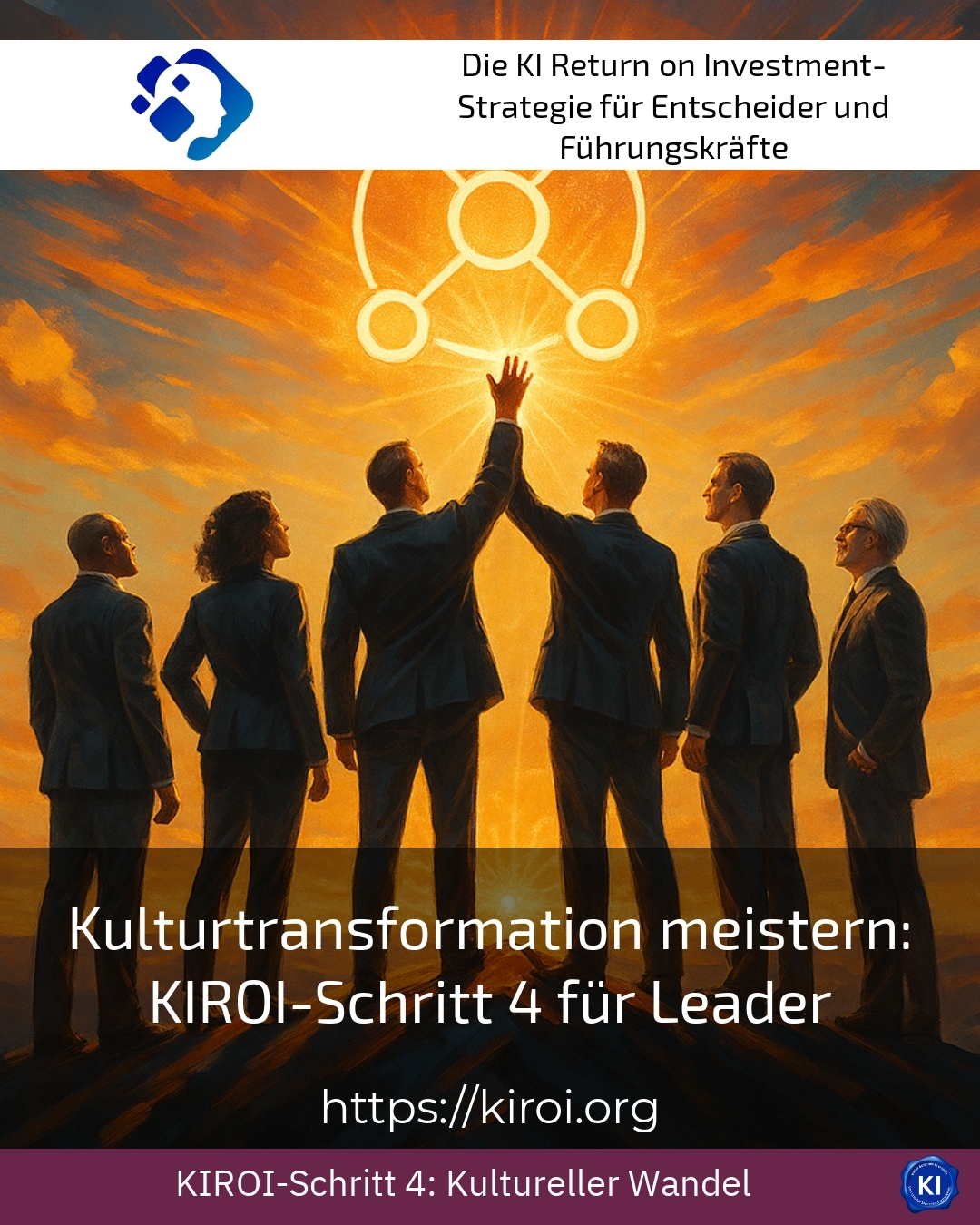
Many companies today face the challenge of systematically evolving their culture. Culture transformation means specifically changing values, behaviours, and structures to be fit for the future. But how can sustainable cultural change be achieved – especially in Step 4 of the KIROI process – and what role do leaders play in this?
Cultural transformation as a foundation for sustainable business success
Culture transformation is not a given, but a continuous process that demands courage, patience, and genuine commitment. The interplay of leadership, employee involvement, and process adjustments is particularly crucial, as only then can new values be lived. Experience shows that without active management support, cultural change remains superficial. At the same time, many leaders desire practical impulses on how they can bring their teams along and recognise resistance. This is precisely where transruption coaching aims to support culture transformations in companies.
An example from the industry: A medium-sized manufacturing company launched an initiative for more open internal communication. Managers were prepared for this through coaching, to regularly moderate dialogue sessions. The result: Employees felt more involved, collaboration improved measurably, and the company culture became more flexible[4].
Another practical example: a logistics service provider introduced regular, interdisciplinary team sessions. The aim was to break down departmental boundaries and foster a culture of collaboration. This resulted in stronger commitment to shared goals and a noticeable increase in innovative capacity.
There are also success stories in retail: a chain of stores trained its store managers in appreciative leadership and installed a transparent feedback system. The result was a decrease in staff turnover and a higher identification with the company.
The leadership factor in cultural change
Leaders are the driving force behind any cultural transformation because they have to embody new values and communicate change authentically. Employees take their cues from the daily behaviour of their superiors. Therefore, it is advisable to involve the leadership team early on and to develop them deliberately.
In practice, one-to-one coaching and team workshops help leaders to strengthen their role model function and identify barriers. This creates the seeds of a new culture within a few months, which then radiate into other areas. An established approach is for experienced managers to train other managers – the principle of „those who teach, learn“ takes on a new meaning here.
In the manufacturing industry, companies often use so-called change agents who strategically drive change. These individuals receive special training to promote cultural transformation within their teams and address resistance.
In publicly listed corporations, leadership programmes are often implemented, in which values such as agility, a culture of learning from mistakes and innovation are specifically trained. Such measures create accountability and foster trust in change.
Key steps in the KIROI process
The fourth step of the KIROI process is about permanently embedding the new values and constructively utilising failures. An elemental factor is the continuous review of progress – for example, through regular feedback rounds, surveys or workshops[1][4].
A particularly successful example comes from the IT sector: here, an open approach to mistakes was established by encouraging employees to openly identify areas for improvement. This led to a vibrant learning culture and significantly increased innovation capabilities[4].
In the healthcare sector, many stakeholders enhance their transformation with individual target agreements. This gives employees the opportunity to contribute their own ideas to the process and actively participate in the cultural transformation.
In the automotive industry too, companies use targeted incentive systems to reward desired behaviour. This strengthens motivation and ensures that cultural changes are not just on paper.
BEST PRACTICE with one customer (name hidden due to NDA contract) In a medium-sized company, the entire management team was trained in open communication and active listening. In regular values workshops, leaders and employees jointly developed concrete measures to embed the new culture. It was quickly noticeable how the sense of responsibility for shared development grew, and adaptation to market changes became significantly faster. The feedback culture improved perceptibly, and employees contributed constructively to change. Thus, cultural transformation became a collaborative project, not only supported from the top but actively shaped by everyone.
Concrete Measures for Your Culture Transformation
Living culture transformation requires clear goals, transparent communication, and the willingness to learn from mistakes. The following steps have proven effective in practice:
- Clearly define and regularly communicate vision and values
- Targeted training for leadership teams and positioning them as role models
- Actively involve employees and create opportunities for feedback.
- Introduce incentive schemes that encourage the desired behaviour
- Adapt processes and structures incrementally
- Measure, reflect and readjust progress
Participatory formats are particularly effective when it comes to embedding values such as openness, flexibility, or innovation. Dialogue on new topics should therefore be stimulated again and again, so that cultural transformation remains not a one-off event, but a continuous process[3].
Many companies report that proactively addressing uncertainties within a team helps to reduce anxiety. Transruption coaching can also support this by opening up mental spaces and providing impetus for change.
My analysis
Cultural transformation is not a voluntary task, but a central requirement for the future viability of companies. It demands courage to change, patience, and a willingness to share responsibility. The examples show that sustainable change occurs when leaders, employees, and processes pull together. Only in this way can a vibrant, agile, and adaptable corporate culture emerge, which secures innovation and success in the long term.
The experiences gained from supporting numerous companies confirm: although cultural transformation is challenging, the investment in change pays off in the long term – both professionally and personally. Transruptions Coaching offers targeted support to resolve blockages, unlock potential, and successfully shape the shared journey.
Further links from the text above:
Mastering Cultural Transformation: KIROI Step 4 for Decision-Makers
Developing Corporate Culture: Tips & Examples – Salesforce











 Deutsch
  English (UK)