
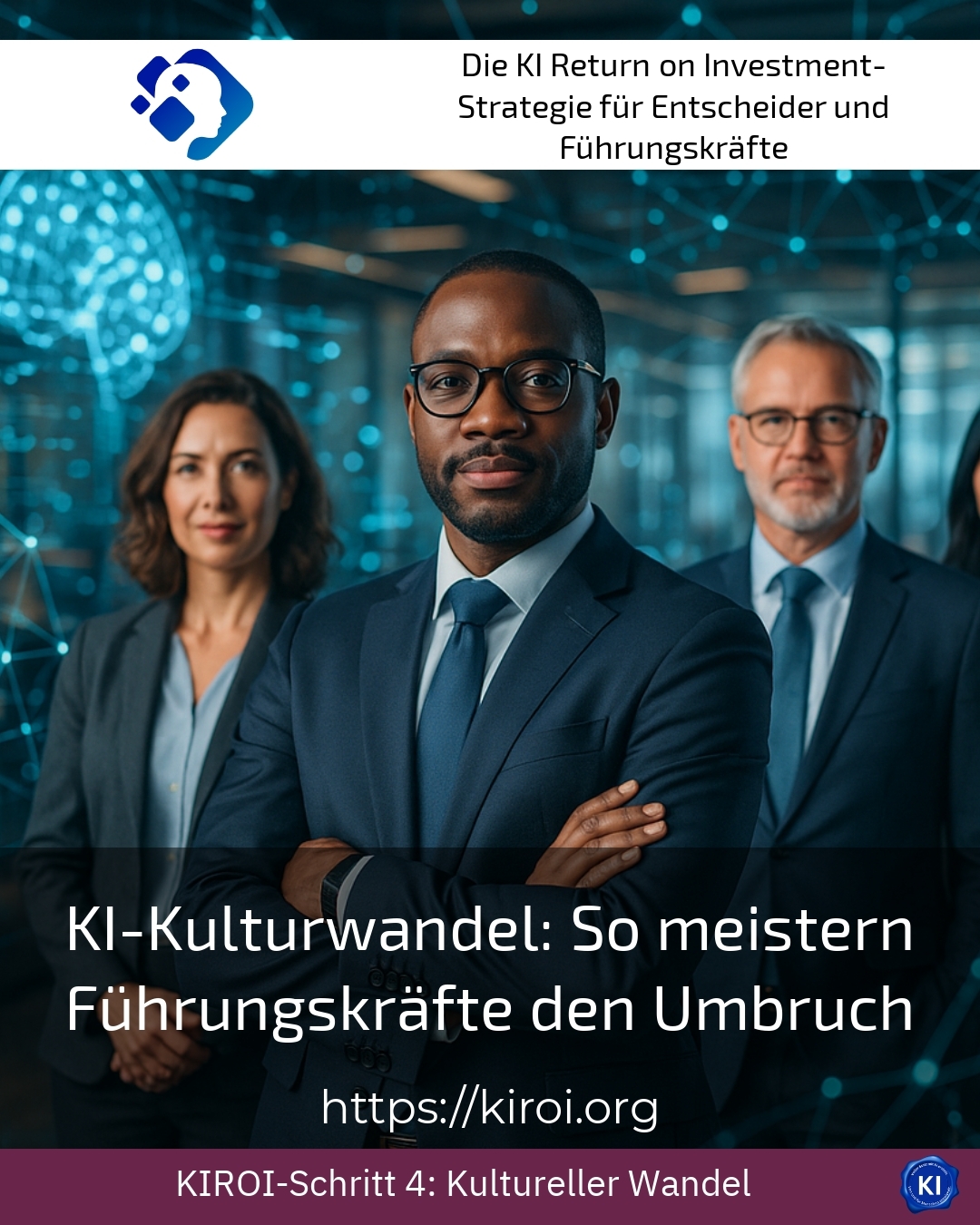
The digital revolution is fundamentally changing our working world. Leaders are facing one of the greatest challenges of our time. AI cultural change This doesn't just concern technology, but above all people. How can the upheaval be managed without losing the workforce? This question occupies decision-makers in all sectors. The answer lies not in algorithms, but in smart leadership. Companies that successfully shape this change focus on support and gradual transformation. Emotional intelligence and strategic foresight play a central role in this.
Understanding the challenge: Why the AI cultural shift requires more than just technology
Many companies underestimate the human dimension of transformation. They invest millions in new systems, forgetting their employees in the process. These employees often experience uncertainty and fear of change. In the financial sector, many consultants report concerns about their future. Bank employees wonder if automated processes will replace their jobs. Insurance agents observe how digital assistants handle customer inquiries. These fears are real and deserve attention.
At the same time, new opportunities and possibilities are emerging for all involved. Financial analysts can take on more complex tasks because routine work is automated. Customer advisors gain time for personal conversations and individual support. Risk managers receive better data foundations for their decisions. The change therefore brings not only challenges but also real improvements. The art lies in making these benefits visible and bringing people along.
Transruptions-Coaching accompanies leaders precisely in this process of realignment [1]. It provides impulses for shaping a positive transformation culture. The methodology supports the recognition of resistance and constructive engagement with it.
Redefining leadership skills in the AI cultural shift
Traditional leadership models are reaching their limits in times of digital transformation. Hierarchical structures significantly slow down the necessary adaptability. Leaders today must act as enablers rather than controllers. This is particularly evident in banking with the introduction of new analytical tools. Branch managers are becoming coaches to their teams, fostering independent learning. Department heads in insurance are moderating change processes instead of dictating them.
A wealth manager recently shared his experiences with transformation. He learned that trust is more important than control during phases of change. His employees needed space to experiment and learn from mistakes. This insight permanently and positively changed his entire leadership style. In investment banking, we are experiencing similar developments with the introduction of algorithmic trading systems. Traders are becoming strategists who monitor and optimise intelligent systems.
Best practice with a AIROI customer
A medium-sized private bank was facing the introduction of an intelligent customer advisory system. Management feared resistance from the experienced team of advisors. The long-serving employees saw their expertise and customer loyalty threatened. This is where transruption coaching came in, guiding the entire change process. In several workshops, managers and advisors jointly developed a future vision. They defined which tasks the system should take over and which should remain human. The advisors realised that by receiving support, they would gain more time for sophisticated conversations. Younger colleagues gained faster access to specialist knowledge through the new digital tools. The experienced employees became mentors for the quality assurance of automated suggestions. After six months, over eighty percent of those involved reported a positive attitude towards the change. Customer satisfaction increased measurably because the quality of advice improved through the combination of human and machine.
Communication as the Key to Successful Change
Open and honest communication forms the foundation of any successful transformation. Leaders must communicate transparently about goals, timelines, and expected impacts. In the insurance sector, companies have had positive experiences with regular town hall meetings, where board members personally answer employees' questions about digital development. Credit institutions use internal podcasts to report on progress and challenges. Asset managers organise learning groups where colleagues inform each other about new technologies.
It is important to admit to uncertainties and not to make false promises. Employees value authenticity and are highly sensitive to whitewashing and euphemisms. A manager from the risk management department shared her own learning curve with the team. She spoke openly about her initial scepticism regarding automated assessment systems. This honesty built trust and facilitated a constructive dialogue about opportunities and risks.
Practical Steps for Implementing a New Company Culture
Cultural change doesn't happen overnight, but requires a systematic and patient approach. Successful financial institutions begin with pilot projects in selected departments or branches. One regional bank initially tested intelligent assistance systems in just three branches. The experiences of these pioneer teams were directly incorporated into the later broad rollout. Insurance companies often start with claims processing as the first area of application. Efficiency gains can be quickly measured and communicated there.
Continuing professional development plays a key role in empowering all staff. Major financial services providers have set up and established their own academies for digital skills [2]. Savings banks offer their employees modular learning pathways with varying levels of specialisation. Investment firms offer work shadowing opportunities in technical departments for interested staff. These measures demonstrate appreciation and take fears of job loss seriously.
Mixed teams of different generations and specialist areas are particularly effective. Young, tech-savvy employees work closely with experienced subject matter experts. In private banking, this results in innovative consulting concepts that combine digital and human strengths. In corporate client support, such teams develop new approaches to creditworthiness assessment.
Best practice with a AIROI customer
A large insurance group wanted to transition its entire internal service to new working methods. The challenge was to bring over two thousand employees on board simultaneously. Transruption coaching supported the development of a multi-stage transformation strategy. Initially, the project team identified internal ambassadors in each department. These multipliers received intensive training and support during the change phase. They became contact points for colleagues with questions or concerns. In parallel, management introduced an open feedback culture with anonymous responses. Employee concerns were systematically recorded and incorporated into decisions. A particular focus was placed on recognising learning progress rather than just error avoidance. After implementation, managers reported significantly higher acceptance than in previous projects. The sickness rate during the transition remained below the average for comparable change processes. Employees spoke positively about the inclusion and transparent communication.
Using resistance as a resource and integrating it constructively
Resistance to change is a natural and often healthy human reaction. It indicates that employees are giving the matter thought and take their work seriously. Astute managers interpret objections as valuable pointers to potential problems. In the asset management sector, experienced advisers expressed concerns about the quality of automated investment recommendations. These critical voices led to significant improvements in the algorithms and control mechanisms. At a building society, employees highlighted data protection risks that the project team had overlooked.
Transruption coaching provides impetus on how leaders can constructively deal with criticism. It supports the development of a culture where dissenting opinions are welcome. Clients often report improved project outcomes through the integration of different perspectives. The methodology guides teams in gaining productive energy from conflicts.
Ensuring sustainability in the cultural shift towards AI
One-off measures are not enough to bring about lasting cultural change. Successful organisations embed continuous learning and adaptation firmly within their corporate culture. Major banks have set up permanent innovation labs where new technologies are tested. Insurance companies use agile methods to respond flexibly to changing requirements. Fund management companies conduct regular reviews of their automated processes, incorporating human quality control.
Measuring progress requires new metrics that go beyond traditional financial indicators. Employee satisfaction, willingness to learn and the level of innovation are becoming key indicators of success. A cooperative bank introduced regular pulse surveys to gauge its workforce’s willingness to embrace change. The results are fed directly into the management of transformation projects. In the investment sector, companies measure how quickly teams adapt to new tools and use them productively.
Leaders themselves must set an example and make their own development visible. A board member of a direct bank publicly learned how to use new analysis tools and shared their experiences. This authenticity inspired employees at all hierarchical levels to pursue their own further training and to be more open.
The role of external support in complex transformations
Internal resources often reach their limits when it comes to far-reaching change processes. External perspectives help to identify blind spots and break out of entrenched ways of thinking [3]. Transruptions coaching is clearly positioned as a support service for projects relating to digital transformation. It does not replace in-house expertise, but rather complements it in a meaningful and targeted way.
The AIROI methodology provides a structured framework for analysing and designing change processes. It takes technical, organisational and human factors into account equally and systematically. In the financial sector, companies have had positive experiences with this holistic approach. Banks value the combination of strategic planning and support for operational implementation. Insurance companies use the methodology to develop long-term transformation roadmaps with clear milestones.
My AIROI Analysis
The transformation driven by smart technologies presents leaders with fundamental challenges. Success depends less on the technology itself than on the ability to get people on board. The AI cultural change requires new leadership skills that go far beyond traditional management. Emotional intelligence, communication skills and genuine empathy are becoming crucial factors for success for leaders.
Examples from the financial sector show that change can be successful if it is managed effectively. Banks, insurance companies and asset managers are demonstrating how people and machines can work together productively. Key factors here are transparent communication, genuine involvement and continuous professional development for all those involved. Companies that treat resistance as a resource achieve better results than those that suppress it.
Transruptions coaching and the AIROI methodology offer valuable support in this complex task. They do not replace the work carried out within the organisation, but rather reinforce and focus it in a targeted manner. The systematic approach helps to avoid typical pitfalls and adapt best practices. Managers who engage with this support often report faster and more sustainable results.
The future belongs to organisations that can combine technological innovation with people-centred leadership. The financial sector presents both opportunities and risks that must be carefully weighed up. With the right strategy, patience and external support, this cultural transformation can become a success story.
Further links from the text above:
[1] Disruption coaching and methodology
[2] Key digital technologies and continuing professional development
[3] The AIROI methodology for transformation projects
For more information and if you have any questions, please contact Contact us or read more blog posts on the topic Artificial intelligence here.







 Deutsch
  English (UK)