
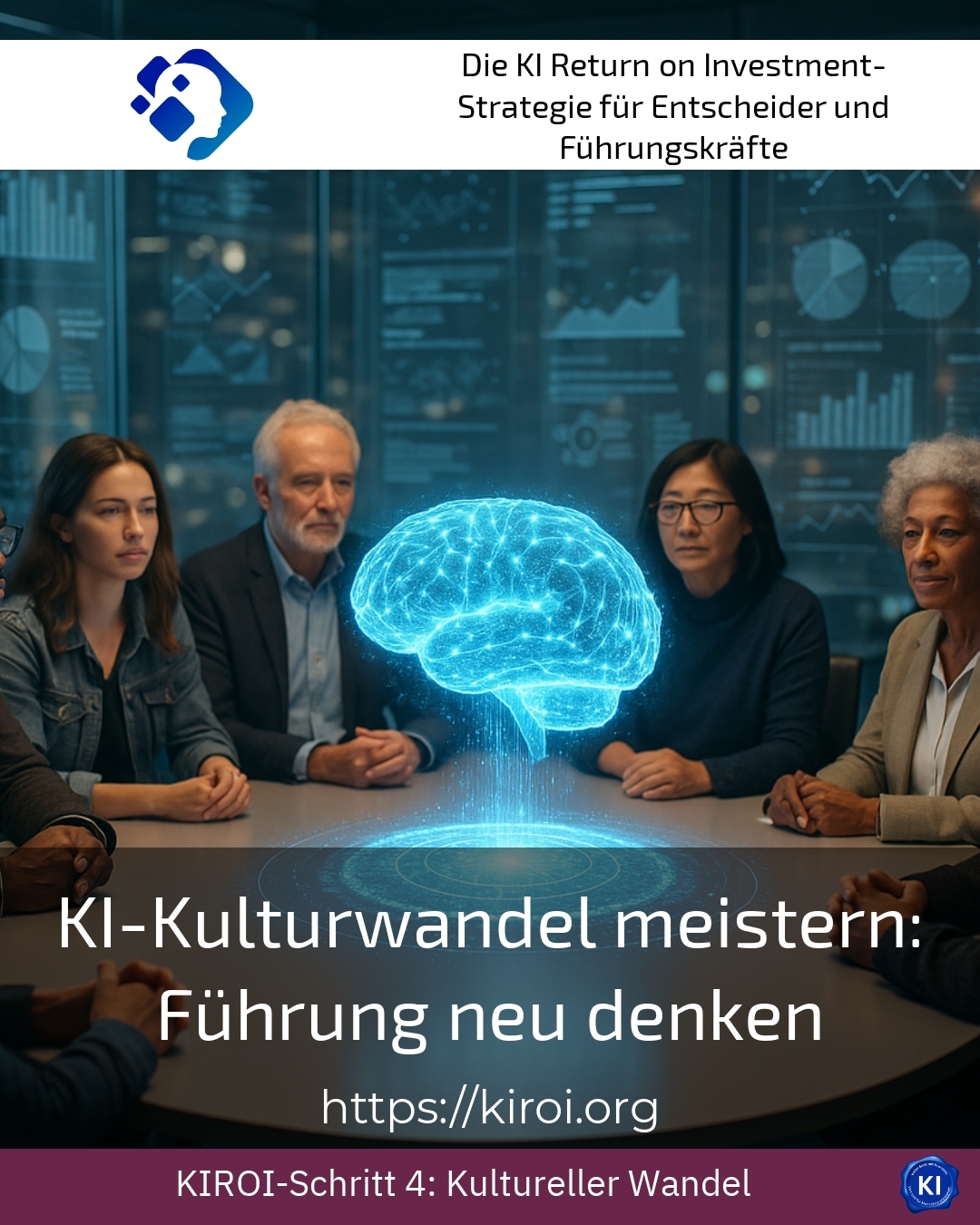
digital transformation is fundamentally changing companies. Leaders face a historic challenge. They must Mastering AI cultural change: Rethinking leadership and take their teams with them. Many organisations underestimate the human dimension of this change. Technology alone does not solve problems. It requires people who can understand and use it. This is why numerous transformation projects fail not because of the technology. They fail due to a lack of leadership skills and cultural understanding. This article shows you how to overcome these hurdles.
Why change requires new leadership approaches
Traditional leadership models are reaching their limits. Hierarchical structures stifle innovation. Today, employees expect transparency and co-creation. A medium-sized mechanical engineering company recognised this early on. The management introduced weekly dialogue rounds. Here, all team members can contribute ideas. This significantly strengthened acceptance of new technologies. Another example shows an insurance company. It established so-called innovation ambassadors in every department. These individuals act as liaisons between technical possibilities and everyday workflows. A logistics company also went down a similar path. It specifically trained team leaders in change communication. This allowed resistance to be identified and addressed early on.
Today, leaders need to ask more questions than give answers. They create space for experimentation and a culture that embraces mistakes. Transruption coaching supports organisations with precisely this reorientation, guiding leadership teams through complex phases of change. Clients often report initial overwhelm, which, through professional support, transforms into confidence. The role of the leader is evolving from decision-maker to enabler.
Mastering AI cultural change: Rethinking leadership in practice
Theory and practice often diverge significantly. This is why companies need concrete approaches. A pharmaceutical company began with small pilot projects, testing new ways of working in one department first. The experience was then incorporated into company-wide strategies. A financial services provider chose a different approach, inviting external catalysts to leadership workshops. These brought fresh perspectives to entrenched ways of thinking. A retail company also highlights interesting paths. It established a reverse mentoring program, where junior employees coach experienced managers on how to use new technologies.
Best practice with a KIROI customer
A family-run business with a long tradition in the manufacturing sector faced significant challenges because its existing management structures were no longer adequate for the demands of digital transformation. The management realised that technological investments alone would not be sufficient to remain competitive. Therefore, the company turned to transruptions-coaching for comprehensive support. Initially, we jointly analysed the existing leadership culture and identified blockages. It became apparent that middle management levels perceived changes more as a threat. In intensive workshops, we addressed this perception. The managers developed their own visions for their areas. They understood the opportunities that change can present. After six months, the atmosphere had fundamentally changed. The teams showed more initiative and a greater willingness to experiment. New ideas were no longer blocked but were jointly evaluated. Fluctuation in critical departments decreased significantly. Employee surveys showed increased satisfaction levels. This example illustrates the importance of professional support during profound changes.
The role of communication and transparency
Communication forms the foundation of every successful transformation. Employees want to know where the journey is heading. They need guidance in uncertain times. An energy provider established an internal podcast for this purpose. The management regularly reports on progress and challenges there. This creates closeness despite spatial distance. A hotel chain chose a visual approach. They visualised the transformation progress on large screens in the entrance area. This way, all employees saw daily what was changing. A technology company went even further. They opened management meetings to interested team members. This transparency significantly strengthened trust in decisions.
A pattern emerges again and again. Open communication reduces anxieties and resistance. People accept changes more easily when they understand them. Therefore, leaders should explain more than instruct. They should encourage questions instead of demanding obedience. This often requires a rethink for experienced managers. This is exactly where transruption coaching provides valuable impulses.
Understanding and constructively using resistance
Resistance to change is completely normal. It shows that people are taking the situation seriously. Savvy leaders use this resistance as a source of information. An automotive supplier had positive experiences with this. They introduced structured feedback rounds after each change phase. Critical voices were not suppressed, but heard. A healthcare provider established so-called "worry clinics". There, employees can voice concerns anonymously. These then feed into strategy development. An educational provider also shows interesting approaches. They form change tandems of skeptics and enthusiasts. These work together on solutions and learn from each other.
Clients often report that dealing with resistance is particularly challenging for them. They feel personally attacked when teams reject innovations. However, there is usually no ill intent behind resistance. People worry about their future and their competence. Leaders should take these concerns seriously. They can provide security without making unrealistic promises.
Mastering AI cultural change: Rethinking leadership through continuous learning
Learning is becoming a central leadership task. This goes beyond simply technical further training. Managers must also develop their posture and attitude. A consulting firm established learning circles at board level for this purpose. The top management team regularly exchanges information there on personal learning progress. A media company introduced so-called learning budgets for managers. These can be freely used for individual development. An industrial group is taking a systematic approach. It links manager evaluations with demonstrable learning progress. This creates clear incentives for continuous development.
Transruptions Coaching accompanies leadership teams precisely on this learning journey. It supports the creation of a learning organisation. Quick fixes are not the focus. It is about sustainable behavioural changes and new ways of thinking. This process requires time and professional support.
Best practice with a KIROI customer
An international retail chain with several thousand employees sought support for its leadership development, as previous training approaches had not led to sustainable changes. The HR department described the problem as a transfer gap between the training room and everyday work. As part of our collaboration, we developed an integrated learning concept with multiple components. First, together with the managers, we defined individual development goals. These were reflected upon and adjusted in regular coaching sessions. In parallel, we established peer learning groups at different hierarchical levels. Participants discussed concrete leadership situations there. They gave each other feedback and jointly developed solutions. After one year, measurable improvements were observed in various areas. Employee satisfaction with their direct line manager increased significantly. Innovation key figures also developed positively. Management emphasised that this investment in leadership development had paid off multiple times. The programme is now being rolled out to further country subsidiaries.
Ensuring sustainability in leadership transformation
One-off measures are not enough. Sustainable change requires continuous attention. A telecommunications company therefore anchored cultural development in its annual objectives. Managers are also measured on soft factors. A food manufacturer introduced regular culture audits. External observers evaluate the lived leadership culture. A financial institution took a participative approach. Employees there evaluate the leadership quality of their superiors twice a year. These results are incorporated into development discussions.
Leaders should regularly engage in self-reflection. Where am I on my development journey? What old patterns are still holding me back? What new behaviours do I want to strengthen? These questions aid continuous development. Professional guidance can support and structure this reflective process.
Don't forget the human dimension
Despite all the enthusiasm for technology, people must not be forgotten. Transformation only succeeds with people, not against them. A software company had important experiences with this. Initially, it invested heavily in technology and forgot about its employees. The consequences were high staff turnover and falling productivity. Only a realignment with a focus on people brought the breakthrough. A care company provides a positive counter-example. It consistently asks about the benefits for employees in all its changes. A construction company also pays attention to the human dimension. It always conducts stress analyses before major changes.
Leaders should pay attention to the emotional state of their teams. Overwhelm and exhaustion jeopardise any transformation. Breaks and recovery are part of the change process. Sustainable leadership considers the limits of human resilience.
My KIROI Analysis
The support of numerous organisations repeatedly shows me similar patterns, as many companies have Mastering AI cultural change: Rethinking leadership underestimate. Technological investments often dominate the agenda, and the human dimension is neglected. Ultimately, however, leadership culture determines success or failure. Companies that involve and develop their leaders early on achieve significantly better results. They experience less resistance and more commitment. Their teams demonstrate initiative and a joy for innovation.
From my experience, there are three key success factors. Firstly, genuine commitment from senior leadership is needed. Change cannot be delegated. Boards and CEOs must lead by example. Secondly, professional support is crucial, as blind spots can only be recognised from the outside. Thirdly, sustainable transformation requires patience and perseverance. Quick successes are rarely long-lasting. The organisations I see as successful think in years rather than quarters. They understand leadership development as a continuous process. Transruption Coaching positions itself as a partner for this demanding journey exactly here [1]. It's not about delivering ready-made solutions, but about developing and learning together [2].
Further links from the text above:
[1] Transruptions Coaching and support for transformation projects
[2] KIROI Blog: Further posts on digital transformation and leadership
For more information and if you have any questions, please contact Contact us or read more blog posts on the topic Artificial intelligence here.











 Deutsch
  English (UK)