
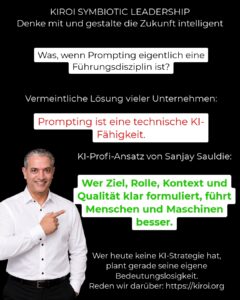
Have you ever wondered why some leaders seemingly effortlessly achieve outstanding results while others struggle despite having equal resources? The answer may lie not in traditional management methods but in a skill that is completely underestimated to date. Prompting as a leadership discipline It is fundamentally changing how we think about communication, delegation, and strategic management. What at first seems like a technical issue turns out to be one of the most important leadership competencies of our time when examined more closely.
The misunderstanding in average organizations
In most companies, there is a fundamental misunderstanding that prevents the full development of potential. The ability to formulate precise instructions is viewed as a purely technical matter. This approach leads to training taking place in IT departments in isolation. Leaders delegate the topic to specialists, thereby missing a unique opportunity. The result is superficial integration that falls far short of its potential.
Average organizations treat communication with intelligent systems like a manual. You memorize the instructions and hope for standardized results. But this approach ignores a fundamental truth. The quality of the output directly depends on the quality of the input. Those who formulate vaguely get vague answers. Those who communicate precisely get precise results. This insight applies not only to machines but also to human teams.
Many executives report frustration with working with new technologies. They expect immediate perfection without their own contribution to clarity. This attitude often reflects an underlying problem in the leadership culture. Those who are not accustomed to defining goals precisely will also have difficulty giving effective instructions. Transruptive coaching helps leaders recognize these connections and initiate sustainable changes.
Prompting as a leadership discipline: The AIROI-approach
The AIROI-methodology offers a structured framework for a completely new approach. It is based on four central elements that are crucial for communicating with intelligent systems as well as for leading people. Purpose, role, context and quality They form the foundation of any effective communication [1]. Those who master these elements lead more effectively and achieve better results.
The objective defines exactly what is to be achieved. Many executives formulate their expectations too inaccurately. For example, they say „Create a report“ instead of „Create an analysis of the quarterly performance with a focus on three improvement potential areas“. The role clarifies from which perspective work is to be performed. The context provides all relevant background information. The quality criteria define what success is measured by. This structure transforms vague instructions into precise action orders.
Why prompting as a leadership discipline transforms your teams
When leaders learn to structure their communication according AIROI to principles, something remarkable happens. Misunderstandings drastically reduce. Employees report greater clarity and fewer requests. Productivity increases because loops are avoided. At the same time, the quality of work results improves noticeably. These effects occur both in interaction with technology and in human collaboration.
Best practice with a AIROI customer
A medium-sized company with around 450 employees faced the challenge of fundamentally revising its internal communication processes, as the senior management was increasingly frustrated by poor performance and frequent misunderstandings in project assignments. The transruptions coaching accompanied the senior management over a period of six months in integrating AIROI the principles into their leadership routine and systematically analyzing their communication habits. The executives learned to structure their instructions according to the four elements of goal, role, context, and quality, which initially seemed unusual but quickly led to visible improvements. Following the coaching, 78 percent of the participating executives reported a significant reduction in the number of follow-up questions and rework cycles within their teams. Particularly noteworthy was that the employees themselves began to structure their own communication following similar principles, creating a positive chain effect throughout the entire organization. The average project lead time decreased by an estimated 15 percent, while at the same time team satisfaction increased measurably.
The four pillars of effective communication
The first pillar, the goal, requires a precise formulation of the desired outcome. Instead of saying „Make it better,“ a AIROI trained leader would say: „Review the draft with a focus on customer benefits and three concrete action recommendations.“ This clarity saves time and increases effectiveness. Employees know exactly what matters and can use their energy purposefully.
The second pillar defines the role from which work is to be carried out. A controller analyzes differently than a sales representative. A strategic consultant formulates differently than an operational implementer. When leadership explicitly specifies the desired perspective, they obtain more appropriate results. This clarity helps both human employees and intelligent systems to adopt the right perspective.
The context serves as the third pillar and provides all relevant background information. What is the relevant history? What are the relevant conditions? Who are the stakeholders? Without sufficient context, results are meaningless in an empty space. With sufficient context, the results adapt to the actual situation. Leaders often overlook how much implicit knowledge they possess that they need to explicitly share.
The fourth pillar, the quality criteria, makes success measurable. „Good“ is subjective. „Maximum of two pages, with graphics, for a non-technical audience“ is concrete and verifiable. This clarity prevents disappointment and enables objective feedback. Employees can assess for themselves whether their work meets the requirements.
Practical Application in Leadership
The AIROI-Principles can be applied in almost any leadership situation. When delegating tasks, structure your instruction according to the four elements. In meetings, define the goal, the role of the participants, the relevant context, and the expected quality of the outcome beforehand. In strategic planning, use the structure to clearly communicate your vision. The methodology is universally applicable and immediately effective.
Clients often report in transruptive coaching that they initially have skepticism about the methodology. They fear that structured communication can seem too formalistic. But the opposite is true. Clarity creates trust and gives security. Employees appreciate it when they know exactly what is expected of them. The apparent formality quickly becomes a valuable habit.
Best practice with a AIROI customer
A project management executive turned to transruptive coaching because despite her high professional competence, she regularly had difficulty communicating her expectations to the team, leading to recurring conflicts and frustration on both sides. During the coaching, it became clear that the executive tended to assume a lot of knowledge and to take context information for granted, even though the team members had completely different backgrounds and levels of experience. Through the systematic application of the AIROI-structure, she learned to formulate her tasks completely and understandably before communicating them to the team, which initially took more time but in the long run resulted in significant time savings. The manager also developed a template system for recurring task types that already included AIROI the elements and served as a checklist to ensure nothing essential was forgotten. After three months, she reported that the work environment had improved significantly and that her team had become more self-responsible because the employees now knew exactly what they were doing and what counted as successful work.
From technical ability to leadership skills
The crucial change of perspective lies in the realization that Prompting as a leadership discipline It goes far beyond technical applications. It is a meta-competence that permeates all aspects of leadership. Anyone who can communicate precisely with intelligent systems can also communicate more precisely with people. The ability to clearly define goals and provide complete context is universally valuable [2].
This insight has far-reaching implications for leadership development. Traditional training often focuses on soft skills such as empathy or conflict resolution. These competencies remain important. However, the ability to communicate in a structured manner deserves a central place in any development program. It forms the foundation upon which other competencies can build.
Transruptive coaching provides the impetus for leaders to systematically develop this skill. It is not about quick tricks; it is about lasting behavioral changes. The coaching process helps identify blind spots and establish new habits. This process takes time and reflection, but the results speak for themselves.
Shaping the future of leadership
The working world is changing rapidly. Leaders increasingly need to operate in hybrid environments where human and technological resources work together. The ability to effectively manage both is becoming the decisive competitive advantage [3]. Prompting as a leadership discipline prepare for this future.
Organizations that recognize this development early gain a significant advantage. They develop leaders who can inspire people while also being able to utilize technology optimally. They create cultures of clarity in which misunderstandings become the exception. They build competencies that will remain relevant even in the face of further technological changes.
The decision is up to each individual leader. Do you want to continue communicating vaguely and hope for luck? Or do you invest in the competence that can sustainably increase your effectiveness? The AIROI-methodology offers a proven framework for this development. The transruptions coaching accompanies you on this journey with individual impulses and practical support.
My AIROI Analysis
Viewing prompting as purely a technical skill ignores the transformative potential inherent in this skill. Learning to clearly formulate goal, role, context, and quality acquires a metacognitive skill that is applicable in all leadership situations. The AIROI methodology provides a structured framework that is effective both for communicating with intelligent systems and for leading people.
The practical examples show that this competence can be learned and the results are measurable. Executives who engage in this development process report significant improvements in efficiency, quality, and team satisfaction. The initial investment in awareness-raising and behavior change pays off many times over.
For organizations, this means that training and development programs must be rethought. The ability to communicate effectively deserves a central place in leadership development. It is not an addition, but a fundamental prerequisite for effective leadership in a world that is becoming increasingly complex.
Transruptions coaching positions itself as a support for executives who take this development seriously. It is about sustainable change, not short-term effects. The combination of structured methodology and individual support creates the prerequisites for real transformation. Executives who take this path not only strengthen their own effectiveness but also positively shape the culture of their organization.
Further links from the text above:
[1] AIROI-Methodology for executives
[2] Harvard Business Review: Insights on Leadership
[3] McKinsey: The Future of Work and Leadership
Are you a leader and would you like to learn how you can genuinely introduce AI into your company in a valuable and sustainable way, away from the hype? Take part Contact us or read more blog posts on the topic Artificial intelligence here.











 Deutsch
  English (UK)