
kiroi.org

KIROI - Artificial Intelligence Return on Invest
The AI strategy for decision-makers and managers

Business excellence for decision-makers & managers by and with Sanjay Sauldie

KIROI - Artificial Intelligence Return on Invest: The AI strategy for decision-makers and managers

KIROI - Artificial Intelligence Return on Invest: The AI strategy for decision-makers and managers

Start » Strengthen the idea department: With KIROI, step 6 towards innovation success
16 August 2025

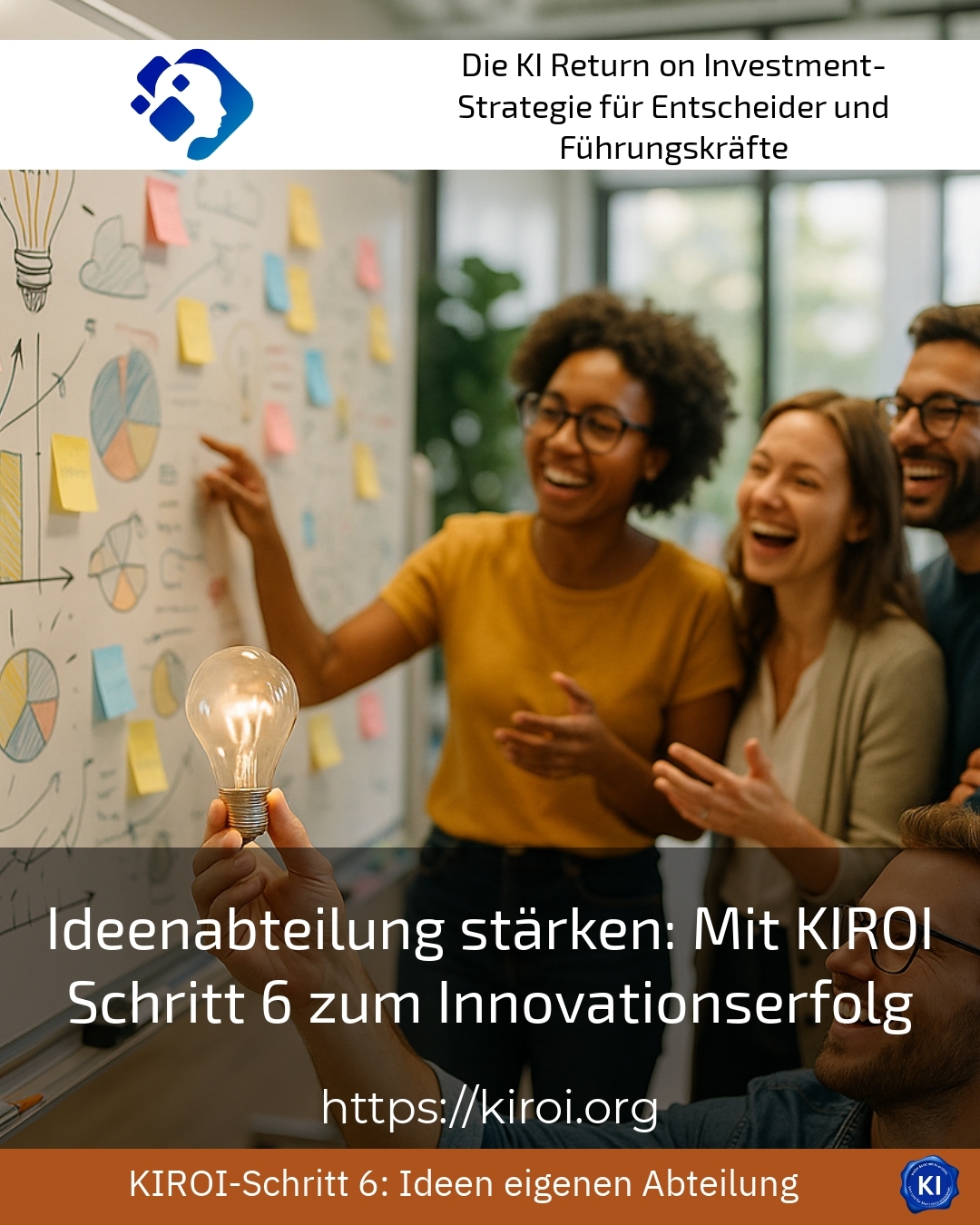
Strengthen the idea department: With KIROI, step 6 towards innovation success

4.8
(814)

The ideas department has always been at the heart of company processes focused on innovation, improvement, and growth. However, to sustainably increase innovative strength, it's not enough to just collect good ideas – clear structures, methods, and a culture that systematically harnesses the creative potential of all employees are needed. This is where I, as a transruption coach, specifically support companies in professionalising their ideas department – and KIROI Step 6 offers an outstanding framework for this.

The role of the Ideas Department in digital transformation

Organisations must not only react quickly to changes today, but also initiate impulses for innovation themselves. The idea department can act as an engine in this process because it pools resources and manages processes surrounding idea generation. Our clients often report that while they have creative approaches, they suffer from a lack of implementation strategies.

BEST PRACTICE with one customer (name hidden due to NDA contract) A medium-sized manufacturing company had a well-staffed ideas department but was dissatisfied with the lack of visibility of its results. As part of a six-month support project, we were able to revise the department's structure, define clear areas of action, and intensify communication between the individual teams. This led to a measurably higher acceptance of improvement suggestions and an increase in the implementation rate by over 30 percent. The impetus to integrate a digital idea management system gave the entire team a tangible boost – including in the perception of the management, who are now actively involved in the ideas department's topics.

Particularly in technology-savvy industries, we often see existing structures being too rigid to react to agile impulses. Another practical example: A mechanical engineering company introduced regular innovation hackathons where external developers and its own workforce collaborate on new solutions. This helped to overcome the reluctance to change and find new impulses for everyday business. A third example comes from the service sector, where a task force for innovation management was set up – this now coordinates all measures from the ideas department and ensures better networking with other company divisions.

Methods and tools for a strong ideas department

For an ideas department to truly become an innovation driver, the targeted use of tried-and-tested methods is recommended. Idea management encompasses the capture, organisation, evaluation, and implementation of ideas submitted by employees, customers, or other stakeholders[1]. The best approaches combine classic methods such as the company suggestion scheme (BVW) and continuous improvement processes (KVP) with modern, digitally supported platforms[2].

In addition, the structured organisation of tasks has proven indispensable, as it promotes transparency and accountability [4]. Companies that regularly critically analyse and adapt their processes report increased innovation speed and greater team engagement. Successful approaches include, for example:

  • The introduction of innovative feedback rounds where ideas are openly discussed and prioritised.
  • The use of digital tools for the simple recording and management of improvement suggestions.
  • Targeted support through transruption coaching, which accompanies teams in implementing new structures and methods.

Another example from the e-commerce sector: here, employee participation was significantly increased with the help of an online platform – over 500 suggestions for improvement were received within a few months, many of which were directly incorporated into process optimisation. It is also worthwhile in the manufacturing industry to conduct regular retrospectives in order to gain new insights for daily work.

STEP 6: Professionalising the Ideas Department

KIROI Step 6 stands for a holistic approach to sustainably anchor innovation culture within the company. The idea department is not considered in isolation but is positioned as an integral part of the corporate strategy. Clearly defined goals, tailored budgets, smart personnel selection, optimised processes, and a high-performing IT infrastructure are key success factors[6].

The focus is on the consistent transfer from theory to implementation. Many companies are now relying on digital portals to simplify collaboration between teams and automate the evaluation of submitted suggestions. Clients often report that even small changes in daily business – such as the introduction of regular „innovation round tables“ – provide tangible momentum.

BEST PRACTICE with one customer (name hidden due to NDA contract) In a medium-sized logistics company, the entire innovation department was reconfigured using the KIROI approach. The process began with a comprehensive analysis of existing structures and innovation potential. This was followed by the establishment of clear responsibilities, the introduction of a digital idea management system, and the launch of an incentive programme for particularly committed suggestions. Employees received targeted training to reduce barriers and foster new impulses. Just three months after the project's start, it became apparent that the innovation department is now perceived as a genuine game-changer – both internally and by external partners and customers.

It's also evident in other industries that implementing a rolling process for idea evaluation increases acceptance and the speed at which innovations are implemented. Additionally, setting up an innovation committee that regularly decides on the implementation of top ideas and actively promotes them is recommended.

Opportunities and challenges for the Ideas department

A strong ideas department offers numerous benefits: process optimisation, product improvements, new business models, cost savings, and higher employee retention[2]. At the same time, there are challenges, such as internal resistance, unclear structures, or a lack of measurable results.

From our own coaching experience, we repeatedly see that companies struggle to clearly formulate innovation goals and provide the necessary resources. An example from the energy sector shows how important it is to make appreciation for creative contributions visible externally. Through regular presentations to senior management and the integration of the ideas department into strategic decisions, its importance has been sustainably increased.

In the chemical industry, in turn, a decentralised innovation platform was established, through which employees from various locations can contribute and prioritise their ideas. This not only promotes collaboration, but also ensures a high degree of transparency and fairness in the selection process. A third example comes from the automotive industry, where the ideas department was closely integrated with product development – this resulted in several marketable solutions being created in a short period of time, which clearly positioned the company.

My analysis

A well-established ideas department is the backbone of sustainable innovation success within a company. With a clear structure, a vibrant feedback system, and the targeted promotion of creativity, companies can significantly increase their competitiveness and proactively address important future issues.

KIROI Step 6's consistent implementation sets new standards, as the focus lies on the connection between innovation culture, digital infrastructure, and company-wide participation. Ultimately, a strong ideas department always pays off – and is often the starting point for surprising new business opportunities and sustainable company development.

Further links from the text above:

What is Idea Management? Definition, Processes and Best Practice
[2] Ideas Management: Definition, Methods, Benefits + Examples
Ideas Department – Business Dictionary
[4] Task Breakdown - Organisation Handbook
[5] Department Definition – What is a department?
[6] Department: Structure and Functions within the Company
[7] Department (Organisation) – Wikipedia

For more information and if you have any questions, please contact Contact us or read more blog posts on the topic Artificial intelligence here.

How useful was this post?

Click on a star to rate it!

Average rating 4.8 / 5. Vote count: 814

No votes so far! Be the first to rate this post.

Spread the love

transruption.org

The digital toolbox for
the digital winners of today and tomorrow

Business excellence for decision-makers & managers by and with Sanjay Sauldie

transruption
transruption

transruption: The digital toolbox for
the digital winners of today and tomorrow

Start » Strengthen the idea department: With KIROI, step 6 towards innovation success
16 August 2025

Strengthen the idea department: With KIROI, step 6 towards innovation success

4.8
(814)

The ideas department has always been at the heart of company processes focused on innovation, improvement, and growth. However, to sustainably increase innovative strength, it's not enough to just collect good ideas – clear structures, methods, and a culture that systematically harnesses the creative potential of all employees are needed. This is where I, as a transruption coach, specifically support companies in professionalising their ideas department – and KIROI Step 6 offers an outstanding framework for this.

The role of the Ideas Department in digital transformation

Organisations must not only react quickly to changes today, but also initiate impulses for innovation themselves. The idea department can act as an engine in this process because it pools resources and manages processes surrounding idea generation. Our clients often report that while they have creative approaches, they suffer from a lack of implementation strategies.

BEST PRACTICE with one customer (name hidden due to NDA contract) A medium-sized manufacturing company had a well-staffed ideas department but was dissatisfied with the lack of visibility of its results. As part of a six-month support project, we were able to revise the department's structure, define clear areas of action, and intensify communication between the individual teams. This led to a measurably higher acceptance of improvement suggestions and an increase in the implementation rate by over 30 percent. The impetus to integrate a digital idea management system gave the entire team a tangible boost – including in the perception of the management, who are now actively involved in the ideas department's topics.

Particularly in technology-savvy industries, we often see existing structures being too rigid to react to agile impulses. Another practical example: A mechanical engineering company introduced regular innovation hackathons where external developers and its own workforce collaborate on new solutions. This helped to overcome the reluctance to change and find new impulses for everyday business. A third example comes from the service sector, where a task force for innovation management was set up – this now coordinates all measures from the ideas department and ensures better networking with other company divisions.

Methods and tools for a strong ideas department

For an ideas department to truly become an innovation driver, the targeted use of tried-and-tested methods is recommended. Idea management encompasses the capture, organisation, evaluation, and implementation of ideas submitted by employees, customers, or other stakeholders[1]. The best approaches combine classic methods such as the company suggestion scheme (BVW) and continuous improvement processes (KVP) with modern, digitally supported platforms[2].

In addition, the structured organisation of tasks has proven indispensable, as it promotes transparency and accountability [4]. Companies that regularly critically analyse and adapt their processes report increased innovation speed and greater team engagement. Successful approaches include, for example:

  • The introduction of innovative feedback rounds where ideas are openly discussed and prioritised.
  • The use of digital tools for the simple recording and management of improvement suggestions.
  • Targeted support through transruption coaching, which accompanies teams in implementing new structures and methods.

Another example from the e-commerce sector: here, employee participation was significantly increased with the help of an online platform – over 500 suggestions for improvement were received within a few months, many of which were directly incorporated into process optimisation. It is also worthwhile in the manufacturing industry to conduct regular retrospectives in order to gain new insights for daily work.

STEP 6: Professionalising the Ideas Department

KIROI Step 6 stands for a holistic approach to sustainably anchor innovation culture within the company. The idea department is not considered in isolation but is positioned as an integral part of the corporate strategy. Clearly defined goals, tailored budgets, smart personnel selection, optimised processes, and a high-performing IT infrastructure are key success factors[6].

The focus is on the consistent transfer from theory to implementation. Many companies are now relying on digital portals to simplify collaboration between teams and automate the evaluation of submitted suggestions. Clients often report that even small changes in daily business – such as the introduction of regular „innovation round tables“ – provide tangible momentum.

BEST PRACTICE with one customer (name hidden due to NDA contract) In a medium-sized logistics company, the entire innovation department was reconfigured using the KIROI approach. The process began with a comprehensive analysis of existing structures and innovation potential. This was followed by the establishment of clear responsibilities, the introduction of a digital idea management system, and the launch of an incentive programme for particularly committed suggestions. Employees received targeted training to reduce barriers and foster new impulses. Just three months after the project's start, it became apparent that the innovation department is now perceived as a genuine game-changer – both internally and by external partners and customers.

It's also evident in other industries that implementing a rolling process for idea evaluation increases acceptance and the speed at which innovations are implemented. Additionally, setting up an innovation committee that regularly decides on the implementation of top ideas and actively promotes them is recommended.

Opportunities and challenges for the Ideas department

A strong ideas department offers numerous benefits: process optimisation, product improvements, new business models, cost savings, and higher employee retention[2]. At the same time, there are challenges, such as internal resistance, unclear structures, or a lack of measurable results.

From our own coaching experience, we repeatedly see that companies struggle to clearly formulate innovation goals and provide the necessary resources. An example from the energy sector shows how important it is to make appreciation for creative contributions visible externally. Through regular presentations to senior management and the integration of the ideas department into strategic decisions, its importance has been sustainably increased.

In the chemical industry, in turn, a decentralised innovation platform was established, through which employees from various locations can contribute and prioritise their ideas. This not only promotes collaboration, but also ensures a high degree of transparency and fairness in the selection process. A third example comes from the automotive industry, where the ideas department was closely integrated with product development – this resulted in several marketable solutions being created in a short period of time, which clearly positioned the company.

My analysis

A well-established ideas department is the backbone of sustainable innovation success within a company. With a clear structure, a vibrant feedback system, and the targeted promotion of creativity, companies can significantly increase their competitiveness and proactively address important future issues.

KIROI Step 6's consistent implementation sets new standards, as the focus lies on the connection between innovation culture, digital infrastructure, and company-wide participation. Ultimately, a strong ideas department always pays off – and is often the starting point for surprising new business opportunities and sustainable company development.

Further links from the text above:

What is Idea Management? Definition, Processes and Best Practice
[2] Ideas Management: Definition, Methods, Benefits + Examples
Ideas Department – Business Dictionary
[4] Task Breakdown - Organisation Handbook
[5] Department Definition – What is a department?
[6] Department: Structure and Functions within the Company
[7] Department (Organisation) – Wikipedia

For more information and if you have any questions, please contact Contact us or read more blog posts on the topic Artificial intelligence here.

How useful was this post?

Click on a star to rate it!

Average rating 4.8 / 5. Vote count: 814

No votes so far! Be the first to rate this post.

Spread the love

Other content worth reading:

Strengthen the idea department: With KIROI, step 6 towards innovation success

written by:

Keywords:

#compliance #Ethikrichtlinien #Ideas Department #Ideenmanagement #InnovationDurchAchtsamkeit #yellow #Sustainability #Unternehmenskultur #Verantwortungsketten Business Development

Follow me on my channels:

Questions on the topic? Contact us now without obligation

Contact us

[wpforms id="331781" title="false"]

More articles worth reading

    Leave a comment










