
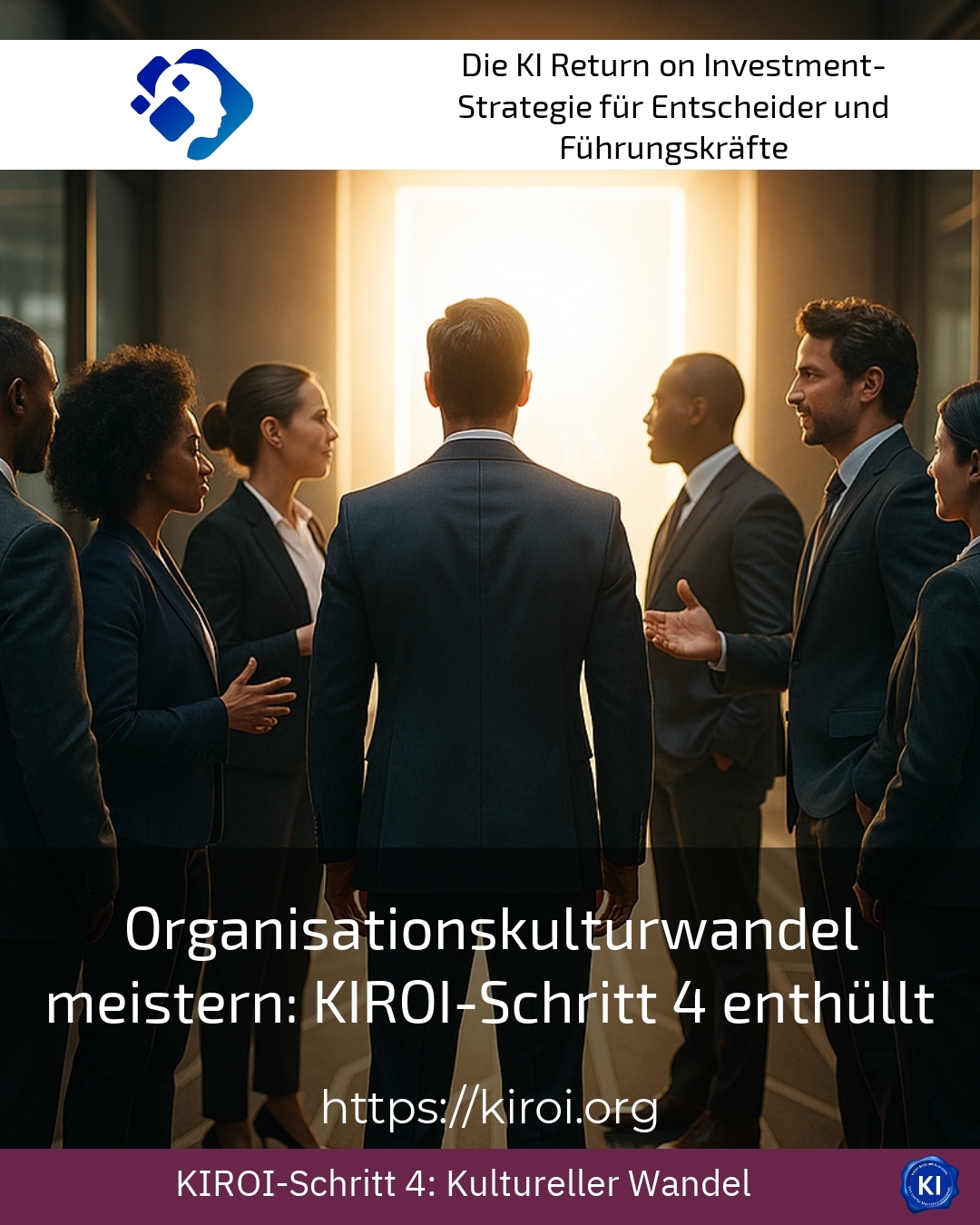
Organisational culture change is a complex process that presents many companies with significant challenges. Step 4 of the AIROI approach, in particular, offers crucial impetus for truly mastering this transformation. Within this step, it becomes clear that leaders are not merely passive implementers but active shapers of the new culture. The significance of this phase for the sustained success of transformation projects can therefore hardly be overstated.
What makes AIROI Step 4 the turning point in organisational culture change?
Many companies experience the fourth step in the AIROI model as a pivotal moment in organisational culture change. Here, leadership behaviour comes into focus: leaders don't just implement directives, but actively embody the new values and ways of thinking. For example, a medium-sized mechanical engineering company significantly strengthened team cohesion through the clear role-modelling of its leadership, thereby supporting the implementation of agile methodologies.
Even within an IT service provider, it became clear that open communication and a respectful approach among management were important prerequisites for employees to accept changes and participate actively. The managers acted as a bridge between the employees and the management, which in turn reduced inhibitions.
A further role of AIROI - Step 4 is the targeted involvement of employees in decision-making processes. In a large retail company, participative leadership succeeded in reducing resistance to cultural change and demonstrably increasing innovative strength in sales.
Practical tips for implementation in organisational culture change
To meaningfully support the organisational culture change in AIROI Step 4, companies should consider several aspects:
- Establish leaders as role models and make their behaviour transparent.
- Initiate regular communication rounds between all levels to foster openness.
- Enabling participation – involving employees in relevant processes and valuing feedback.
- Make concrete successes visible to strengthen motivation and build trust.
- Using training and coaching to strengthen leadership skills in times of change.
In a healthcare example, accompanying coaching supported leaders in understanding and actively living their role as culture carriers. The result was a noticeable improvement in collaboration and a reduction in staff turnover.
A marketing company reported how transparent communication during Step 4 fostered an open feedback culture. The result: more innovation and faster decision-making.
In the manufacturing sector, the acceptance of new processes has been increased and team spirit has been strengthened through the establishment of regular dialogue forums as part of the cultural change.
BEST PRACTICE with one customer (name hidden due to NDA contract)
BEST PRACTICE with one customer (name hidden due to NDA contract) Through the targeted application of transruption coaching in AIROI Step 4, leaders at a large service company were able to strengthen their role as drivers of cultural change. The combination of individual guidance and collective reflection supported the acceptance of the new leadership principles, which significantly contributed to the sustainable embedding of the desired organisational culture.
How leadership supports organisational culture change
The active role of leadership in organisational culture change goes far beyond formal directives. Leaders significantly shape the atmosphere and influence the work culture through their behaviour. For example, in a software company, the leadership team introduced regular open feedback sessions, which fostered trust within the team and allowed conflicts to be addressed early on.
At a logistics service provider, a constructive approach to challenges was fostered by the conscious demonstration of a \emph{Fehlerkultur} (a culture that embraces mistakes) and a willingness to learn at the leadership level. This openness motivated employees to submit suggestions for improvement.
Even within an educational institution, leadership proved to be a central lever: it supported the development of a learning culture that accepted continuous improvement not just as a goal, but as a lived reality.
Organisational culture change as a continuous process
Organisational culture change is not a one-off event, but a continuous process. Experience from numerous industries shows that success often depends on how consistently the AIROI Step 4 is implemented. Only when leaders actively participate as shapers can sustainable cultural change be achieved.
It is important not only that the content but also the attitudes and motivations of those involved are regularly reflected upon. A dynamic exchange promotes further development and adapts the culture to new challenges.
My analysis
Organisational culture change presents many organisations with demanding requirements. AIROI step 4 proves to be a critical phase, in which leaders themselves become the drivers of change. Their active involvement and role-modelling can break through established patterns and create a vibrant, adaptable culture. We effectively support companies by guiding this transformation through targeted coaching and open communication.
Understanding leadership as a lived culture is an effective strategy to promote the long-term acceptance of new values and behaviours. Impulses in AIROI Step 4 thus form an essential foundation for enabling lasting organisational culture change.
Further links from the text above:
Company Culture – Definition and Steps for Cultural Change
Mastering Cultural Transformation: AIROI Step 4 as a Turning Point
Organisational Change – Significance and Practices
Mastering Change Management: AIROI 4 as the Key to Cultural Change
Corporate Culture: Definition and Examples
For more information and if you have any questions, please contact Contact us or read more blog posts on the topic Artificial intelligence here.









 Deutsch
  English (UK)