
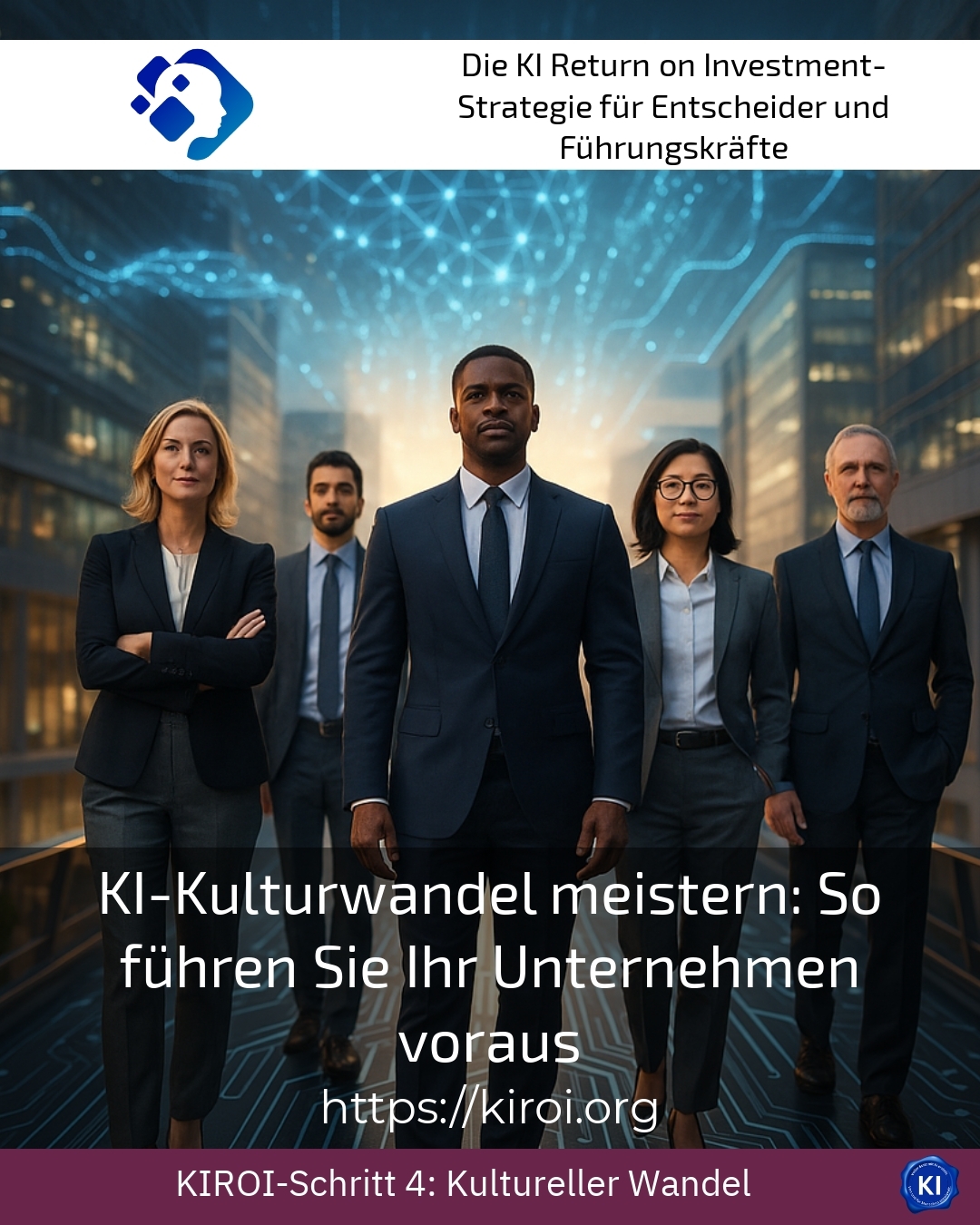
The digital revolution is fundamentally changing our world of work. Companies are facing the challenge of Mastering AI cultural change to have to. Anyone who doesn't act now risks falling behind the competition. This is no longer just about technology. It's about people, processes, and a completely new way of thinking. Leaders must take their teams on this journey. The good news is: with the right support, this transformation can be sustainable. In this article, you will learn how to successfully transform your company.
Why mastering the AI culture shift is becoming a matter of survival
The pace of technological development surprises even seasoned industry experts. Companies that were considered market leaders yesterday are struggling for relevance today. This dynamic requires a fundamental rethink in corporate management. Traditional hierarchies and rigid processes often hinder the necessary adaptability. Therefore, organisations must make their structures more flexible. Employees need new skills and a changed mindset. Clients often report initial resistance within the team. This resistance usually stems from uncertainty and a lack of information. With professional guidance, such hurdles can be overcome.
This change is particularly evident in retail. Large retail chains are already relying on automated warehouse systems and intelligent inventory management. Smaller retailers are experimenting with personalised customer engagement via digital channels. Completely new possibilities for diagnostics and treatment planning are also emerging in the healthcare sector. Banks and insurance companies are transforming their customer advisory services through intelligent assistance systems. These examples illustrate the breadth of the changes. Every industry must find its own way. Transruptions coaching supports this as a competent partner for projects related to this transformation [1].
Best practice with a AIROI customer
A medium-sized manufacturing company faced enormous challenges in introducing intelligent production systems. Initially, the workforce reacted with scepticism to the announced changes. Many employees feared job losses due to automated processes. Management realised that technical implementation alone would not be sufficient. Therefore, they decided to seek comprehensive support through the AIROI programme. In several workshops, managers and employees collaboratively developed a vision for the future. It became clear that intelligent systems should facilitate work rather than replace it. Communication improved significantly through regular information events. After six months, the mood within the company had fundamentally changed. Employees contributed their own suggestions for improvement and actively participated in the transformation. Productivity increased measurably, while employee turnover significantly decreased.
The human side of technological transformation
Technology alone does not create sustainable change in organisations. The key success factor lies in the involvement of all stakeholders. Leaders must lead by example and embody change authentically. At the same time, they need the ability to take fears seriously and deal with them constructively. This competence does not develop automatically, but requires conscious work on one's own attitude. Many companies underestimate the emotional effort of such a transformation. Employees go through different phases of change, from rejection to acceptance to active co-creation.
In the logistics sector, we are currently experiencing massive upheaval through automated route planning and predictive maintenance. Haulage companies are optimising their fleets with intelligent algorithms. Warehouse operators are relying on networked systems for more efficient order picking. Employees in these areas must acquire completely new skills. They are evolving from operational staff to system administrators and process optimisers. The tourism industry is also undergoing profound changes through personalised travel recommendations and automated booking systems. Hotels are using intelligent systems for pricing and capacity planning. These examples show that hardly any industry remains unaffected by the transformation [2].
Developing leadership in the digital age
Modern leadership requires a completely new understanding of authority and collaboration. Hierarchical thinking is increasingly giving way to collaborative approaches. Leaders are becoming enablers and coaches for their teams. They create frameworks within which innovation can emerge. This change is initially difficult for many experienced managers. Behaviours practised for years cannot be discarded overnight. Therefore, professional support is needed on this path. The AIROI framework offers inspiration for this personal development.
This shift in leadership is particularly striking in the media industry. Today, newsrooms operate in agile teams rather than rigid department structures. Publishers are experimenting with automated content creation and personalised news feeds. The advertising industry is also undergoing a fundamental transformation through data-driven campaign optimisation. Creative agencies are using intelligent tools for idea generation and concept development. These new ways of working require leaders who can tolerate uncertainty. They must trust their teams and enable experimentation. At the same time, they must maintain a strategic overview and provide clear direction.
Best practice with a AIROI customer
A senior executive from the financial sector came to transruptions coaching with the issue of feeling overwhelmed. The bank had initiated extensive digitalisation projects, and expectations of management had increased enormously. The client reported sleepless nights and increasing stress in his daily work. In coaching, we initially worked on personal resilience and dealing with uncertainty. It became clear that the client's perfectionism was a significant obstacle. Together, we developed strategies for more realistic self-assessment and better prioritisation. The client learned to delegate responsibility and to trust his team more. After a few months, his quality of life had significantly improved. He led his team with greater composure and, at the same time, greater effectiveness. The digitalisation projects ran more successfully because he focused his energy more effectively.
Mastering the AI culture change through systematic preparation
Successful transformations begin long before the actual technical implementation. Companies must first take an honest stock of their current situation. What skills are already present, and which need to be developed? How pronounced is the willingness to change within the organisation, really? These questions demand courageous, unvarnished answers. Only on this basis can realistic transformation plans be developed. It helps to gain external perspectives and uncover blind spots [3].
In the manufacturing sector, we are currently seeing massive investment in networked production facilities. Automotive suppliers are optimising their production processes through predictive maintenance and quality control. Mechanical engineering companies are developing new business models around data-based services. The food industry is using intelligent systems to optimise recipes and production processes. The pharmaceutical industry is also accelerating its research through automated data analysis. However, these technological advances require more than just new software and hardware. They demand a fundamental reorientation of corporate culture.
Using resistance as an opportunity for profound change
Resistance to change is a natural human reaction, not a sign of weakness. It contains valuable information about the actual needs and concerns of those affected. Savvy leaders use this resistance as a starting point for constructive dialogue. They create spaces where concerns can be openly expressed. Active listening often leads to surprising insights and innovative solutions. This process requires time and patience but pays off in the long run.
The education sector is currently experiencing intense discussions about the use of intelligent learning systems. Schools and universities are experimenting with adaptive learning platforms and automated performance assessment. Many teachers are expressing valid concerns regarding data protection and pedagogical quality. These critical voices are leading to important improvements in the systems being used. Digitisation is also progressing in public administration. Citizen services are being supplemented and improved by intelligent assistance systems. Employees in these areas are undergoing intensive training programmes for new ways of working [4].
Best practice with a AIROI customer
A retail company with several hundred branches wanted to introduce a new automated staff scheduling system. Initially, branch managers reacted with considerable resistance to the project. They feared losing their decision-making authority to an algorithm. The head office had originally planned to roll out the system without significant involvement from those affected. As part of the AIROI support, we fundamentally changed this approach. We organised regional dialogue events with all branch managers. During these events, they were able to voice their concerns and make suggestions for improvement. Many of these suggestions were actually incorporated into the system configuration. The branch managers recognised that the system was intended to facilitate their work rather than control it. In the end, the project was a success because everyone involved was brought along. The acceptance of the new system was significantly higher than originally expected.
Establish sustainable change through continuous learning
Transformation is not a one-off project, but an ongoing process. Organisations must develop a culture of continuous learning and constant adaptation. This requires appropriate structures and resources for further training and development. Employees need time and space to acquire new competencies. Leaders must actively lead and promote learning by example. Mistakes should be seen as valuable learning opportunities rather than a cause for blame.
This culture of learning is particularly evident in the energy sector. Utility companies are transforming their business models from pure energy supply to intelligent energy services. They are relying on networked systems for grid control and consumption optimisation. The construction industry is increasingly using digital planning tools and automated construction machinery. Architectural firms are working with generative design systems for innovative designs. Agriculture is also evolving through precision farming and automated harvesting systems. These diverse examples illustrate the breadth of the ongoing transformation [5].
My AIROI Analysis
Accompanying numerous transformation projects has provided me with important insights into factors contributing to success and failure. The crucial difference between successful and failing projects rarely lies in the technology itself. It lies in the quality of human leadership and communication. Companies that involve and genuinely consider their employees from an early stage achieve significantly better results. Investing in support and coaching pays off multiple times over through higher acceptance and reduced friction. It becomes clear again and again that the Mastering AI cultural change is not a purely technical task.
From my experience with the AIROI framework, several key recommendations can be derived. Firstly, transformation projects should always start from the corporate strategy and not from technological possibilities. Secondly, realistic timelines are needed that allow for learning and adaptation. Thirdly, leaders must actively pursue their own development and not just that of their employees. Fourthly, success should not only be measured by technical key figures, but also by employee satisfaction and learning progress. This holistic perspective distinguishes sustainable transformation from short-term optimisation projects. Companies that consistently pursue this path position themselves successfully for the future and create added value for all stakeholders.
Further links from the text above:
[1] Business Transruption Coaching
[2] AIROI Masterclass for Leaders
[3] Strategy development for intelligent systems
[4] Change Management in Digital Transformation
[5] Building competence for the digital future
For more information and if you have any questions, please contact Contact us or read more blog posts on the topic Artificial intelligence here.










 Deutsch
  English (UK)