
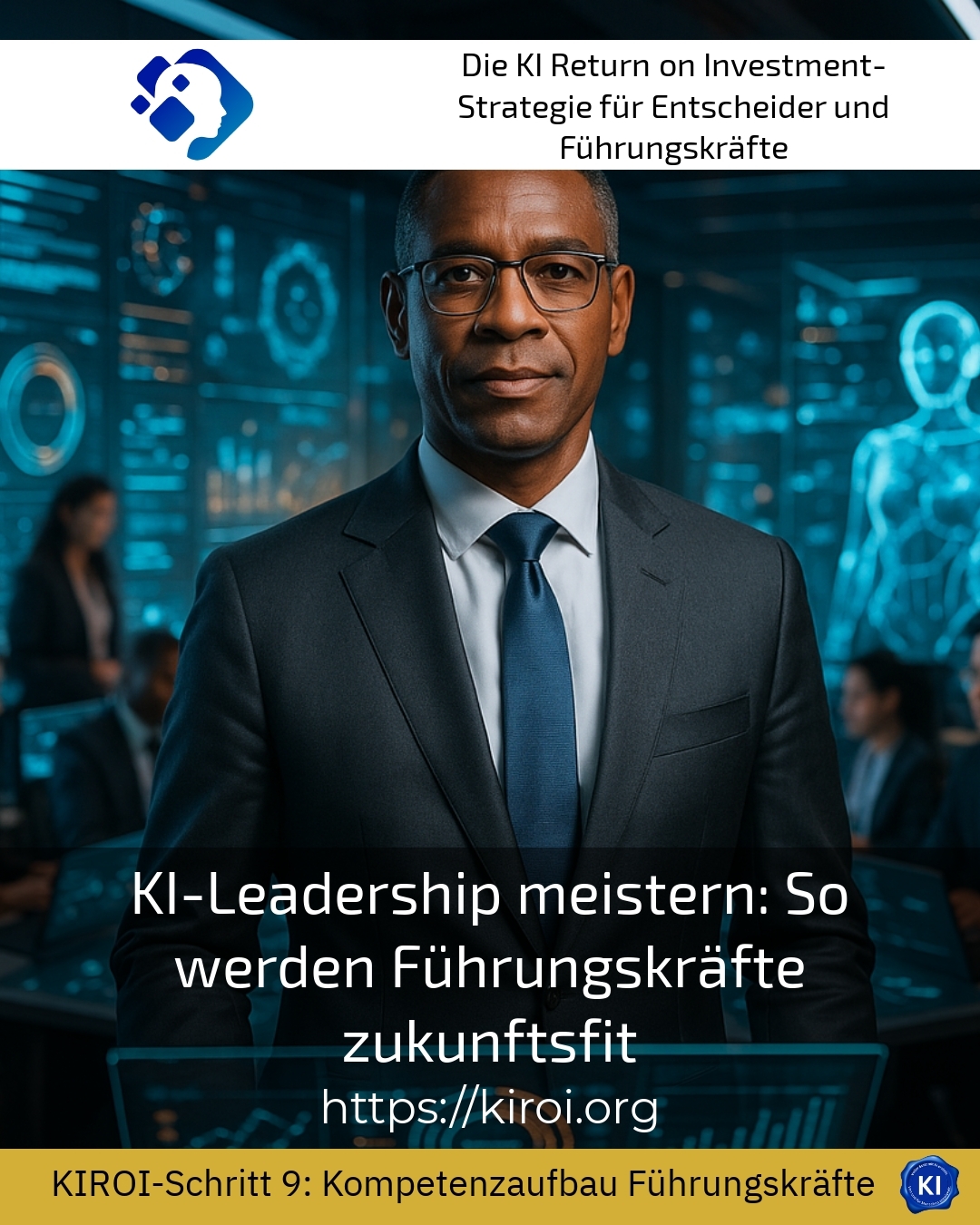
The digital transformation is fundamentally changing companies and presenting leaders with entirely new challenges. Those at the top of a company today must intensely grapple with how intelligent systems are changing decision-making processes and realigning teams. The topic Mastering AI Leadership This currently concerns boards of directors, managing directors, and heads of department alike, as the integration of algorithmic tools demands not only technical understanding but also a fundamentally new understanding of leadership. In this article, you will learn what concrete steps are necessary for you as a leader to keep pace and successfully guide your company into a future characterised by learning machines.
The new role of the leader in the digital age
Traditional leadership models were long based on hierarchies, clear chains of command, and the assumption that knowledge is concentrated at the top. However, these basic assumptions are increasingly losing their validity because intelligent systems can today analyse data faster than any human. Leaders must therefore learn to redefine their own role and abandon the notion that they have to provide all the answers themselves. Instead, the ability to ask the right questions and orchestrate teams so that humans and machines collaborate optimally is becoming more important.
A medium-sized manufacturing company in the mechanical engineering sector, for example, faced the challenge of optimising its quality control. Management decided to introduce an image-based recognition system to automatically identify defects. It quickly became apparent that the technical aspect was only one part of the task. The question of how the production employees should handle the new system became much more important. Management had to learn to allay fears and, at the same time, promote new skills.
Another example can be found in the financial sector, where banks are increasingly employing algorithmic systems for credit assessment. Here, executives must understand how these systems make decisions and the ethical implications involved. Responsibility for decisions remains with humans, even when machines offer recommendations. In healthcare, conversely, diagnostic algorithms assist doctors with image analysis, completely reshaping the collaboration between medical staff and technical systems.
Mastering AI Leadership through Strategic Competency Development
The path to a future-proof leader begins with an honest assessment of one's own digital competence. Many managers report feeling overwhelmed by the pace of technological developments. This uncertainty is understandable and widespread, which is why professional support in competence development can make a valuable contribution. Transruption coaching offers support here by systematically introducing leaders to new technologies while simultaneously addressing the human dimension of change.
In retail, the importance of strategic competence development is clearly evident. Large retail chains are already using predictive analyses for inventory planning. Store managers need to understand why the system suggests certain order quantities. Only then can they make informed decisions about when to follow the recommendation and when local knowledge is more important. A logistics company recently implemented a route optimisation system for its vehicle fleet. Dispatchers had to learn to work with the system's suggestions without disregarding their own experience.
In the insurance industry, claims are increasingly being pre-checked automatically. Claims handlers and their managers face the task of establishing a new way of working. Human expertise is now focusing on complex cases and customer relationships. This shift requires managers to be able to realign and motivate their teams.
Best practice with a AIROI customer An international company in the automotive supply sector approached us because its senior management was struggling to manage the implementation of a comprehensive analysis system designed to evaluate production data in real-time. The challenge lay in the fact that middle management was sceptical of the system, fearing a loss of importance due to automated decision-making suggestions. As part of the transruption coaching, we collaboratively developed a strategy that initially focused on building understanding, enabling managers to grasp how the system worked without needing to become technical experts. We supported the project team over several months, establishing regular reflection sessions where managers could share their experiences. This showed that initial scepticism gave way to a constructive approach once participants understood that the system complemented their work rather than replacing it. The result was significantly higher acceptance among employees and measurably improved collaboration between technical teams and production, which was also reflected in the quality of decision-making processes.
Emotional intelligence as a key competence
The more routine tasks that are taken over by machines, the more important human skills such as empathy, creativity, and ethical judgment become. Leaders who Mastering AI Leadership Wollen, paradoxically, need to sharpen their most human qualities. The ability to lead teams through change processes becomes the central competence. At the same time, communication about technological changes is gaining in importance.
In customer service, companies are increasingly relying on chatbots and virtual assistants. Employees now handle more complex queries that require a delicate touch. Managers must guide this shift and train their teams accordingly. In the media industry, algorithmic systems are already creating standardised news texts. Editorial leads face the task of focusing their journalists on in-depth research and investigative formats. A recruitment agency uses predictive analytics to improve the fit between candidates and positions, although human judgement remains crucial.
Mastering corporate culture as a success factor for AI leadership
The most successful companies are characterised by having established a culture of continuous learning. Leaders play a key role in this because they set signals through their own behaviour. When a leader openly admits that they too still have to learn, they create a space in which mistakes are understood as learning opportunities. This psychological safety is crucial for the successful integration of new technologies [1].
A pharmaceutical company introduced a system to accelerate drug development. Research leads had to learn to develop hypotheses jointly with the system. This new way of working required a culture that permitted experimentation. A large auditing firm implemented automated audit routines for financial statements. Partners had to convince their teams that the technology would not replace them but would free them up for higher-value activities. In the construction industry, systems are now optimising project schedules and identifying potential risks early on, presenting project managers with new coordination tasks.
Constructively using resistance to change
Resistance to technological change is normal and often contains important information. Leaders should not view criticism as a disruption, but as valuable feedback. Clients often report that it is precisely the sceptical employees who provide particularly important pointers to weaknesses. Transruption coaching supports leaders in understanding and constructively using resistance.
An energy provider wanted to introduce predictive maintenance systems for its electricity grid. The experienced technicians were initially sceptical. However, their concerns led to important adjustments to the system. A hotel chain implemented a dynamic pricing system that automatically adjusts room rates. The reception staff had concerns regarding customer reactions. These feedback sessions helped to improve the communication strategy. In public services, systems are being introduced to speed up administrative processes, with the concerns of case workers contributing to the development of clear guidelines.
Best practice with a AIROI customer A family business with a rich tradition in the food industry approached us because the introduction of a supply chain optimisation system encountered significant resistance from the workforce. Long-serving employees, in particular, feared that their accumulated experience would be devalued and they could ultimately become redundant. In transruptions coaching, we first worked intensively with management to develop a deep understanding of the employees' concerns, before jointly designing workshops where the staff could actively contribute to the system's configuration, bringing their expertise to bear. This participatory approach led to the system being better adapted to the company's actual needs, while simultaneously significantly increasing employee acceptance, as they felt part of the solution rather than those affected by a top-down change. Through this process, management learned that successful technology implementation is always also a social process that requires patience, empathy, and genuine involvement.
Practical Steps for Transformation
The journey to becoming a future-ready leader begins with concrete steps. Firstly, it is advisable to honestly assess your own digital literacy. Many leaders overestimate their knowledge or avoid areas where they feel uncertain. A professional skills assessment can provide valuable insights here [2]. Transruption coaching supports leaders in this self-reflection and helps to define individual development paths.
In the telecommunications sector, companies use systems for predicting customer churn. Sales managers need to understand how these forecasts are generated to be able to respond appropriately. An advertising agency uses creative assistance systems for initial drafts. Creative directors had to learn to use these suggestions as a starting point. In the legal field, systems assist with document analysis and research into relevant precedents, freeing up lawyers for more complex advisory services.
Networking and continuous learning
No leader needs to walk the path to the digital future alone. Exchanging ideas with other leaders facing similar challenges offers valuable perspectives. Cross-industry networks enable learning from experiences in other sectors. At the same time, continuous professional development is essential, and this does not always have to be formal [3].
A retail company has set up internal learning circles in which managers regularly discuss new developments. A hospital group has established a mentoring programme in which younger, tech-savvy staff support managers. An industrial company regularly sends its managers to technology hubs to gain first-hand insight into new developments.
My AIROI Analysis
Following intensive consideration of the topic Mastering AI Leadership a clear picture emerges. Leaders who invest today will be the winners tomorrow. This is not about technical expertise, but about a fundamental understanding of the possibilities and limitations of intelligent systems. Human leadership skills will not become less important, but will shift to other areas of responsibility.
In my estimation, the greatest challenge lies in the speed of change. Leaders must learn to deal with uncertainty and make decisions even when not all information is available. At the same time, they must lead their teams through this uncertainty and provide direction without offering false reassurances. This balance requires a high degree of emotional intelligence and self-reflection.
The participatory approach to technology adoption appears particularly important. Companies that involve their employees early on and take their expertise seriously achieve significantly better results. The resistance encountered in many organisations is not a disruption, but a valuable source of information. Leaders who understand this can design change processes more successfully and create sustainable acceptance.
Finally, I would like to emphasise that professional support can make a crucial difference in this transformation. Transruption coaching offers leaders a safe space to reflect on uncertainties and develop new competencies. Investing in one's own development pays off in the long term, both for individual careers and for the success of the entire company.
Further links from the text above:
[1] Harvard Business Review – Leadership
[2] McKinsey – People and Organisational Performance
[3] World Economic Forum – Future of Work
For more information and if you have any questions, please contact Contact us or read more blog posts on the topic Artificial intelligence here.









 Deutsch
  English (UK)