
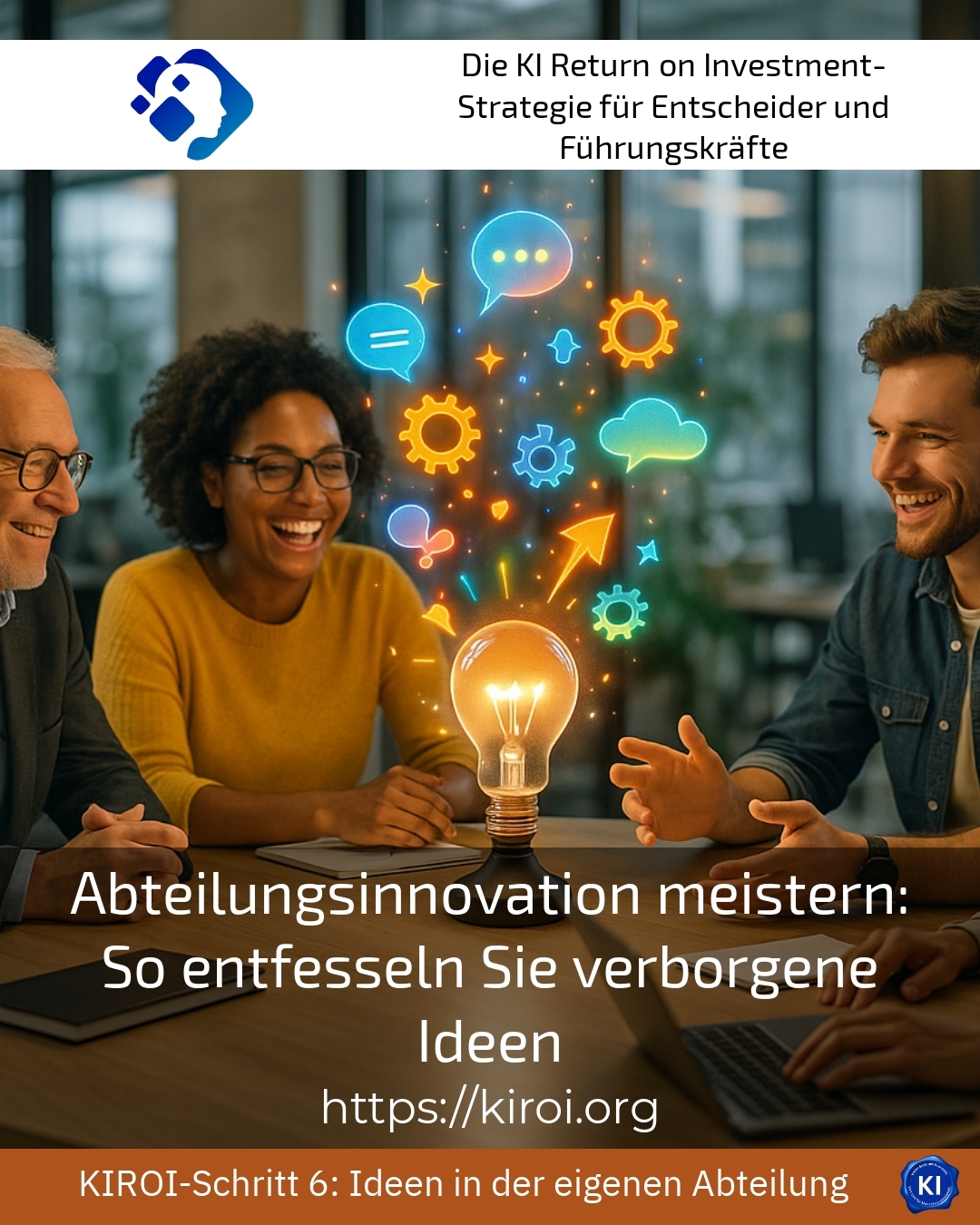
Imagine groundbreaking concepts lying dormant within your organisation, just waiting to be discovered. Every day, valuable flashes of inspiration are lost because no one is asking the right questions. But what if you could systematically unearth these hidden treasures? Mastering Departmental Innovation means searching for untapped potential in a structured way. This is not about expensive technology or external consultants. Rather, the key lies in your own teams and their collective intelligence. In this post, you will learn tried-and-tested methods to unleash creative impulses and drive sustainable change.
The invisible goldmine in your company
Many managers systematically underestimate the creative potential of their employees. The most valuable suggestions for improvement often arise from the ground up, where people interact with customers daily and experience processes firsthand. For example, a mechanical engineering company discovered that its service technicians had been collecting optimisation ideas for years. However, these suggestions remained untapped in notebooks and were never passed on. It was only when the company introduced structured feedback channels that these insights began to flow into product development.
This was similar for a medium-sized logistics provider, whose warehouse workers observed inefficient processes daily. They quietly developed their own workarounds, which no one officially documented. When transruptive coaching brought these hidden practices to light, process times could be significantly reduced. Furthermore, employee satisfaction increased noticeably because people finally felt heard.
A third example comes from the healthcare sector, where nurses developed innovative care approaches. These methods demonstrably improved patient satisfaction while simultaneously reducing workload. However, they remained confined to individual wards for a long time due to a lack of systematic knowledge sharing.
Best practice with a KIROI customer A family-run business steeped in tradition within the metalworking sector faced the challenge of maintaining its competitiveness in an increasingly digitised market. The management had already engaged various external consultants, but the proposed solutions did not align with the company's established culture. As part of the transruption coaching support, an interdepartmental ideas forum was initially established, meeting monthly to facilitate discussions free from hierarchical constraints. Employees from production, sales, and administration contributed their respective perspectives, quickly revealing that many optimisation approaches already existed. For instance, an experienced machine operator had developed a method to significantly reduce setup times, while an administrator in order processing had devised a process for faster quotation generation. Through the systematic recording and evaluation of these ideas, a portfolio of over sixty concrete improvement suggestions emerged, twenty of which were successfully implemented within the first six months. Employees frequently report that they now perceive themselves as active shapers of the company's future, rather than merely as executors of tasks.
Mastering Departmental Innovation through Psychological Safety
Without psychological safety, creative thoughts remain hidden. People only share their unconventional ideas if they don't have to fear negative consequences. However, many organisations have a culture of implicit punishment. Those who express dissenting opinions are often ridiculed or ignored. This leads to employees keeping their most valuable ideas to themselves.
A software company identified this problem when analysing its staff turnover rate [1]. Departing developers stated in exit interviews that their suggestions were systematically ignored. They had developed numerous ideas for improving the product architecture, but these were never heard. After introducing anonymous suggestion boxes and regular retrospectives, the atmosphere changed fundamentally.
A financial services provider had similar experiences, whose compliance department identified risks for years. However, these warnings were dismissed by management as exaggerated. It was only after an external incident shook the industry that the internal voices finally gained weight. Since then, all concerns have been systematically documented and included in decision-making processes.
A similar pattern emerged in the retail sector with a chain of stores boasting over a hundred locations. Sales staff observed customer behaviour and market trends daily. However, their observations rarely factored into central product range planning. The introduction of a digital platform for field reports successfully bridged this knowledge gap.
Methods for promoting open communication
Creating a trusting environment requires concrete actions and continuous attention. Leaders must actively set an example that dissenting opinions are welcome. This can be achieved, for instance, by regularly asking for alternative viewpoints in meetings. Furthermore, mistakes should be seen as learning opportunities and not used as a reason for assigning blame.
A pharmaceutical company established so-called dissent rounds, in which employees were deliberately tasked with formulating counter-arguments [2]. This exercise sharpened critical thinking and led to more robust decisions. At the same time, the teams became accustomed to giving and receiving constructive criticism.
In the automotive supplier sector, a company used Design Thinking workshops to foster interdepartmental creativity. Engineers worked alongside marketing experts and production staff on prototypes. These encounters not only generated new product ideas but also strengthened mutual understanding.
One energy supplier went a step further and set up an internal innovation fund. Employees could submit project proposals and, if positively evaluated, received budget and release time. This initiative unleashed a wave of improvement initiatives from all areas of the company.
Structured processes for sustainable creativity
Spontaneous ideas are valuable, but without structured processes, they fizzle out ineffectively. In order to Mastering Departmental Innovation To be able to do this, organisations need clear processes for capturing and evaluating ideas. These processes need to be accessible and allow for quick feedback. Nothing is more demotivating than suggestions that disappear into bureaucratic mills.
A telecommunications provider implemented a digital idea management system with transparent tracking [3]. Each submitter could follow the status of their suggestion and received initial feedback within two weeks. This transparency increased participation many times over compared to the previous paper-based process.
An insurance company achieved similar successes through monthly innovation jams. At these half-day events, mixed teams worked on predefined challenges. The best solution approaches then received resources for further development. This rhythmic approach generated continuous creative output.
The concept of innovation sponsorships proved successful in mechanical engineering, where experienced managers sponsored promising ideas. These sponsors provided resources and removed organisational obstacles. This significantly increased the implementation rate of suggestions for improvement.
Best practice with a KIROI customer An internationally operating trading company with several thousand employees struggled with fragmented improvement initiatives across different regional subsidiaries. While innovative approaches were being developed in one region, these often remained unknown to colleagues in other countries. As part of the transruption coaching support, an inventory of all ongoing optimisation projects was first conducted, revealing surprising overlaps. For example, four different teams were working in parallel on similar solutions for warehousing without knowing about each other. By establishing a global innovation platform with monthly virtual exchange formats, this duplication of effort was eliminated. The teams began to systematically share their findings and develop them further together. The introduction of innovation ambassadors in each regional subsidiary, who acted as local points of contact and built cultural bridges, proved particularly effective. The managers involved frequently report that this networking not only saves costs but also significantly improves the quality of the solutions due to the inclusion of diverse perspectives.
Mastering the Leader's Role in Departmental Innovation
Leaders significantly shape whether creative impulses flourish or wither. Their attitude sends signals to employees daily. Those who ask questions instead of giving instructions encourage independent thinking. Those who allow experiments and accept setbacks encourage bolder suggestions.
A chemical company specifically trained its middle management in innovation-promoting behaviour. Participants learned how to elicit hidden ideas from their team members through targeted questioning techniques. They also practised giving constructive feedback that motivates rather than demotivates.
In the banking sector, an institution established regular discussions between the board and junior staff. These direct encounters, free from hierarchical filters, provided unvarnished insights into operational challenges. At the same time, they conveyed to the young talents that their perspectives were valued.
A media company experimented with rotating leadership roles within project teams. Different team members took turns coordinating, which brought various leadership styles to the fore. This experience made all those involved more aware of the importance of supportive leadership behaviour.
Technology as an enabler of creative processes
Digital tools can greatly facilitate the capture and networking of ideas. However, technology never replaces fundamental cultural work. Modern collaboration platforms offer functions for brainstorming, assessment, and project management. They make creative processes visible and understandable.
A construction company used specialised software to record suggestions for improvements on building sites. Employees could take and submit photos and voice notes directly on-site. This low-threshold input method significantly increased the number of suggestions.
In the retail sector, a chain incorporated gamification elements into its idea management system [4]. Employees collected points for submitted and evaluated suggestions. These playful incentives increased engagement and fostered positive competition between branches.
A technology company integrated artificial intelligence into its innovation process. Algorithms analysed submissions of ideas and suggested similar proposals from the past. This interconnection prevented duplication of effort and allowed for the combination of related approaches.
Mastering Departmental Innovation through External Impetus
Sometimes it takes an outside perspective to break ingrained patterns of thought. External guidance can help identify blind spots and introduce new perspectives. It's not about providing ready-made solutions. Rather, professional guidance supports you in making better use of your own resources.
A textile company invited students to cast a fresh pair of eyes over established processes. The young people asked naive questions that experienced employees no longer asked. This led to taken-for-granted assumptions being questioned and ingrained practices being challenged.
In the healthcare sector, a clinic group organised regular work placements in other industries. Managers visited hotels, airports and theme parks to study service concepts. These external influences inspired new approaches to patient care.
A mechanical engineer established an advisory board comprising customers, suppliers, and researchers. This committee regularly contributed external perspectives to strategic discussions. The diversity of viewpoints significantly enriched internal debates.
My KIROI Analysis
The systematic unlocking of hidden creative potential represents one of the most important leadership tasks of our time. Organisations that view their employees as a source of valuable insights gain sustainable competitive advantages. It repeatedly becomes clear that the technical aspects of idea management are less crucial than the cultural framework. Psychological safety, appreciative communication, and rapid feedback form the foundation of successful innovation cultures.
The examples presented clearly show that companies of all industries and sizes can benefit from structured approaches. Consistent implementation and continuous development of the chosen methods are crucial. One-off actions are ineffective, whereas sustainable programmes bring about lasting changes in behaviour. Leaders play a key role in this as role models and enablers.
Transruptions-Coaching supports organisations through these transformation processes with proven methods and individual guidance. Experience shows that external input can offer valuable direction, particularly in the initial phase. Clients often report that they already possessed the crucial insights within themselves but required support with implementation. This guidance provides impetus without imposing ready-made solutions. It activates existing resources and creates structures for sustainable change. Ultimately, the greatest innovation potential lies within the people who work for your organisation every day.
Further links from the text above:
[1] Harvard Business Review – Employee Retention
[2] McKinsey – People & Organisational Performance Insights
[3] Gartner – Human Resources Research
[4] Forbes – Innovation Section
For more information and if you have any questions, please contact Contact us or read more blog posts on the topic Artificial intelligence here.











 Deutsch
  English (UK)