
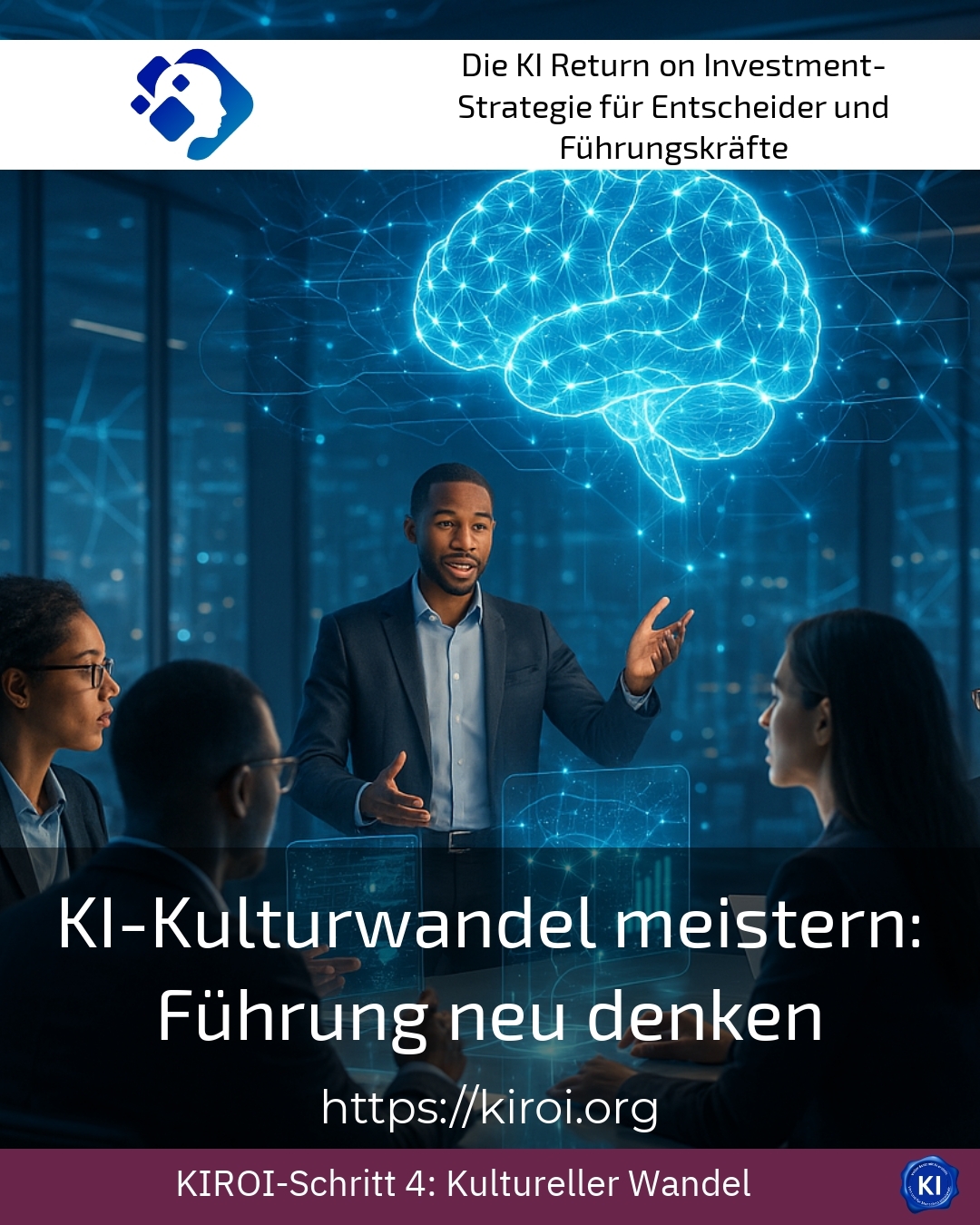
The world of work is currently undergoing a fundamental transformation that goes far beyond technological innovations and penetrates deeply into the self-perception of organisations. Those who are able to Mastering AI cultural change faces one of the greatest leadership challenges of our time. This is because intelligent systems not only transform processes and workflows, but also challenge us to fundamentally rethink established hierarchies, communication channels and decision-making structures. Managers often report feeling disoriented by this transformation. The good news, however, is that with the right support and a clear understanding of the cultural dimensions, this change can not only be managed but actively shaped.
Understanding the invisible dimension of change
When companies introduce new technological tools, they often focus on the obvious aspects such as training, licences and implementation plans. In doing so, however, they overlook the far more complex issue of cultural adaptation, which determines success or failure. The introduction of intelligent assistance systems, for example, changes the way teams work together and share knowledge. Suddenly, new questions arise: Who owns the expertise when algorithms provide the basis for decision-making? How does the role of specialists change when automated systems can take on similar tasks? These questions are on the minds of many organisations. In transruptions coaching, we support leaders in recognising these invisible dynamics and addressing them constructively [1].
For instance, a medium-sized manufacturing company introduced predictive maintenance systems. The technology worked flawlessly, but the experienced technicians suddenly felt devalued. Their years of expertise seemed to be replaced by sensors and algorithms. Another example can be seen in customer service departments, where chatbots handle simple enquiries. Employees there often struggle with the question of whether their work is still valued. We observe similar patterns in the legal departments of large corporations, where intelligent contract review systems are changing the work of paralegals. These examples illustrate that cultural change represents a distinct management task.
Best practice with a AIROI customer
An international engineering firm faced the challenge of introducing intelligent quality control systems into its production halls, but the long-serving quality inspectors showed considerable resistance, and the implementation was in danger of failing. As part of the AIROI support programme, we worked with the management team to develop a concept that actively incorporated the expertise of the experienced staff and redefined their roles. The quality inspectors were appointed as ‘algorithm mentors’, training the system and validating its decisions, thereby securing a new, valued position within the company. Within six months, the initial resistance turned into genuine enthusiasm, as employees realised that their expertise was now being preserved and passed on in digital form. The error rate fell by thirty per cent, whilst at the same time employee satisfaction in the department rose measurably, demonstrating that technological and cultural change can go hand in hand.
Mastering the AI-driven cultural shift through new leadership paradigms
Traditional leadership models are based on the assumption that managers know more than their teams and should therefore be the ones to make decisions. This fundamental assumption is being fundamentally challenged by intelligent systems. Algorithms can now analyse volumes of data in a fraction of a second that would take humans weeks to process. They identify patterns that remain hidden from the human eye and provide forecasts with impressive accuracy [2]. Managers who Mastering AI cultural change must therefore fundamentally rethink their role. Their remit is shifting from being the sole custodians of knowledge to creating the framework within which humans and machines can work together productively.
This shift is particularly evident in the finance departments of large companies. In the past, controllers were regarded as indispensable experts in figures and forecasts. Today, automated systems handle the bulk of the analytical work. As a result, the role of the controller is evolving into that of a strategic advisor who interprets and contextualises results. We are seeing a similar pattern in HR departments, where intelligent systems pre-screen applications and calculate matching scores. Recruiters must learn to critically scrutinise these suggestions and bring human intuition to bear. In marketing departments, meanwhile, algorithms create personalised campaigns in real time, whilst creative staff can focus their energy on overarching brand strategies.
These shifts require a new kind of humility from leaders. They must accept that they no longer have—nor can they have—all the answers. At the same time, their responsibility for ethical issues and for ensuring that human values are upheld in algorithmic processes is growing. Transruptions coaching helps leaders to find their feet in this new role and to fulfil it with confidence.
Building trust as the foundation for cultural change in AI
Without trust, any change process is doomed to fail. This is particularly true when intelligent systems are integrated into work processes. Employees understandably wonder whether their jobs are at risk and whether they will be able to cope with the new demands [3]. Managers must take these fears seriously and address them proactively. Transparency regarding planned changes is essential in this regard. Equally important is clear communication about which tasks will be automated and which are explicitly to remain in human hands. Within the AIROI framework, we have developed specific communication strategies to support managers during this sensitive phase.
One logistics company, for example, introduced autonomous transport robots into its warehouses. The warehouse staff’s initial scepticism only began to fade once management made it clear that no one would be made redundant. Instead, staff were retrained for new, more challenging roles. At an insurance company, the introduction of automated claims assessment initially caused panic among claims handlers. It was only when management outlined concrete career development paths that the unease subsided. A third example comes from the healthcare sector, where nursing staff learned to view diagnostic assistance systems as a support rather than a threat, because management communicated the limitations of these systems transparently from the outset.
Best practice with a AIROI customer
A large retail chain implemented intelligent inventory management that automatically triggered reorders and fundamentally changed the work of store managers. The initial reaction was marked by distrust, as store managers feared losing their decision-making authority and being reduced to mere order-takers for an algorithm. In the AIROI coaching process, we worked intensively with the leadership team on a new role definition that explicitly assigned store managers responsibility for customer relationships and local marketing. The system took over the operational routine, while human expertise was freed up for strategic and interpersonal tasks, leading to a significant increase in customer satisfaction. Store managers today frequently report that they find their work more meaningful and fulfilling because they have more time for genuine customer advice and have to deal with fewer administrative tasks.
Developing skills for the new world of work
Cultural change also requires a fundamental reorientation of further training strategies. Technical training alone is far from sufficient. Employees must learn to deal with uncertainty and accept continuous learning as a normal working condition [4]. Critical thinking is gaining importance because algorithmic recommendations must be questioned and put into context. Emotional intelligence is becoming more important because human skills such as empathy and creativity are the domains in which people remain indispensable. The Mastering AI cultural change therefore also means creating learning cultures that systematically promote these competences.
In accountancy firms, we are seeing a dramatic shift in the demands placed on auditors. Whereas meticulous attention to detail was once the order of the day, today it is analytical judgement and communication skills that count. Similar developments are evident in engineering firms, where generative design systems produce initial drafts and engineers take on the role of curators and optimisers. In translation agencies, meanwhile, the focus is shifting from linguistic translation to cultural adaptation and creative text design, as machine translation takes over the groundwork. These examples illustrate that professional development must go far beyond technical skills.
Transruptions coaching provides inspiration for designing such learning environments. We support organisations in tailoring their professional development programmes to address both technical and soft skills. In doing so, we always take into account the specific corporate culture and the individual needs of employees.
Establish ethical guardrails
Any organisation that uses intelligent systems must address ethical issues. How transparent must algorithmic decisions be? Who bears responsibility if a system makes a mistake? What limits do we place on automation? These questions cannot be answered by the IT department alone. They require a broad dialogue involving a range of perspectives and stakeholders [5]. Managers play a central role in this, as they must set the framework for these discussions and ensure that ethical considerations are not sidelined under pressure to prioritise efficiency.
One recruitment agency, for example, made a conscious decision not to use emotion recognition in job interviews, even though the technology was available. Ethical concerns outweighed the potential benefits. A bank, on the other hand, set up an ethics committee to review every new algorithm before it is deployed and to make recommendations. At a media company, editors worked with the technology department to develop guidelines for the use of automated content generation in order to uphold journalistic standards.
My AIROI Analysis
The transformation that intelligent systems are bringing about within organisations is fundamental and irreversible. It affects not only processes and structures, but the very nature of work and leadership. Anyone who Mastering AI cultural change Anyone wishing to do so must be prepared to let go of old certainties and embrace a continuous learning process. The good news is that organisations do not have to go it alone. With the right support and a structured approach, the challenges can be overcome and the opportunities seized.
In my work with numerous companies, I've observed that success is significantly dependent on the attitude of leadership. Those organisations that embrace change as an opportunity and actively involve their employees achieve significantly better results than those that impose technology from above. The cultural dimension is often the decisive success factor, going beyond technical implementation issues. The AIROI framework offers a structured approach to shaping this cultural transformation, keeping both human needs and business requirements in focus. It enables leaders to find orientation in a time of great uncertainty and navigate their teams through change. The journey is challenging, but it is worthwhile for all involved.
Further links from the text above:
[1] Harvard Business Review – Organizational Culture
[2] McKinsey – Insights on People and Organisational Performance
[3] World Economic Forum – Future of Work
[4] Gartner – Future of Work Trends
[5] Forbes Tech Council – AI Ethics and Leadership
For more information and if you have any questions, please contact Contact us or read more blog posts on the topic Artificial intelligence here.








 Deutsch
  English (UK)