
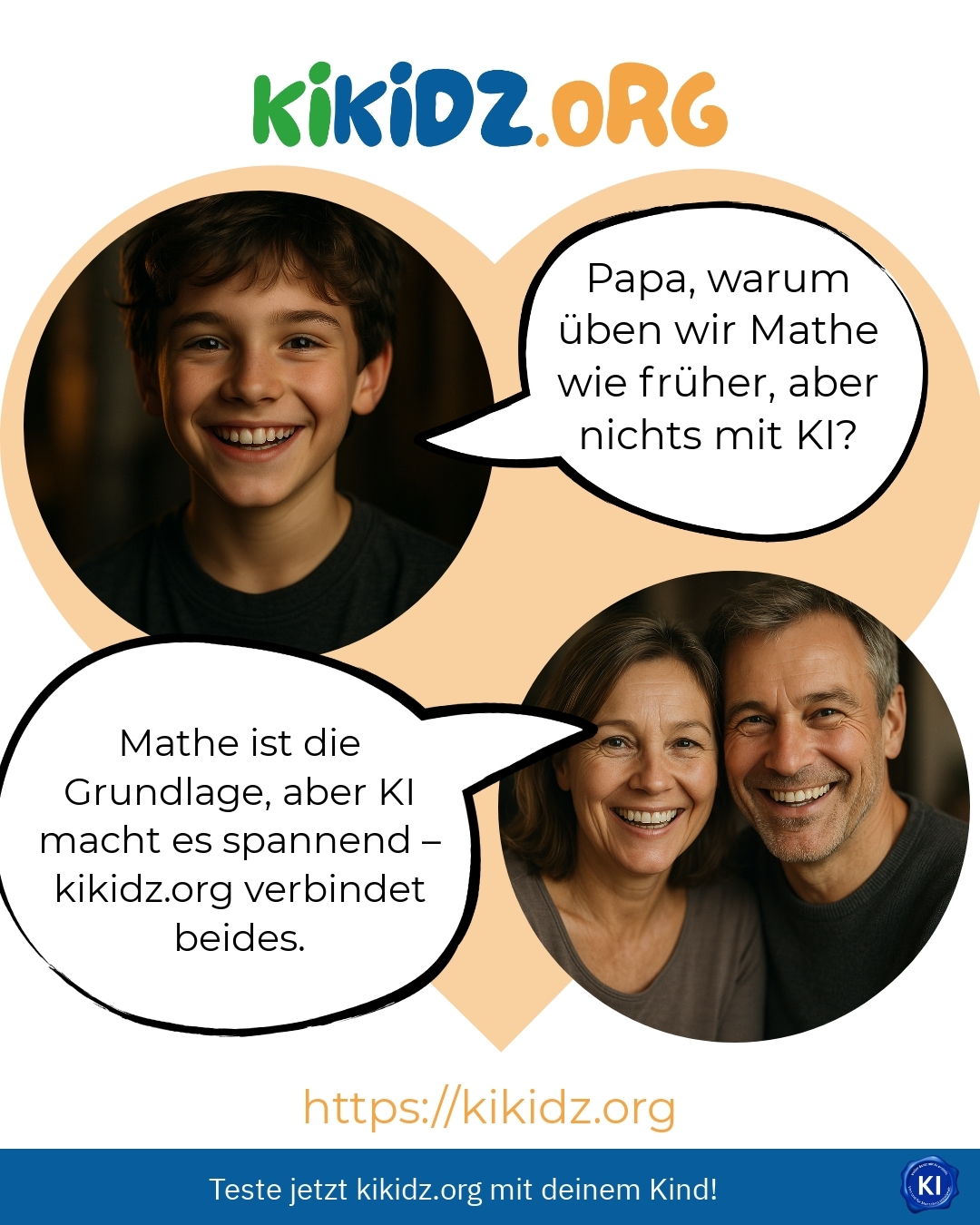
„Dad, why are we still practising maths the old way, but nothing with AI?“ – this is a question many children understandably ask today when they hear about artificial intelligence (AI) in everyday life but hardly experience it in the classroom. This question touches on a central issue of our time: how can modern education keep pace with digital technologies and truly integrate the potential of AI into teaching? In this article, we want to explore this question and provide parents with practical ideas on how to meaningfully combine maths learning and AI.
Dad, why are we still doing maths like we used to, but nothing about AI? – a look at current lessons
Many parents report that their children are still calculating, solving problems, and using formulas in mathematics lessons in the traditional way, as they did in their grandmothers' days. Although AI has long been permeating our everyday lives, pupils rarely learn how artificial intelligence can support mathematics learning. One reason for this is that school curricula and teaching methods are often modernised with a time delay. Teachers must first be sufficiently trained to be able to use AI tools competently. Furthermore, there is the challenge of understanding AI not merely as a technology, but as a didactically meaningful tool.
Example 1: Parents observe that children often still practice maths with pen and paper, even though there are fascinating AI learning platforms available.
Example 2: Children are asking for explanations about AI-powered apps that offer personalised support and analyse mistakes, yet school is still operating conventionally.
Example 3: A father is wondering why maths lessons discuss AI in theory but don't offer practical exercises using AI-based tools.
How can AI meaningfully support maths learning today?
Artificial intelligence is opening up new ways to teach mathematics in a personalised and motivating manner. For example, AI systems enable the analysis of learning strategies through so-called eyetracking. They recognise where children hesitate or feel confident, and specifically adapt tasks accordingly [3]. Furthermore, there are AI tutors that support pupils with practice by recognising errors and providing feedback [4]. This allows lessons to become more personal and effective.
Example 1: A child receives individual recommendations after each exercise on how to better understand specific calculation steps, thanks to AI.
Example 2: Teachers are using AI tools to generate tailored assignments that precisely address students' weaknesses.
Example 3: Parents are experiencing how their child delves into maths topics much more independently with an AI-powered learning system.
Dad, why are we practising maths like before, but nothing with AI? – Perspectives for parents
This question highlights the importance of parents and teachers working together to shape the transition to AI-supported learning. Parents can support their children by trying out digital learning opportunities with them early on and explaining how AI works. This way, children perceive technologies as tools that assist them, rather than replace them.
A practical tip for home: Encourage your child to use an AI-powered learning platform to supplement their maths practice. Platforms like https://kikidz.org offer training and materials that specifically address this intersection. Furthermore, parents and teachers can jointly advocate for schools to integrate AI applications into their teaching promptly and support them meaningfully.
Example 1: A parent uses an AI-based maths app with their child and subsequently discusses the provided assistance.
Example 2: Teachers attending further training on the use of AI in the classroom provide impetus for everyday school life.
Example 3: Parents bring up the topic of AI at school events or parents' evenings to encourage open discussion.
My analysis
„Dad, why are we still practising maths like we used to, but not engaging with AI at all?“ is a perfectly valid question that points to the tension between traditional teaching methods and new technological possibilities. AI can’t replace learning maths by any means, but it can support learning processes, foster individual development, and lead to increased motivation. The challenge lies in ensuring schools and teachers are adequately prepared to teach AI competencies. Parents can support this transition by exploring AI offerings with their children and advocating for innovative school concepts. The path to contemporary maths education with AI is open, and platforms like https://kikidz.org offer excellent training and materials for this purpose.
Further links from the text above:
KIMADU – KI Research Project on Mathematics Didactics
AI pilot project in North Rhine-Westphalia
Learning maths with an AI system and eye-tracking
Teacher training on the use of AI in mathematics lessons
For more information and if you have any questions, please contact Contact us or read more blog posts on the topic Children and Artificial Intelligence here. You can find the courses here: Children and Artificial Intelligence Courses










 Deutsch
  English (UK)