
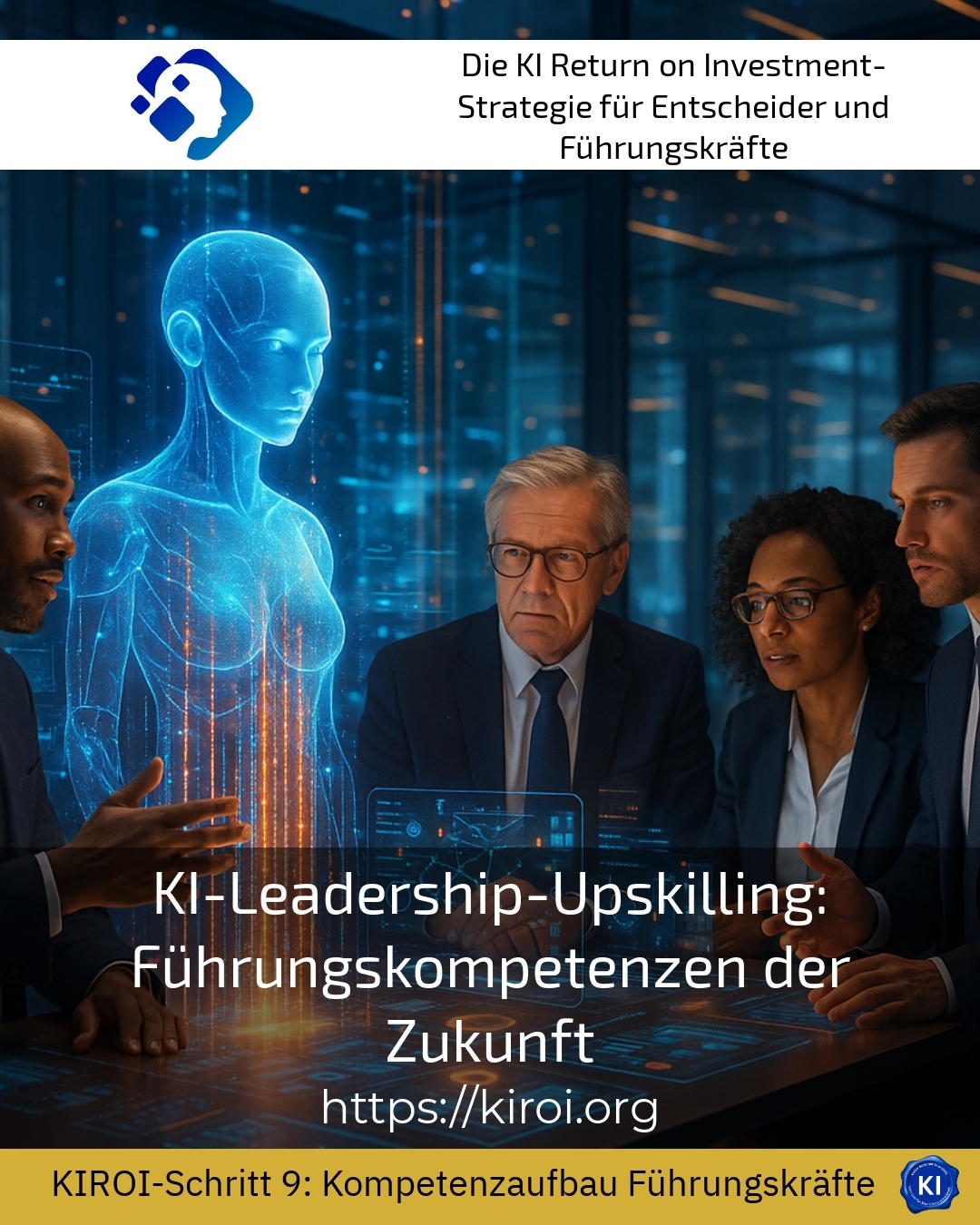
The world of work is changing rapidly, and those in positions of responsibility today face entirely new challenges. AI Leadership Upskilling This is becoming the decisive factor for the success of organisations. Leaders who do not continue to develop risk falling behind. But what does it actually mean to lead teams in a world where intelligent systems are taking on more and more tasks? And how can decision-makers expand their competencies so that they remain relevant in the future? These questions are currently occupying companies of all sizes. The answers are more complex than many initially suspect.
Why traditional leadership models are reaching their limits
Traditional leadership concepts stem from a time when hierarchies were clearly defined and information flowed slowly. Today, the reality is completely different, as data is available in real-time and decisions must be made within seconds. Leaders often report feeling overwhelmed as the complexity of their tasks increases exponentially. For example, a medium-sized logistics company experienced how automated route planning systems fundamentally changed the role of dispatchers. The employees suddenly needed different competencies, and the managers had to learn to sensibly orchestrate human and machine. A similar picture emerges in the insurance industry, as claims handlers now work hand in hand with algorithms that detect fraud patterns. Leadership is also being transformed in retail, as inventory is managed through intelligent forecasts and staff must be retrained accordingly.
AI Leadership Upskilling as a Strategic Necessity
Anyone who wants to shape leadership for the future cannot avoid systematic further training. AI Leadership Upskilling This describes the process of specifically preparing leaders to work with intelligent systems. It's not about becoming a programmer yourself, but rather about a deep understanding of the possibilities and limitations of these technologies. The CEO of a mechanical engineering company recently described how he was initially sceptical because he perceived technological changes as a threat. However, after an intensive coaching process, he realised that his experience and understanding of people gave him precisely the qualities that algorithms cannot replace. We are observing similar developments in the pharmaceutical industry, as laboratory managers need to learn to oversee automated analysis processes while also motivating their teams. Banks face the challenge that credit decisions are increasingly supported by scoring models, while the final responsibility still lies with humans.
Accompanying the emotional dimension of change
Change causes uncertainty for many people, and ignoring these feelings would be a serious mistake. Leaders who undertake further training often report confronting their own fears at first. This is perfectly normal and even a good sign, because it shows that the change process is being taken seriously. Transruptions coaching supports overcoming these emotional hurdles and seeing them as opportunities for growth. A department head from the energy sector described how he had fought against the introduction of automated grid monitoring for months. It was only through professional support that he realised his opposition had less to do with factual arguments and more to do with the fear of losing control. Similar patterns are seen in the healthcare industry, where doctors and nurses must learn to view diagnostic support systems as an enrichment rather than a competition.
Best practice with a AIROI customer
An internationally active trading company faced the challenge of preparing its management team for collaboration with predictive analytics systems. The executive board recognised early on that technical training alone would not suffice to bring about the necessary cultural change. Therefore, they opted for a comprehensive support programme that addressed both professional and emotional aspects. Over a period of six months, the executives worked intensively on their personal attitudes towards technological change. At the same time, they developed practical skills in handling data-based decision-making foundations. The results were impressive, as the acceptance of the new systems increased significantly. Employee satisfaction also improved because the managers could now authentically communicate why certain changes were necessary. Particularly noteworthy was that some of the initially most sceptical managers became the most committed ambassadors of change. They had understood that their role was not becoming obsolete, but merely transforming.
Practical skills for leading tomorrow
Today's leaders require a broad spectrum of skills that go far beyond traditional management. Among the most important competencies is the ability to communicate complex technological contexts in an understandable way. A production manager in the automotive industry, for instance, must be able to explain why certain manufacturing steps are now being taken over by robots, without causing panic among employees. At the same time, they need the sensitivity to identify those who require particular support in adapting. The media industry demonstrates how important it is to guide creative teams through phases of technological upheaval, as many editors perceive automated text generation as an existential threat. Leaders can provide impetus here and show how human creativity and machine efficiency can work together.
Embedding AI Leadership Upskilling in Daily Practice
Further training only unfolds its full potential when it is integrated into everyday work. Theoretical knowledge alone is not enough because the real challenges arise in specific situations. Therefore, an approach that combines continuous learning with practical application is recommended. For example, a telecommunications company has introduced so-called reflection rounds, in which managers exchange their experiences with new systems. These formats create a protected space in which uncertainties can also be expressed. In the food industry, some companies are experimenting with mentoring programmes, where tech-savvy younger employees support experienced managers. This reversal of traditional hierarchies may seem irritating at first, but many participants report extremely positive experiences. Further training is also gaining importance in the construction industry, as digital planning tools and automated construction monitoring are fundamentally changing the work of project managers.
The role of coaching in developing sustainable leadership
Professional guidance can make the difference between superficial adaptation and profound transformation. transruptions-coaching offers a structured framework for defining and systematically pursuing individual development goals. Unlike standardised training programmes, this approach takes into account the specific needs of each individual leader. A CFO of an insurance company recently described how intensive coaching helped him overcome his initial scepticism towards automated risk assessments. He learned to critically question the results of these systems while also leveraging their potential. In the logistics industry, coaching supports leaders in finding the balance between increasing efficiency and employee orientation. Even in the healthcare sector, where ethical questions play a significant role in the use of diagnostic systems, professional guidance can offer valuable orientation.
Best practice with a AIROI customer
A medium-sized financial services provider wanted to support its customer advisory services with predictive analytics but encountered significant resistance from the management team. Department heads feared that their years of experience would be replaced by algorithms, and this concern was entirely understandable. Through a tailored coaching programme, it was possible to take these fears seriously while simultaneously opening up new perspectives. The managers gradually realised that the new tools could enrich their work rather than replace it. They learned to use analyses as an additional source of information without giving up their own judgement. Particularly effective was the work on concrete case studies, where managers experienced how human intuition and data-based insights can complement each other. After completing the programme, participants were not only better prepared professionally but also emotionally strengthened. They were able to lead their teams authentically through the change process because they themselves had gone through the transformation.
Achieving Sustainable Change Through AI Leadership Upskilling
Long-term success requires more than short-term adjustments to new technologies. It’s about developing a fundamental attitude that understands change as a constant and actively shapes it. Leaders who have internalised this mindset won't be thrown off course by every new development. They understand that their central task is to guide people through uncertainty and provide direction. A Chief People Officer from the chemical industry aptly summarised it when he said that while technology changes much, human leadership qualities are more important than ever. Many leaders who have gone through an intensive development process share this realisation. The education sector shows how headteachers and university managers are learning to use digital learning platforms effectively without neglecting personal contact. The topic is also gaining importance in public administration, as citizen services are increasingly being digitised.
My AIROI Analysis
The development of leadership skills in the context of technological transformation is not an optional extra qualification, but a strategic necessity for any organisation. My analysis clearly shows that companies investing in the further training of their leaders navigate change processes significantly better than those that neglect this dimension. It is crucial to consider both technical and emotional aspects, as technological change always brings personal challenges. Examples from various industries illustrate that there is no one-size-fits-all solution, but rather individual approaches are required. Of particular importance, in my view, is the realisation that leaders themselves must go through the change process before they can credibly guide others. Coaching and professional support play a central role in this, as they offer a safe space for reflection and development. Organisations should AI Leadership Upskilling and not as a one-off measure. Companies that set the right course today will be better positioned tomorrow to take advantage of technological developments while also bringing their employees along. My recommendation therefore is to begin with the systematic development of leadership skills at an early stage, relying on proven methods such as transruption coaching [1].
Further links from the text above:
[1] AIROI Blog: Strategies for Successful Transformation
For more information and if you have any questions, please contact Contact us or read more blog posts on the topic Artificial intelligence here.








 Deutsch
  English (UK)