kiroi.org

KIROI - Artificial Intelligence Return on Invest
The AI strategy for decision-makers and managers

Business excellence for decision-makers & managers by and with Sanjay Sauldie

KIROI - Artificial Intelligence Return on Invest: The AI strategy for decision-makers and managers

KIROI - Artificial Intelligence Return on Invest: The AI strategy for decision-makers and managers

Start » KIROI Step 9: Leadership Competency Development for Leaders
31 May 2025

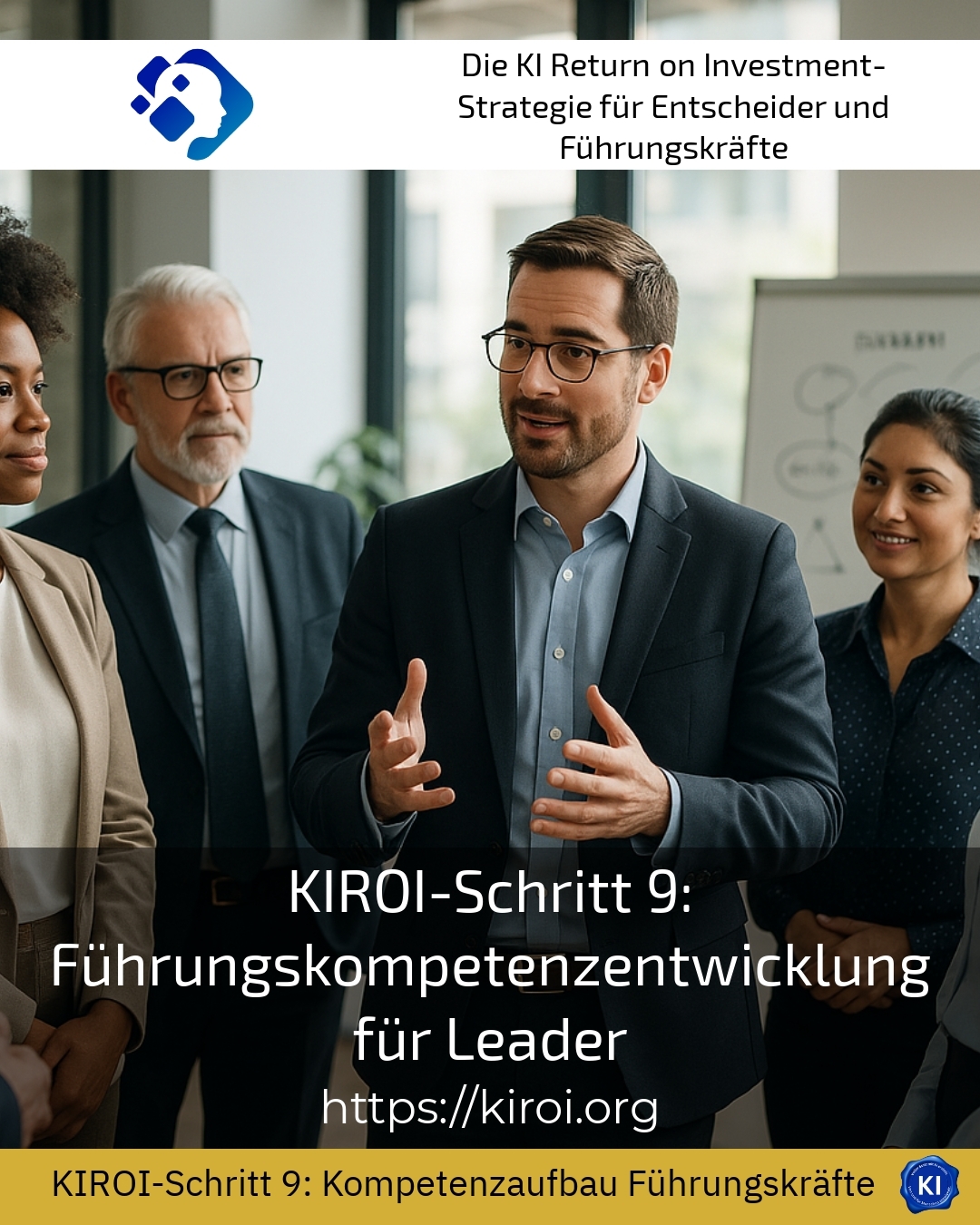
KIROI Step 9: Leadership Competency Development for Leaders

4.5
(811)

„`html


Leadership Development for Leaders – KIROI Step 9


In today's working world, leaders face increasingly complex challenges. Digital transformation, agile methods, and a diverse workforce demand continuous learning and development from you as a leader. Therefore, KIROI Step 9 focuses on a central theme: leadership competence development. [1] This encompasses all targeted measures, methods, and tools to sustainably enhance your leadership skills and thereby successfully shape your team and your organisation. [2] transruptions-Coaching will accompany you as a leader on this path and help you to fully utilise your leadership potential through strategic leadership competence development.

Why leadership skills development is indispensable today

Studies repeatedly show a clear picture: good leadership significantly reduces staff turnover. [5] For your company, this specifically means lower costs and higher productivity. But it's about more than just numbers. Your employees want to develop, feel understood, and recognise purpose in their work. [2] You can achieve this through continuous development of leadership skills.

The demands placed on modern leaders are diverse. [2] They require professional expertise in their field, social skills such as communication and conflict resolution, methodological skills for problem-solving, and not least, self-competence. [2] Sound leadership development systematically addresses all these areas.

What topics do leaders come to us with? Clients often report uncertainty in difficult conversations. They struggle with decision-making under pressure. Many find delegation difficult. Conflicts within teams escalate instead of being resolved. All these challenges can be addressed through professional support in leadership competency development.

The three pillars of leadership competence development

Coaching and mentoring as core elements

Mentoring and coaching are among the most effective methods for developing leadership skills. [1] A coach works with you one-on-one, helping you to overcome specific challenges. [11] A mentor, on the other hand, is an experienced leader who shares their experience with you. [1]

Large corporations like Google and IBM systematically use mentoring to develop their executives. [11] Reverse mentoring is particularly interesting here: younger employees support established executives with digitisation topics. [5] This promotes mutual learning and breaks down old hierarchies.

BEST PRACTICE with a customer (name hidden due to NDA contract): A medium-sized manufacturing company implemented a mentoring programme for its junior managers. Experienced managers each mentored two young talents over six months. Result: 90 percent of the mentees remained with the company and soon took on their own leadership responsibilities. The development of leadership skills through mentoring showed measurable success in retention and internal career mobility.

Training and workshops for practice-oriented skills

Formal training and workshops remain effective tools for leadership development. [11] They systematically impart leadership methods, conflict resolution techniques, and team leadership. [11] Large corporations such as Siemens and Bosch regularly offer internal programmes. [11]

The important thing with training is its practical relevance. Interactive training sessions with role-playing and case studies allow you to practice new skills immediately. You don't just sit in a classroom and listen. Instead, you experience realistic scenarios and develop solutions together with other managers.

Blended learning combines the best of both worlds. Online modules prepare you flexibly. In-person workshops then deepen knowledge through exchange and practical exercises. [7] This creates a sustainable learning environment that leads to genuine behavioural change.

Action Learning and gaining practical experience

The most effective leadership competency development happens through practical experience. [2] Action Learning combines problem-solving with learning: you work in teams on real projects or challenges within your company. [11] Companies like Lufthansa have successfully integrated this approach. [11]

Rotation programmes also support your development. [5] You will become familiar with different areas, build cross-departmental understanding, and grasp process dependencies. [3] This holistic perspective makes you a better leader.

BEST PRACTICE with a customer (name hidden due to NDA contract): A logistics company introduced rotations for junior executives. Young leaders spent four months in different departments. One candidate rotated between warehousing, sales, and accounting. This practical leadership development proved successful: he developed empathy for the challenges faced by other teams and later, as overall manager, made significantly better, more holistic decisions.

E-learning and digital formats in modern leadership competency development

E-learning platforms offer high flexibility for your leadership skills development. You learn unbound by time and place. Modules are repeatable and adaptable to your daily life. Compared to pure self-study, e-learning also offers higher interactivity and company relevance.

Modern platforms even enable virtual role-playing games for the development of social skills. [2] They train difficult conversations with AI-powered avatars or other participants. This significantly reduces inhibitions in real-life situations.

Online courses, however, require more self-initiative from you. Without your own discipline, you'll get stuck. Therefore, we often recommend combining online formats with coaching. This way, you'll have a personal contact for your questions and challenges in leadership competency development.

The systematic approach to leadership competency development

Development of good leadership skills follows a clear process. [9] First comes the analysis: Where are you today? [3] What are your strengths? What skills do you still need? [3] Only on the basis of this current analysis can leaders be developed strategically. [9]

The second step is the creation of an individual development plan. This plan includes concrete goals, suitable methods, and a timeframe. A good plan takes into account your personal learning styles and your professional situation.

Then comes implementation with continuous support. [7] Leadership competency development is not a one-off event, but an ongoing process. [7] Regular reflection and adjustment of the plan ensure that you stay on course.

BEST PRACTICE with a customer (name hidden due to NDA contract): An insurance group implemented a holistic leadership development programme for 50 middle managers. First, a competency matrix was created. This was followed by individual consultation with each manager. The company then combined online modules with group coaching and peer learning sessions. After nine months, the results showed a 23 percent increase in employee satisfaction, and three managers were ready for promotion. This systematic leadership competency development delivered a measurable ROI.

Leadership competency development in different industries and contexts

Different industries, different requirements

A manufacturing company needs different focal points for leadership competence development than a tech startup. In this industry, operational excellence and process control are central. A department manager at Bosch focuses heavily on efficiency, quality, and team organisation.

In the financial sector, on the other hand, the focus is on compliance and risk management. Here, managers learn how to meet regulatory requirements while remaining innovative. Leadership competency development must take these specific contexts into account.

However, what is common everywhere is that leadership development requires a clear strategy. [7] The methods and content must be linked to the company's objectives. [7] Only then can a sustainable contribution to the company's success be made.

Leadership Development in the Context of Digitalisation

Digitalisation is dramatically changing leadership requirements. Remote teams, asynchronous communication and virtual collaboration demand new skills. Leadership competence development must address these digital realities.

Reverse mentoring helps: younger employees with digital affinity support established managers. [5] This is particularly valuable for topics such as digitalisation, but also inclusion and modern working culture. [5]

The ability for digital leadership is a core aspect of leadership competency development today. Can you unite teams virtually? Do you use digital tools effectively? Do you communicate clearly across different channels? These competencies can be trained and developed.

transruptions-Coaching: Your guide in leadership competence development

transruptions-Coaching positions itself as specialised support for projects concerning leadership competency development. [1] We do not support you with off-the-shelf solutions, but with tailor-made ones.

Our approach is holistic. We begin with a thorough analysis of your situation. Then, together, we develop a plan that suits you. Whether it's individual coaching, group workshops or long-term support: we combine formats to create sustainable leadership development.

Our focus on reflection is particularly valuable. Good leadership development requires time for thought. What have you learned? Where would you like to act differently? How do you put new insights into practice? These questions are at the heart of our support.

BEST PRACTICE with a customer (name hidden due to NDA contract): The managing director of an agency came to us with the challenge of not delegating properly within his team. Over a six-month coaching process, we worked intensively with him on the topics of trust building and delegation. Parallel workshops with his team fostered trust and psychological safety. The development of leadership competence through this combined support resulted in the managing director having more strategic time, while employees became more autonomous and satisfied.

Avoiding mistakes in leadership competence development

Common mistakes in leadership competency development are quickly identified. [3] The first mistake: poor candidate selection. [3] Not everyone is ready for a leadership position. A thorough potential analysis is essential.

The second error: lack of planning. [3] When leadership competency development takes place in isolation, without connection to company goals, the effect is lost. The leader returns to the old routine.

The third mistake: too short a period of support. Leadership development is a marathon, not a sprint. Continuous measures over several m
How useful was this post?

Click on a star to rate it!

Average rating 4.5 / 5. Vote count: 811

No votes so far! Be the first to rate this post.

Spread the love

transruption.org

The digital toolbox for
the digital winners of today and tomorrow

Business excellence for decision-makers & managers by and with Sanjay Sauldie

transruption
transruption

transruption: The digital toolbox for
the digital winners of today and tomorrow

Start » KIROI Step 9: Leadership Competency Development for Leaders
31 May 2025

KIROI Step 9: Leadership Competency Development for Leaders

4.5
(811)

„`html


Leadership Development for Leaders – KIROI Step 9


In today's working world, leaders face increasingly complex challenges. Digital transformation, agile methods, and a diverse workforce demand continuous learning and development from you as a leader. Therefore, KIROI Step 9 focuses on a central theme: leadership competence development. [1] This encompasses all targeted measures, methods, and tools to sustainably enhance your leadership skills and thereby successfully shape your team and your organisation. [2] transruptions-Coaching will accompany you as a leader on this path and help you to fully utilise your leadership potential through strategic leadership competence development.

Why leadership skills development is indispensable today

Studies repeatedly show a clear picture: good leadership significantly reduces staff turnover. [5] For your company, this specifically means lower costs and higher productivity. But it's about more than just numbers. Your employees want to develop, feel understood, and recognise purpose in their work. [2] You can achieve this through continuous development of leadership skills.

The demands placed on modern leaders are diverse. [2] They require professional expertise in their field, social skills such as communication and conflict resolution, methodological skills for problem-solving, and not least, self-competence. [2] Sound leadership development systematically addresses all these areas.

What topics do leaders come to us with? Clients often report uncertainty in difficult conversations. They struggle with decision-making under pressure. Many find delegation difficult. Conflicts within teams escalate instead of being resolved. All these challenges can be addressed through professional support in leadership competency development.

The three pillars of leadership competence development

Coaching and mentoring as core elements

Mentoring and coaching are among the most effective methods for developing leadership skills. [1] A coach works with you one-on-one, helping you to overcome specific challenges. [11] A mentor, on the other hand, is an experienced leader who shares their experience with you. [1]

Large corporations like Google and IBM systematically use mentoring to develop their executives. [11] Reverse mentoring is particularly interesting here: younger employees support established executives with digitisation topics. [5] This promotes mutual learning and breaks down old hierarchies.

BEST PRACTICE with a customer (name hidden due to NDA contract): A medium-sized manufacturing company implemented a mentoring programme for its junior managers. Experienced managers each mentored two young talents over six months. Result: 90 percent of the mentees remained with the company and soon took on their own leadership responsibilities. The development of leadership skills through mentoring showed measurable success in retention and internal career mobility.

Training and workshops for practice-oriented skills

Formal training and workshops remain effective tools for leadership development. [11] They systematically impart leadership methods, conflict resolution techniques, and team leadership. [11] Large corporations such as Siemens and Bosch regularly offer internal programmes. [11]

The important thing with training is its practical relevance. Interactive training sessions with role-playing and case studies allow you to practice new skills immediately. You don't just sit in a classroom and listen. Instead, you experience realistic scenarios and develop solutions together with other managers.

Blended learning combines the best of both worlds. Online modules prepare you flexibly. In-person workshops then deepen knowledge through exchange and practical exercises. [7] This creates a sustainable learning environment that leads to genuine behavioural change.

Action Learning and gaining practical experience

The most effective leadership competency development happens through practical experience. [2] Action Learning combines problem-solving with learning: you work in teams on real projects or challenges within your company. [11] Companies like Lufthansa have successfully integrated this approach. [11]

Rotation programmes also support your development. [5] You will become familiar with different areas, build cross-departmental understanding, and grasp process dependencies. [3] This holistic perspective makes you a better leader.

BEST PRACTICE with a customer (name hidden due to NDA contract): A logistics company introduced rotations for junior executives. Young leaders spent four months in different departments. One candidate rotated between warehousing, sales, and accounting. This practical leadership development proved successful: he developed empathy for the challenges faced by other teams and later, as overall manager, made significantly better, more holistic decisions.

E-learning and digital formats in modern leadership competency development

E-learning platforms offer high flexibility for your leadership skills development. You learn unbound by time and place. Modules are repeatable and adaptable to your daily life. Compared to pure self-study, e-learning also offers higher interactivity and company relevance.

Modern platforms even enable virtual role-playing games for the development of social skills. [2] They train difficult conversations with AI-powered avatars or other participants. This significantly reduces inhibitions in real-life situations.

Online courses, however, require more self-initiative from you. Without your own discipline, you'll get stuck. Therefore, we often recommend combining online formats with coaching. This way, you'll have a personal contact for your questions and challenges in leadership competency development.

The systematic approach to leadership competency development

Development of good leadership skills follows a clear process. [9] First comes the analysis: Where are you today? [3] What are your strengths? What skills do you still need? [3] Only on the basis of this current analysis can leaders be developed strategically. [9]

The second step is the creation of an individual development plan. This plan includes concrete goals, suitable methods, and a timeframe. A good plan takes into account your personal learning styles and your professional situation.

Then comes implementation with continuous support. [7] Leadership competency development is not a one-off event, but an ongoing process. [7] Regular reflection and adjustment of the plan ensure that you stay on course.

BEST PRACTICE with a customer (name hidden due to NDA contract): An insurance group implemented a holistic leadership development programme for 50 middle managers. First, a competency matrix was created. This was followed by individual consultation with each manager. The company then combined online modules with group coaching and peer learning sessions. After nine months, the results showed a 23 percent increase in employee satisfaction, and three managers were ready for promotion. This systematic leadership competency development delivered a measurable ROI.

Leadership competency development in different industries and contexts

Different industries, different requirements

A manufacturing company needs different focal points for leadership competence development than a tech startup. In this industry, operational excellence and process control are central. A department manager at Bosch focuses heavily on efficiency, quality, and team organisation.

In the financial sector, on the other hand, the focus is on compliance and risk management. Here, managers learn how to meet regulatory requirements while remaining innovative. Leadership competency development must take these specific contexts into account.

However, what is common everywhere is that leadership development requires a clear strategy. [7] The methods and content must be linked to the company's objectives. [7] Only then can a sustainable contribution to the company's success be made.

Leadership Development in the Context of Digitalisation

Digitalisation is dramatically changing leadership requirements. Remote teams, asynchronous communication and virtual collaboration demand new skills. Leadership competence development must address these digital realities.

Reverse mentoring helps: younger employees with digital affinity support established managers. [5] This is particularly valuable for topics such as digitalisation, but also inclusion and modern working culture. [5]

The ability for digital leadership is a core aspect of leadership competency development today. Can you unite teams virtually? Do you use digital tools effectively? Do you communicate clearly across different channels? These competencies can be trained and developed.

transruptions-Coaching: Your guide in leadership competence development

transruptions-Coaching positions itself as specialised support for projects concerning leadership competency development. [1] We do not support you with off-the-shelf solutions, but with tailor-made ones.

Our approach is holistic. We begin with a thorough analysis of your situation. Then, together, we develop a plan that suits you. Whether it's individual coaching, group workshops or long-term support: we combine formats to create sustainable leadership development.

Our focus on reflection is particularly valuable. Good leadership development requires time for thought. What have you learned? Where would you like to act differently? How do you put new insights into practice? These questions are at the heart of our support.

BEST PRACTICE with a customer (name hidden due to NDA contract): The managing director of an agency came to us with the challenge of not delegating properly within his team. Over a six-month coaching process, we worked intensively with him on the topics of trust building and delegation. Parallel workshops with his team fostered trust and psychological safety. The development of leadership competence through this combined support resulted in the managing director having more strategic time, while employees became more autonomous and satisfied.

Avoiding mistakes in leadership competence development

Common mistakes in leadership competency development are quickly identified. [3] The first mistake: poor candidate selection. [3] Not everyone is ready for a leadership position. A thorough potential analysis is essential.

The second error: lack of planning. [3] When leadership competency development takes place in isolation, without connection to company goals, the effect is lost. The leader returns to the old routine.

The third mistake: too short a period of support. Leadership development is a marathon, not a sprint. Continuous measures over several m
How useful was this post?

Click on a star to rate it!

Average rating 4.5 / 5. Vote count: 811

No votes so far! Be the first to rate this post.

Spread the love

Other content worth reading:

KIROI Step 9: Leadership Competency Development for Leaders

written by:

Keywords:

#Big Data #Coaching #compliance #Datenintelligenz #E-Learning #Ethikrichtlinien #Leadership Competency Development #InnovationDurchAchtsamkeit #artificial intelligence #Leadership2025 #mentoring #Sustainability #SmartData #Unternehmenskultur #Verantwortungsketten

Follow me on my channels:

Questions on the topic? Contact us now without obligation

Contact us

[wpforms id="331781" title="false"]

More articles worth reading

    Leave a comment