
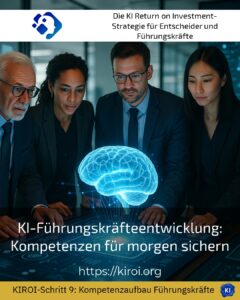
Leadership development is becoming increasingly important in today's companies, as the demands on leadership and collaboration are changing rapidly. Within the scope of AIROI Step 9, it becomes clear that leadership development must be rethought to meet dynamic challenges. This approach offers impulses to effectively support leaders and sustainably strengthen their competencies.
Leadership Development: Modern Challenges and New Perspectives
Leadership development now encompasses far more than traditional seminars or training sessions. Many companies report that theoretical knowledge alone is insufficient to achieve sustainable changes in leadership behaviour. Instead, accompanying measures are supported that promote practical application in everyday working life and specifically initiate personal development processes.
For example, industrial companies are experiencing that employee management in hybrid work environments requires new competencies. Managers are being called upon to successfully manage communication and motivation, even via digital channels. A manufacturing company has therefore devised a programme with a mix of online seminars, mentoring, and practical tasks to specifically support managers in this challenge.
Similarly, customers from the service sector report that the topic of emotional intelligence is becoming increasingly important. Individual coaching supports managers in developing empathetic leadership styles and constructively mastering difficult conflict situations.
A further example illustrates an IT company that implemented a comprehensive leadership development programme, utilising job rotation to provide divisional heads with a broader understanding of various technical and organisational contexts. This experience significantly fostered cross-divisional collaboration.
AIROI Step 9: Understand leadership development as an integral process
AIROI does not see leadership development as a one-off measure, but as a continuous process that is individually tailored to the needs of the leader. Methods such as coaching, mentoring and practical learning play a central role in this. This combination supports reflective self-leadership as well as the implementation of new leadership approaches in everyday work.
BEST PRACTICE with a client (name withheld due to NDA agreement): As part of a multi-stage programme, transruptions-Coaching supported the managers of a medium-sized company with individually tailored coaching sessions, practical tasks and peer-to-peer exchanges. This led to a significant improvement in conflict resolution skills and greater self-confidence when making difficult decisions.
The targeted involvement of leadership in the change process promotes motivation and secures the sustainability of development measures. The support focuses on the so-called mindset change, i.e., the alteration of attitudes and perspectives, and on the implementation of new behavioural patterns in everyday leadership.
Practice-oriented methods for leadership development
Sustainable leadership development utilizes various proven methods that can be flexibly combined:
- Coaching: Individual coaching supports managers in their personal and professional development and encourages reflection on their own leadership skills.
- Mentoring Experienced managers pass on their knowledge and act as sparring partners. Innovation-oriented companies are increasingly relying on reverse mentoring, through which younger employees also support managers in digital topics.
- On-the-Job Learning Developing leadership skills directly within the work process through job rotation, challenging projects, or peer learning combines theory with practice.
- Seminars and Workshops These formats create focus and reflection spaces in which new leadership topics can be explored in depth.
- 360-degree feedback Through systematic feedback from colleagues, employees and superiors, leaders gain valuable perspectives for further development.
BEST PRACTICE at a client (Name redacted due to NDA): A large financial company implemented a leadership programme with regular 360-degree feedback, combined with practical workshops. Participants reported a better understanding of their own impact and improved team communication skills.
BEST PRACTICE with a client (name redacted due to NDA agreement): In a technology-based start-up, mentoring relationships were established to specifically support the young leadership team in developing agile leadership styles. The guidance provided by transruption coaching made a significant contribution to increased team satisfaction and a more agile corporate culture.
Key impulses for sustainable development
For successful leadership development, it is crucial to tailor learning content to the individual's level of maturity and to create a balance of knowledge expansion, self-reflection, and practical application. Leaders need space for an open engagement with their own challenges.
Furthermore, it becomes clear that long-term programmes with continuous support achieve significantly better results than short-term individual measures. The integration of transruption coaching as a supportive measure offers valuable assistance in implementing and consolidating what has been learned.
My analysis
Leadership development needs to be rethought today in order to meet the diverse demands of modern work environments. The focus is increasingly on practical, individual, and sustainable development processes. The combination of coaching, mentoring, on-the-job learning, and feedback creates effective impulses. Transruptions coaching can effectively support leaders on their development path, helping them to fill leadership roles with confidence and reflection. This effectively supports leadership in the sense of collaboration and change.
Further links from the text above:
How to Succeed in Leadership Development – Methods, Concepts, and More
Implementing leadership development in practice – Change Journey and Methods
Methods of Leadership Development: On- and Off-the-Job
Measures and concepts of modern leadership development
For more information and if you have any questions, please contact Contact us or read more blog posts on the topic Artificial intelligence here.







 Deutsch
  English (UK)