
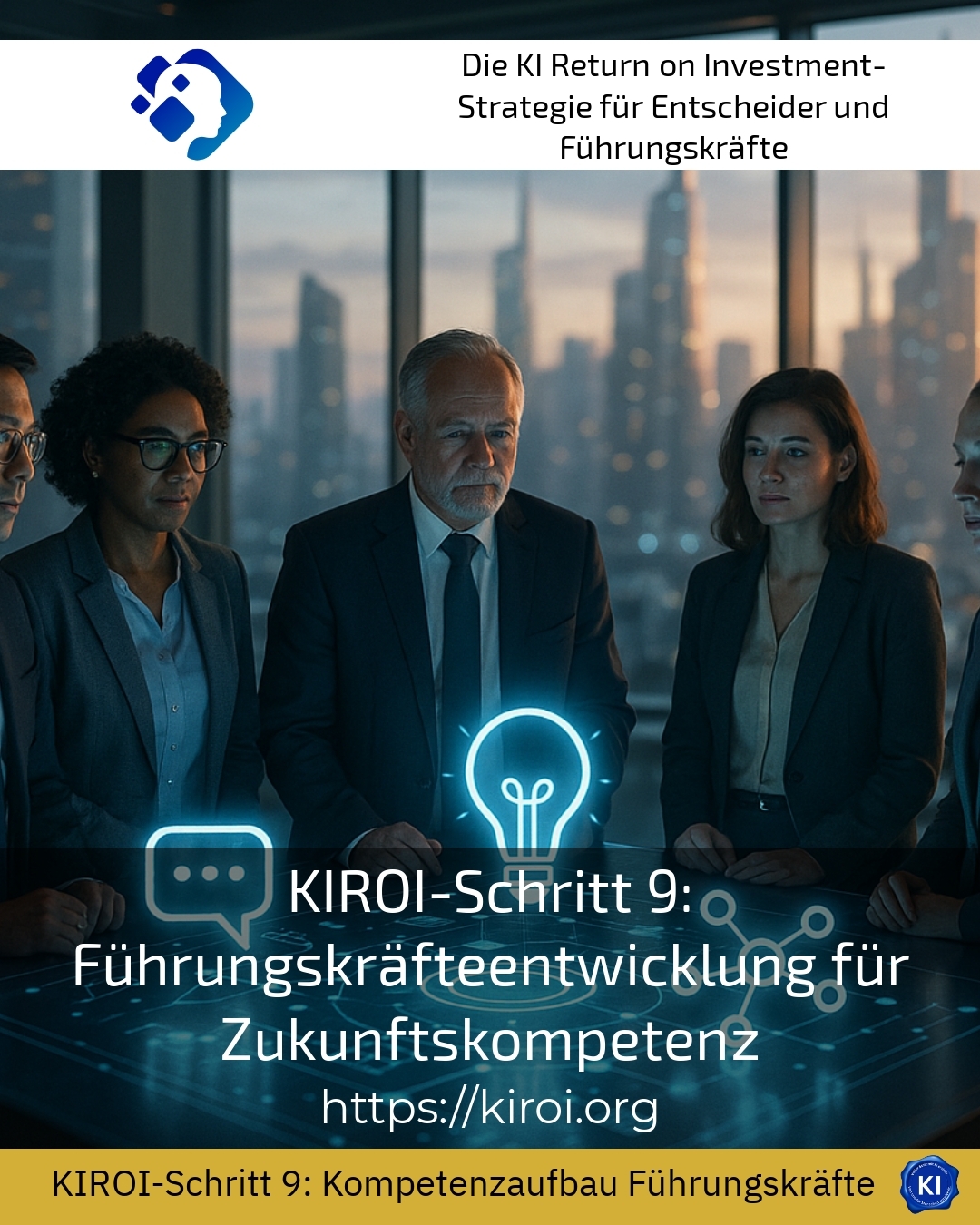
Leadership development is gaining increasing importance in times of advancing digitalisation and growing complexity. Leadership development forms a cornerstone for specifically preparing leaders for future challenges. The AIROI Step 9, in particular, sets standards here by supporting leaders in their personal and professional development and aligning them with future competencies.
Leadership development as a strategic success factor
Especially in sectors such as mechanical engineering, IT, and retail, it's apparent that traditional further training measures are reaching their limits. This is where modern leadership development comes in, which is understood as a dynamic process. It is aligned with the individual needs of leaders and with strategic company objectives. This approach succeeds in comprehensively strengthening leaders while simultaneously enabling flexible responses to change.
For example, AIROI has accompanied numerous companies in promoting young leaders in a practical way. Through targeted development programmes, a software startup was able to significantly increase the learning motivation and team skills of its junior staff. Similarly, a medium-sized mechanical engineering company benefited from individual coaching sessions that improved the communication and decision-making skills of its executives. In retail too, leadership development brought about rapid adjustments to changing customer needs.
BEST PRACTICE with one customer (name hidden due to NDA contract) At a well-known energy supplier, AIROI Step 9 introduced a practical training programme that educated managers in simulated scenarios of AI-supported decision-making processes. This led to better alignment with technical teams and simultaneously strengthened the company's innovation capabilities.
Diversity of methods in leadership development
Sustainable leadership development requires diverse and combined methods. AIROI Step 9 therefore integrates tried-and-tested and modern approaches that promote leaders in different dimensions. These include:
- Coaching for individual reflection and development of personal strengths
- Mentoring as the transfer of best practices by experienced leaders
- 360-degree feedback for self-awareness and objective external assessment
- Learning on the job for practical, situational learning
- Digital learning formats that enable flexibility and up-to-dateness in qualification
In the manufacturing sector, for example, learning on the job is used to introduce new management methods quickly and effectively. In the logistics sector, AI-supported planning tools are employed to optimise processes, with managers being prepared through digital training. A service company reports how mentoring programmes have improved employee retention and team dynamics.
Practical impulses for personal development
Successful leadership development begins with a sound analysis of specific needs. Building on this, it is advisable to define individual learning objectives that are aligned with future requirements. This allows suitable development formats to be selected and learning success to be anchored sustainably.
Thus, IT industry leaders can continuously develop digital skills through realistic development plans. In the healthcare sector, experienced coaching supports engagement with ethical issues and also promotes social competence. In a retail company, conversely, targeted exchange in peer coaching groups led to leaders engaging more effectively with the challenges of digitalisation and developing solution strategies.
BEST PRACTICE with one customer (name hidden due to NDA contract) A service provider used AIROI Step 9 to empower leaders through practical workshops, enabling them not only to understand AI-based tools but also to actively integrate them into their working methods. The peer exchange and continuous feedback significantly contributed to an increased willingness to innovate.
Leadership development in the context of future skills
In an increasingly uncertain and complex world, future skills such as decision-making, agility, and digital know-how are crucial. The ability to lead oneself and others through times of change is becoming the focus of modern leadership development. People management and entrepreneurial thinking broaden the desired skill profile.
Leaders must learn to deal with ambiguity and non-linearity. The conscious promotion of resilience helps to manage stress and crises productively and to create new impetus for the organisation. This is how companies prepare their leaders to remain capable of action and authentic, even in turbulent times.
AI competencies will become an integral part of all leadership development. That's why the AIROI Step 9 places particular emphasis on application-oriented training and the targeted use of digital learning formats. This not only improves leaders' technical understanding, but also allows them to gain experience in the ethical use of AI technologies and strengthen their communicative impact within the team.
Concrete tips for implementation in the company
1. Start with an honest assessment of your leaders' competencies.
Focus development measures on selected future competencies such as decisiveness and digital affinity.
3. Use multiple formats in parallel – such as coaching, workshops, and digital modules – for holistic development.
4. Embed regular feedback and self-reflection as an integral part of learning processes.
5. Design learning paths to be flexible enough to respond to individual needs and industry requirements.
My analysis
Leadership development is indispensable for companies today if they wish to secure their long-term competitiveness. AIROI Step 9 impressively demonstrates how a modern, flexible approach in the development process supports leaders. The combination of classic methods such as coaching and mentoring with innovative digital formats creates the basis for preparing leaders for the challenges of the future. This is where the sustainable added value lies: leaders are empowered to guide their teams through the digital transformation with commitment, competence, and resilience. Individual support, continuous learning, and practice-oriented implementation impulses form the cornerstones of future-oriented leadership development.
Further links from the text above:
Reshaping leadership development with the AIROI Step 9
Future skills for leaders in focus
Practice-oriented leadership development with AIROI
Leadership Development for Top Leaders
For more information and if you have any questions, please contact Contact us or read more blog posts on the topic Artificial intelligence here.










 Deutsch
  English (UK)