
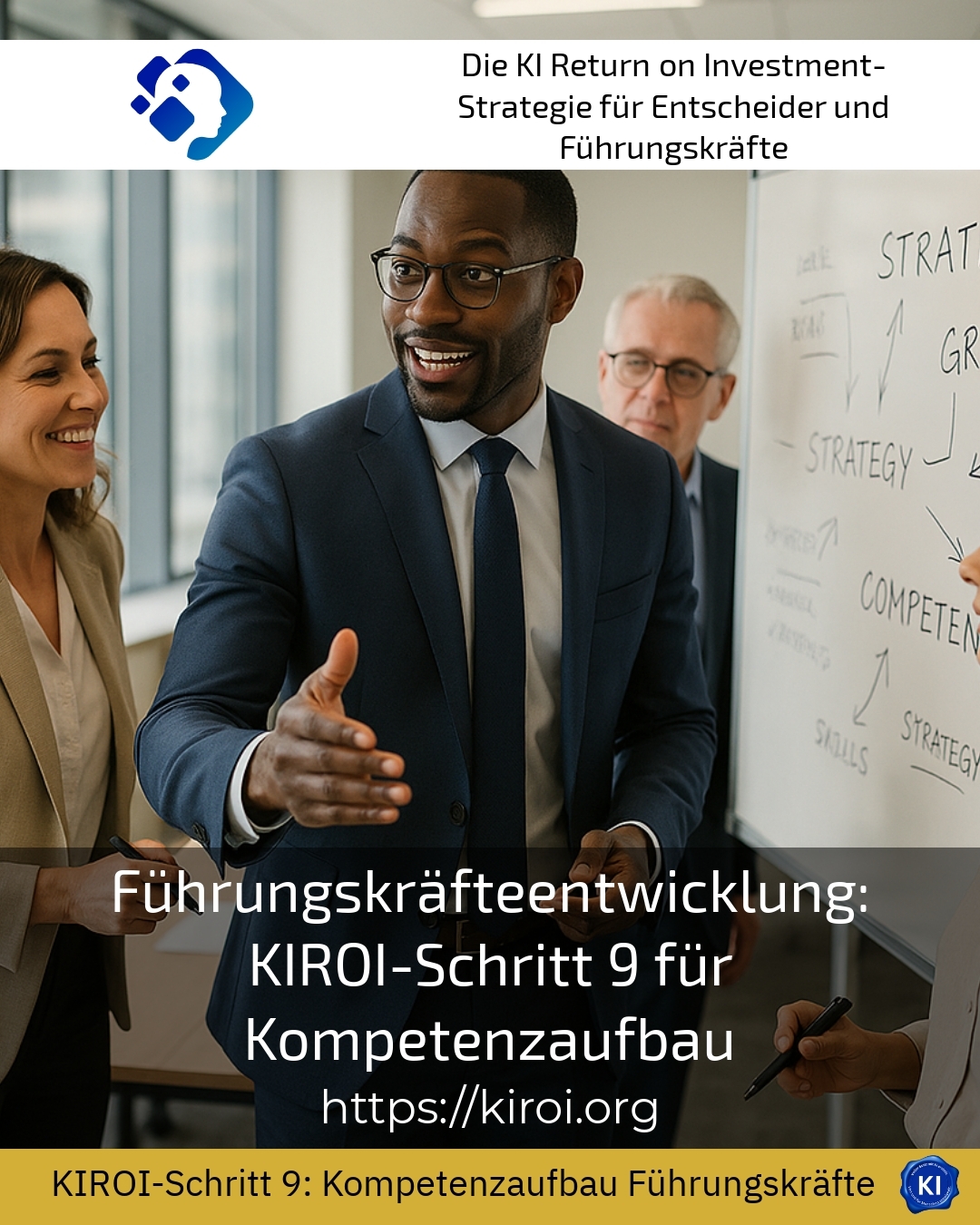
Leadership development is a key component for sustainable success and a future-proof corporate strategy. Here, the ninth step in the KIROI model plays an important role in targeted competence building. Leaders are not only trained in technical skills, but above all learn to further develop their role as transformative leaders and role models and to successfully master complex challenges. Leadership development supports the development and targeted expansion of individual strengths.
Understanding and strategically shaping leadership development
Leadership development encompasses various measures designed to systematically strengthen the competence of leaders. This includes formal training, coaching and mentoring, as well as practical learning experiences in everyday work. KIROI Step 9 focuses precisely on this by supporting and reflecting on the implementation of what has been learned in concrete leadership situations. This allows leaders to continually adapt and further improve their skills to meet the demands of their role.
Practical examples illustrate the impact of this approach: During leadership training at an international technology firm, coaching sessions encouraged executives to directly apply newly learned strategies within their teams and subsequently discuss their impact collectively. Similarly, a medium-sized family business demonstrated that the combination of workshops and follow-up coaching enabled sustainable competency development in agile leadership. The automotive sector provides another example, where job rotation is linked with targeted mentoring to prepare executives for future challenges.
KIROI Step 9: Practical Implementation and Reflection
The ninth step in the KIROI model emphasises the importance of actively transferring learning content into daily leadership practice. Leaders are guided in applying their new competencies to real-life projects and systematically reflecting on the outcomes. This reflection allows for the identification of strengths and areas for development, fostering the further evolution of their personal leadership style.
For example, a wholesale company has implemented a policy where managers write a practical report after each development module and discuss it in coaching sessions. This not only promotes self-awareness but also stimulates inter-collegial exchange. Another example comes from the financial sector, where managers specifically practice leadership competencies in virtual teams after workshops and subsequently discuss their experiences with their coaches. Likewise, a medium-sized company in the healthcare sector found that structured feedback rounds after on-the-job learning make a crucial contribution to sustainable development.
BEST PRACTICE with one customer (name hidden due to NDA contract) A manufacturing company uses a combination of practical workshops and subsequent reflection discussions with coaches for its leadership development. The managers report that the targeted follow-up, in particular, helped them to confidently integrate new methods and react flexibly to changing demands.
Practical tips for supporting competency development
So that managers can successfully use the ninth KIROI step, it is recommended to observe the following practical steps:
- Regular reflections are encouraged: leaders should be guided to systematically document their experiences and discuss them with coaches or mentors.
- Create individual development plans: These plans support targeted learning processes and enable the focused management of competency development.
- Establishing a feedback culture: Honest and constructive feedback from colleagues, employees, and superiors helps to understand and build one's own impact.
- Integrating practical challenges: workplace learning through real projects ensures immediate application of new skills.
- Coaching or mentoring as support: Personal conversations help to overcome obstacles and develop new perspectives.
For example, IT industry executives can gain a better understanding of different teams and manage complex projects more effectively through job rotation. In retail, leaders benefit from specifically guiding their employees through change processes and applying newly developed communication strategies. In the service sector, a clear feedback culture additionally motivates further development and promotes cohesion.
Leadership development as a continuous process
Leadership development does not end with a single measure, but is an ongoing process, where the KIROI Step 9 forms the link between theory and practice. The effective integration of learning and the sustainable development of leadership skills are supported by close mentoring. This enables leaders to react flexibly to new demands and to successfully lead their teams.
For example, a modern leadership development programme at a large energy supplier combines targeted coaching with practice-oriented transfer tasks. The managers report that this combination not only gives them confidence in applying new methods but also strengthens their personal responsibility for further development. In the automotive industry, too, it is evident that systematic support from experienced coaches significantly accelerates competence building. Another example is a software company that combines targeted workshops with digital learning modules to promote managers in a flexible way.
My analysis
Leadership development requires a systematic and practical approach to build competencies sustainably. KIROI Step 9 is of great importance in this regard because it promotes the transfer and reflection of newly acquired skills. The connection between learning and real-world application in daily professional life strengthens the capabilities of leaders and supports them in fulfilling their role responsibly and effectively. Companies benefit not only from more effective leadership teams but also from a constructive and future-oriented corporate culture.
Further links from the text above:
How to succeed in leadership development – Methods
Coaching methods for everyday leadership
Leadership Development: Comprehensive Guide
Leadership Development: Key Methods and Recommendations
Leadership Development: Trends and Measures
For more information and if you have any questions, please contact Contact us or read more blog posts on the topic Artificial intelligence here.











 Deutsch
  English (UK)