
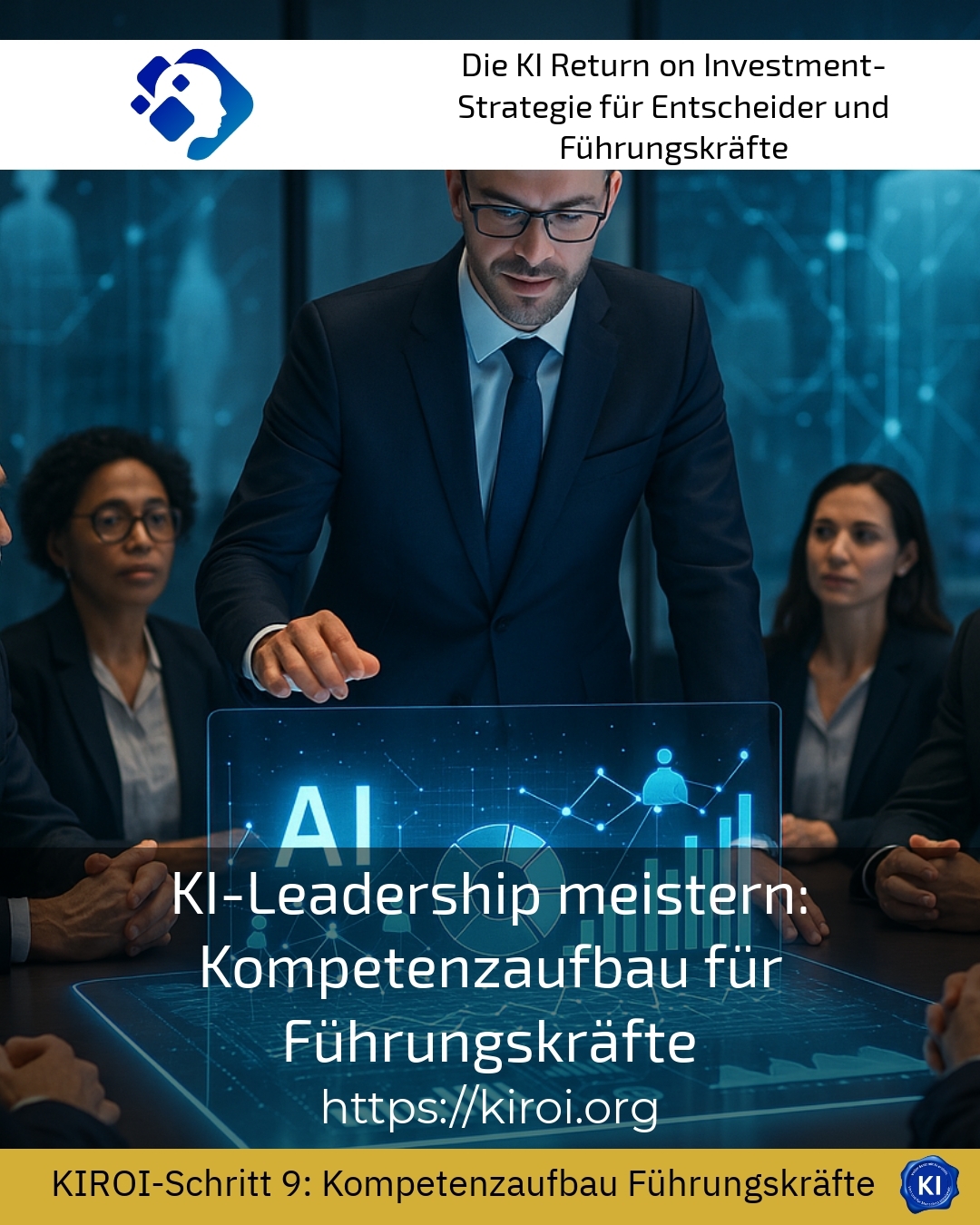
Imagine walking into your office tomorrow and noticing that half of your strategic decisions are being prepared by intelligent systems. This reality has already become the daily norm for many leaders. Mastering AI leadership: competency building for leaders today means more than just technical understanding. It requires a fundamental reorientation of one's own understanding of leadership. Many decision-makers come for coaching with this exact challenge. They feel the pressure of transformation. At the same time, they lack a compass for the right path.
The new role of the manager in the age of intelligent systems
The demands on modern leaders have fundamentally changed. Previously, mastering operational excellence and team leadership was sufficient. Today, leaders must also understand how algorithmic systems can support decision-making processes. They need to be able to assess which tasks are suitable for machine support. Furthermore, they require the ability to guide their teams through these changes. Clients often report feeling overwhelmed by these diverse demands.
For example, a production manager in the automotive industry faced the challenge of introducing predictive maintenance systems. His staff showed resistance to the new technologies. He himself only had a superficial understanding of the technical fundamentals. Through guidance from transruptional coaching, he gradually developed a deeper understanding, enabling him to authentically lead his teams through the change. Another example comes from the financial sector. There, a divisional manager struggled to implement automated credit decision systems. She had to simultaneously meet regulatory requirements and take her employees' ethical concerns seriously. In the retail sector, managers experience daily how algorithms influence assortment decisions and pricing.
Mastering AI Leadership through Strategic Foresight
Strategic competence today means recognising and correctly assessing technology trends early on. Leaders must be able to distinguish between short-term fads and sustainable developments. They need an intuition for which investments will pay off in the long term. The pharmaceutical company Johnson & Johnson is already extensively using intelligent systems in drug development [1]. This development is changing the demands placed on leaders across the entire industry. In the energy sector, companies such as Siemens Energy are relying on intelligent grid control [2]. Leaders there must understand how such systems work and what strategic implications they have.
The logistics sector offers another clear example of this development. DHL is investing heavily in automated warehouse systems and route optimisation [3]. Managers in this sector face the challenge of combining traditional logistics expertise with technological understanding. They must take their employees on a journey. The goal of this journey is a highly automated world of work. At the same time, they must not neglect the human factor. Because ultimately, people remain the decisive element in complex situations.
Best practice with a AIROI customer
A medium-sized mechanical engineering company faced the challenge of preparing its management level for the integration of intelligent systems. The executive board recognised early on that technological investments alone would not suffice. Instead, the second and third-tier managers required comprehensive skills development. transruptions-coaching supported the company over a period of eight months. During this time, we jointly developed a tailored development programme for twelve managers. Initially, the participants learned the basic functionalities of intelligent systems. Subsequently, they worked out concrete application cases for their respective areas. A particular focus was placed on the ability to address employee fears constructively and transform them into productive energy. The managers practised conducting difficult conversations about automation through role-play. They developed communication strategies for their teams. By the end of the programme, all participants felt significantly more confident in dealing with the subject matter. The implementation of a new quality control system subsequently proceeded much more smoothly than previous technology projects.
Emotional Intelligence as a Key Competence in Leadership Skill Building
Paradoxically, emotional intelligence is gaining importance precisely in the age of machines. The more routine tasks are automated, the more important genuinely human skills become. Leaders must show empathy and communicate authentically. They must build trust in times of uncertainty. The insurance industry is experiencing this development particularly intensely. Claims are increasingly being processed automatically. At the same time, the need for human advice in complex situations is rising. Leaders at companies like Allianz or Zurich have to renegotiate this balance daily.
A similar dynamic can be observed in the healthcare sector. Hospitals are increasingly relying on diagnostic support systems. The Charité in Berlin is experimenting with various applications in medical imaging [4]. Chief physicians and heads of nursing are faced with the task of combining technology and humanity. They must convince their teams that machines are tools, not competitors. This requires a high level of communication skills. It also demands the capacity for self-reflection. Because only those who are aware of their own fears and reservations can credibly engage with others.
Ethical Leadership and Responsible Technology Use
Modern leaders bear responsibility for the ethical use of new technologies. They must be able to answer questions for which there are no easy answers. What decisions can be automated? Where are human controls indispensable? How do we deal with algorithmic bias? These questions are particularly pressing in human resources. Application processes are increasingly supported by automated systems. Companies such as Unilever have already widely introduced such systems [5]. Leaders in HR departments must understand how these systems work. They must ensure that no discriminatory patterns are reproduced.
The media industry offers further examples of ethical challenges. Newsrooms are using automated systems for news selection and text generation. Springer-Verlag is actively experimenting with various applications [6]. Editors-in-chief must balance efficiency with journalistic responsibility. They need to guide their newsrooms through a profound transformation. This requires both ethical clarity and communication skills. In the banking sector, meanwhile, the focus is on issues of financial inclusion. Algorithms decide on lending and insurance terms. Managers are responsible for ensuring these decisions are fair and transparent.
Best practice with a AIROI customer
A financial services provider approached us with a complex challenge in credit decision-making. The company had implemented an automated assessment system that pre-screened loan applications and made recommendations. However, the credit department managers felt uncertain about how to handle the system's recommendations. They weren't sure when to follow the recommendations and when to apply their own judgment. As part of the transruption coaching, we jointly developed a decision framework for such situations. Managers learned to assess the strengths and weaknesses of the automated system. They developed criteria for cases requiring in-depth human review. Of particular importance was the work on their own attitudes towards technological aids. Many participants had unconscious reservations that were hindering their work. These reservations were addressed through targeted reflection exercises. The result was significantly improved collaboration between humans and the system. Credit decisions became both faster and of higher quality. Employee satisfaction in the department increased measurably.
Practical steps to mastering AI leadership in everyday work
Building competence for leaders requires a systematic approach. First, it is important to honestly assess one's own knowledge. Many leaders overestimate their technological understanding. Others underestimate the importance of their existing leadership skills. A realistic assessment forms the basis for targeted development. In the next step, an intensive engagement with specific use cases from one's own industry is recommended. The telecommunications industry offers rich illustrative material here. Deutsche Telekom uses intelligent systems in a variety of areas [7]. The applications range from customer service and network optimisation to fraud detection.
The retail sector particularly clearly shows how technology is changing business. Amazon has set standards with its logistics and recommendation technology. However, traditional retailers such as REWE and Zalando are also investing heavily in intelligent systems. Retail executives must understand how personalised recommendations work. They need to grasp the dynamics of automated price adjustments. The construction industry, on the other hand, is still at the beginning of this development, with great potential lying dormant. Executives who engage with the topic early on can achieve competitive advantages. Transruption coaching supports executives from all these sectors with their individual projects.
Team Leadership in Hybrid Working Environments
Collaboration between humans and intelligent systems requires new leadership approaches. Teams must learn to understand machine support as an enrichment. At the same time, they need clear boundaries and responsibilities. Leaders play a crucial role in shaping these hybrid working environments. We are experiencing this development particularly intensely in the automotive industry. BMW, Mercedes, and Volkswagen are fundamentally transforming their production processes [8]. Leaders in the plants must coordinate humans and robots equally. This requires completely new competencies and approaches.
The creative industry shows a different facet of this development. Advertising agencies use generative systems for idea generation and concept development. Leaders must rethink the creative process. They must decide where machine support is valuable and where human creativity remains indispensable. Intelligent systems are also gaining importance in the legal field. Law firms use them for document analysis and legal research. Partners and leaders must understand how these tools are changing legal work. They must prepare their associates for this and simultaneously ensure the quality of the work.
My AIROI Analysis
Accompanying leaders in their skill development for the new technological era shows me daily how diverse the challenges are. Mastering AI leadership is not a one-off project, but a continuous development process. The most successful leaders are characterised by a combination of curiosity and humility. They are willing to learn new things without forgetting their existing strengths. They understand that technology is a tool that complements human leadership but does not replace it. The ability for self-reflection seems particularly important to me. Leaders must be aware of their own fears and reservations. Only then can they act authentically and credibly lead their teams through change.
Industry examples show that no sector is exempt from this development. From manufacturing and the service sector to creative industries, technology is fundamentally changing the world of work. Leaders who face this reality and actively work on their development become shapers of change. Those who wait and hope become driven. Transruption coaching supports leaders in taking the first path. The coaching provides impetus for personal and professional development. It creates space for reflection and exchange. Clients often report that this support gives them security in uncertain times. Investing in one's own skill development is an investment in the future viability of the entire company.
Further links from the text above:
[1] Johnson & Johnson KI in Drug Development
[2] Siemens Energy Digitalisation
[4] Digital Health
[5] Unilever digital recruitment
[7] Deutsche Telekom Artificial Intelligence
For more information and if you have any questions, please contact Contact us or read more blog posts on the topic Artificial intelligence here.








 Deutsch
  English (UK)