
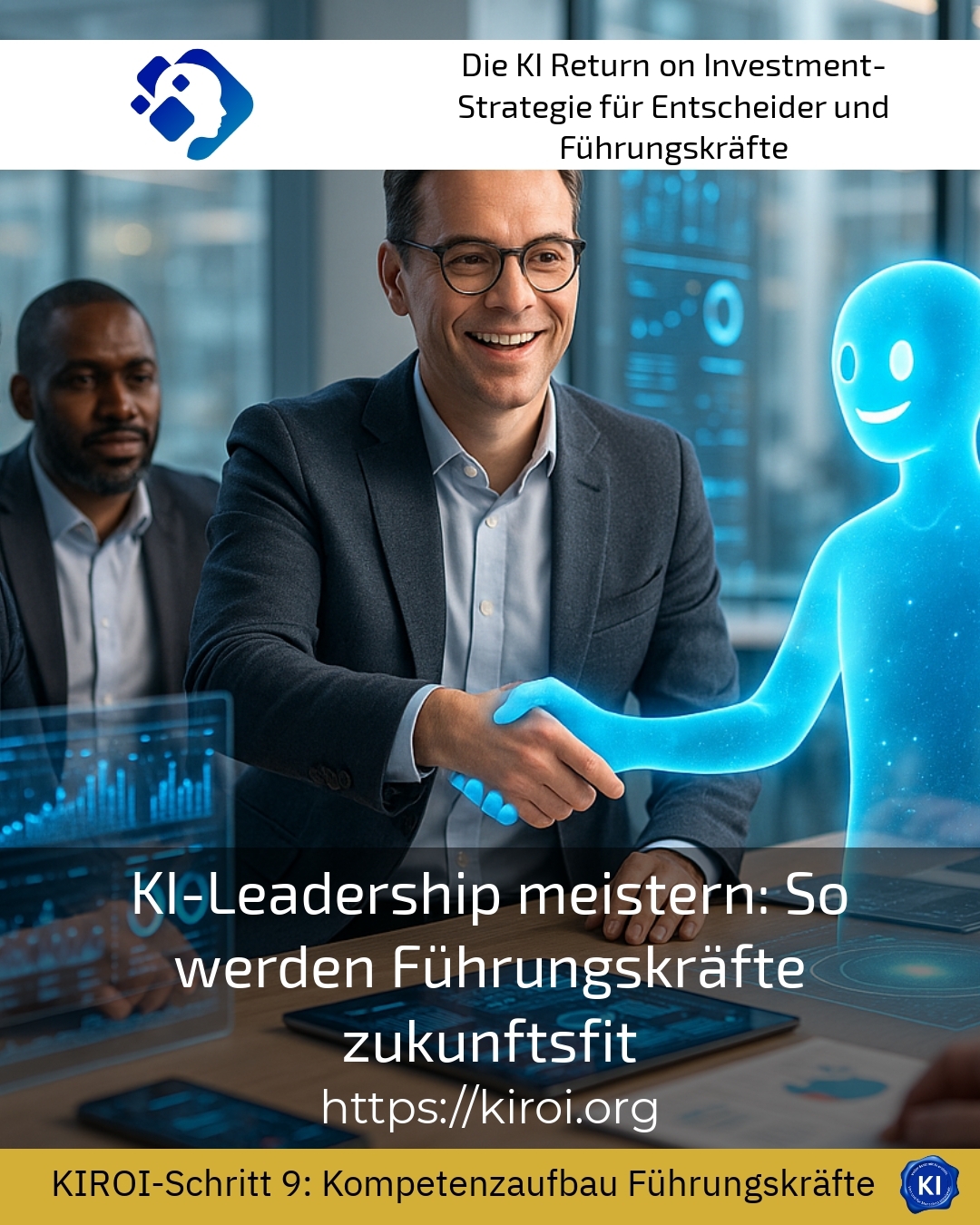
The world of work is changing rapidly. Algorithms are making decisions. Machines are learning independently. Leaders are facing completely new challenges. Those who don't act now will be left behind. Mastering AI Leadership means more than technical understanding. It requires a fundamental transformation of leadership culture. Many managers are asking themselves how to navigate their teams through these upheavals. The answer lies in a combination of human competence and technological foresight. This article shows concrete ways forward.
Why traditional leadership concepts are no longer sufficient
The classic notion of leadership is based on hierarchy and control. Superiors gave instructions. Employees executed them. This model no longer works in an algorithmically defined world. Intelligent systems are taking over routine tasks in human resources departments. They analyse applications and create initial assessments. Controlling departments use automated forecasting models for their financial planning. Marketing teams rely on data-driven campaign optimisation in real-time.
A medium-sized engineering company recently introduced an intelligent maintenance system. Suddenly, the machines knew more than the service technicians. The manager had to completely redefine their role, shifting from an order-giver to a facilitator between humans and technology. This change is currently being experienced across many industries simultaneously.
Banks use algorithmic systems for lending decisions. Insurance companies calculate risk profiles with learning models. Logistics companies optimise their routes using intelligent planning software. In all these cases, the task of management changes fundamentally. Human competence shifts from execution to interpretation and ethical evaluation.
Mastering AI leadership through new competencies
Future-proof leaders require an expanded competency profile. A basic technical understanding only forms the foundation. Social and strategic skills are much more important. The art lies in optimally connecting people and machines. Clients often report feeling overwhelmed during this transformation process. They feel caught between worlds.
A sales manager in the pharmaceutical industry faced exactly this problem. His team used an intelligent CRM system with a recommendation function. The software suggested optimal appointment times with doctors. It prioritised contacts based on the probability of success. However, the experienced sales representatives resisted the suggestions. They felt their expertise was not being recognised. The sales manager had to learn to integrate both sides.
Similar situations are found in healthcare. Senior physicians work together with diagnostic support systems. These analyse imaging material faster than any radiologist. Nevertheless, the final decision still rests with the human. Managers must design this interface professionally. They define responsibilities and build trust in hybrid processes.
Best practice with a KIROI customer
An internationally operating retail company faced a particular challenge in its management structure. Management had decided to introduce intelligent analysis systems in all branches. These systems were intended to generate sales forecasts and optimise staffing. Initially, the branch managers reacted with considerable scepticism to this change. They feared a loss of their decision-making autonomy in day-to-day operations. Through support within the framework of the KIROI approach, we jointly developed a new understanding of leadership. The branch managers learned to interpret system suggestions as impulses rather than commands. They received training on critically evaluating algorithmic recommendations. Work on their communication skills with their teams was particularly important. After six months, remarkable results became apparent in practice. Acceptance of the technology increased significantly at all locations. At the same time, human leadership competence was maintained and even strengthened. Fluctuations in middle management noticeably decreased compared to previous years. This project illustrates the value of systematic support in such transformation processes.
The emotional dimension of technological transformation
Change processes trigger fears. This is particularly true for technological upheavals of this magnitude. Employees fear for their jobs. Managers worry about their relevance. These emotional aspects are often underestimated. Yet, they significantly determine the success of any transformation.
In the automotive industry, we are experiencing this dynamic particularly intensely. Engineers who have developed combustion engines for decades now have to rethink their approach. Production managers are suddenly overseeing highly automated production lines. The personal identity of many specialists is tied to their previous expertise. If algorithms seemingly replace this knowledge, profound uncertainties arise.
A production director at a supplier reported sleepless nights. He wondered what value his thirty years of experience still held. In the coaching process, he realised an important truth. His experience enabled him to recognise the limitations of systems. He could assess critical situations that no algorithm had foreseen. This insight gave him new confidence in his leadership role.
We are observing similar developments in retail. Shoppers are working with algorithmic trend predictions. The systems analyse social media data and search queries in real time. They often identify emerging trends earlier than experienced industry experts. However, the final assortment decision still requires human judgment. Algorithms only capture cultural nuances and local specificities inadequately.
Mastering AI Leadership Through Ethical Competence
Intelligent systems make decisions with far-reaching consequences. They recommend dismissals or promotions. They control resource allocation and budget allocation. The ethical responsibility for these decisions remains with humans. Leaders must learn to critically question algorithmic proposals.
A HR manager within the telecommunications sector was facing a dilemma. The analysis system recommended the dismissal of a long-serving employee. Her performance indicators were below average. However, the HR manager knew more than the system did. The employee informally supported new colleagues. She was the social glue in her department. These aspects the algorithm could not capture.
Such situations require ethical judgement. They demand a deep understanding of the limitations of data-driven decisions. Leaders must supplement systems, not blindly follow them. This competence can be developed and trained. TransRuptions Coaching supports leaders with precisely these challenges.
Practical strategies for everyday leadership
Theoretical insight alone is not enough. Leaders need concrete options for action in their daily work. A variety of approaches have proven particularly effective. They can be applied across industries and adapted individually.
Firstly, leaders should schedule regular reflection times. Technological changes require continuous learning and adaptation. A weekly slot for personal development supports this process. This isn't just about technical training. Reflecting on one's own leadership role is at least as important.
In the media industry, editors-in-chief successfully establish such routines. They analyse weekly how algorithmic systems have influenced their decisions. They ask themselves which content the automated recommendation systems have favoured. And they check whether this selection meets their journalistic quality standards.
Secondly, the structure of heterogeneous teams proves itself. Technical experts and domain specialists complement each other optimally. Some understand how the systems work. The others bring industry knowledge and customer understanding. Managers moderate the exchange between both groups.
An energy provider implemented this principle when introducing a smart grid system. Engineers worked closely with customer advisors. Data scientists regularly liaised with network technicians. The leadership team created spaces for this interdisciplinary dialogue.
Best practice with a KIROI customer
A large insurance company wanted to speed up its claims processing using intelligent systems. The algorithms were intended to automatically categorise claims and suggest processing routes. The team leaders in claims processing felt overwhelmed by this development. They were concerned they would merely become agents of the technology. As part of the KIROI support, we developed a new understanding of the role for this management level. The team leaders were trained to become quality guardians of the automated process. They received skills to review algorithmic decisions in complex cases. Their new function as an escalation point for contentious situations was particularly important. They learned to systematically provide feedback to the development department. As a result, the algorithms continuously improved through human expertise. Customer satisfaction increased measurably after the introduction of this hybrid model. Processing times were reduced while simultaneously achieving higher quality decisions. This example shows how human leadership and technological support can mutually reinforce each other.
Mastering the Significance of a Continuous Learning Culture for AI Leadership
Technology is developing exponentially. What is state of the art today can be outdated tomorrow. Leaders must therefore embody and promote a culture of learning. They create environments where experimentation is encouraged. Mistakes are understood as learning opportunities rather than failures.
In the food industry, a group introduced so-called Innovation Labs. There, teams tested new technological applications in a protected environment. Leaders themselves participated in these experiments. They thereby showed that learning is not a weakness but a strength.
Similar approaches can be found in the education sector. School principals use learning systems for lesson planning. Universities employ algorithmic systems for academic advising. The leaders of these institutions must combine both pedagogical and technological competence.
The construction industry provides another example. BIM systems [1] are revolutionising project planning and management. Site managers work with digital twins of their projects. They need to understand how these models work and what their limitations are. At the same time, responsibility for safety and quality remains with them.
The role of coaching in leadership transformation
Processes of change of this magnitude are rarely successful on their own. Professional support assists leaders in reorientation. TransRuptions Coaching offers a structured framework for this development. It combines personal reflection with strategic planning.
Clients come to this support with a variety of concerns. Some feel overwhelmed by the pace of change. Others are looking for their place in an increasingly automated organisation. Still others want to shape things proactively rather than just react.
A managing director from the printing industry was seeking support for a fundamental realignment. His industry was experiencing dramatic changes due to digitalisation. He knew that intelligent production systems were inevitable. However, he was unsure how to bring his workforce along with him. In coaching, he developed a communication strategy for the change. He learned to address fears and demonstrate future prospects.
Projects involving technological transformation require specific expertise. This combines an understanding of organisational dynamics with knowledge of technological possibilities. Input from external perspectives helps to identify blind spots.
My KIROI Analysis
The transformation into a future-proof leader is not a one-off project but a continuous process. It requires courage, openness, and a commitment to lifelong learning. The examples described from various industries show that this development is possible and rewarding. Leaders who embrace this challenge gain relevance and effectiveness.
My analysis of current developments reveals several key insights. Firstly, the ability to critically evaluate algorithmic recommendations is becoming a core competency. Leaders need to understand when to trust systems and when not to. Secondly, emotional intelligence is gaining importance in technologically driven environments. The more routine is automated, the more crucial genuinely human qualities become.
Thirdly, I observe a shift in the leadership task from control to enablement. Successful leaders create frameworks in which people and systems interact optimally. They define ethical guardrails and moderate conflicts between technological possibilities and human values. Fourthly, it is apparent that industry boundaries are blurring with these challenges. The fundamental questions are similar everywhere, even if the specific applications vary.
For the coming years, I expect these developments to accelerate further. Leaders who invest in their transformation now will reap significant benefits. They will be able to navigate their organisations safely through turbulent times. They will be valued as trusted guides in a complex world. Investing in appropriate support and development will therefore pay off many times over.
Further links from the text above:
[1] Building Information Modeling – Was ist BIM?
For more information and if you have any questions, please contact Contact us or read more blog posts on the topic Artificial intelligence here.











 Deutsch
  English (UK)