
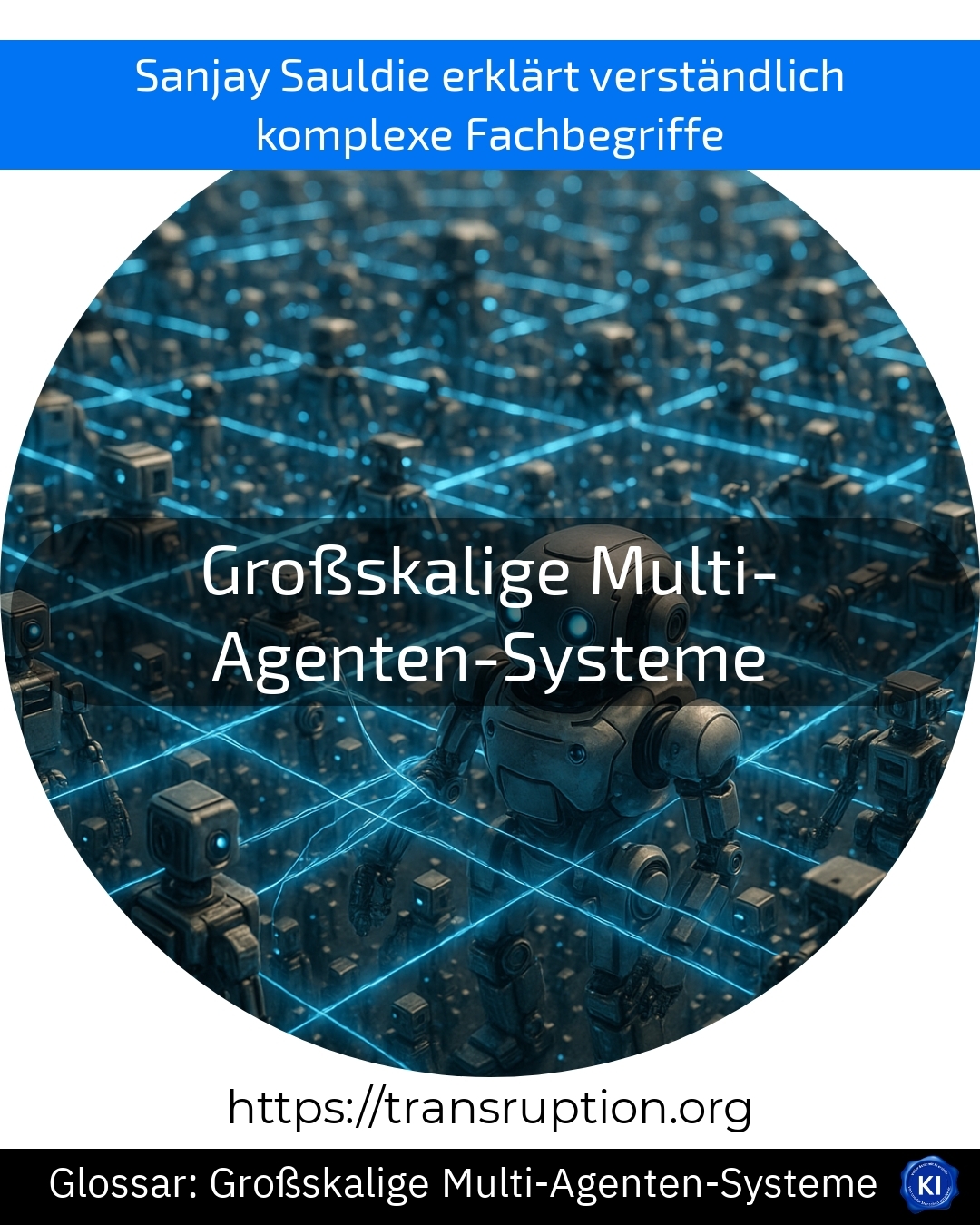
Large-scale multi-agent systems are primarily found in the fields of artificial intelligence, automation, and Industry 4.0. The term describes complex computer systems in which many digital „agents“ independently interact and communicate with each other. These virtual agents can be programs, robots, or sensors that collectively solve tasks that would be far too complex for individual computers.
A typical example: in a modern factory, hundreds of robots work together to build cars. Each robot is an agent that receives information, performs tasks, and communicates with other robots. The entire system flexibly adapts to changes, for instance, when new models are built or disruptions occur.
Large-scale multi-agent systems make processes in industry more efficient and enable rapid responses to new challenges. They are particularly useful when many sub-tasks need to be coordinated and completed simultaneously. This makes production chains smarter, more flexible, and often more cost-effective.
This technology is an important step towards the „intelligent factory“ and plays a key role in the digitalisation and automation of modern companies.











 Deutsch
  English (UK)