kiroi.org

KIROI - Artificial Intelligence Return on Invest
The AI strategy for decision-makers and managers

Business excellence for decision-makers & managers by and with Sanjay Sauldie

KIROI - Artificial Intelligence Return on Invest: The AI strategy for decision-makers and managers

KIROI - Artificial Intelligence Return on Invest: The AI strategy for decision-makers and managers

Start » Mastering knowledge exchange: KIROI Step 1 for decision-makers
24 August 2025

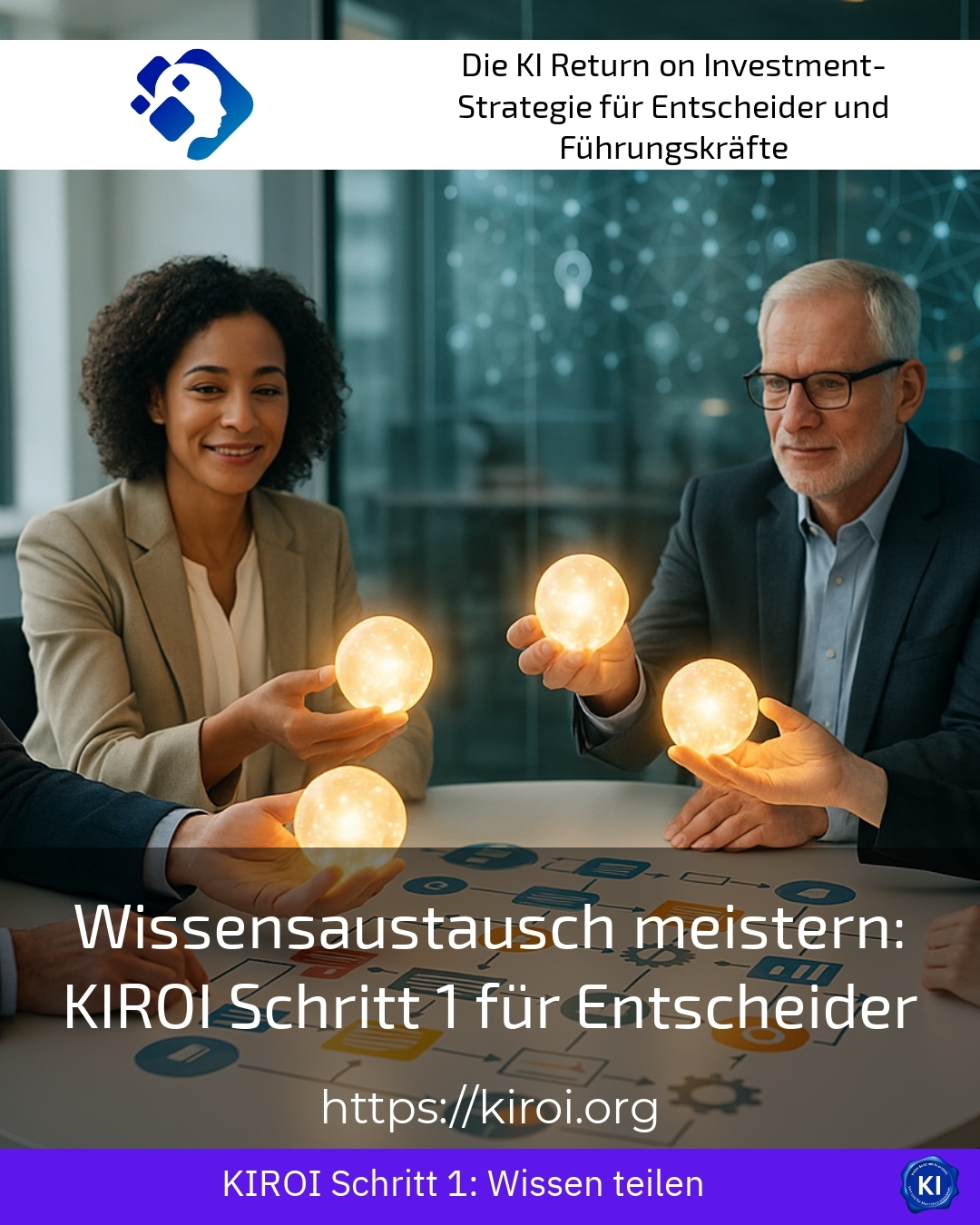
Mastering knowledge exchange: KIROI Step 1 for decision-makers

4.8
(1181)

Knowledge exchange as the foundation for business success

Knowledge exchange today accompanies many leaders and teams across various industries. It is not simply understood as the transfer of information, but as a dynamic process that significantly shapes culture, communication, and collaboration. Especially in complex business environments, it becomes clear that appropriate structures and methods not only make knowledge available but also create motivation. Therefore, the focus is often on how to design knowledge exchange so that it enriches daily life while being flexible and sustainable.

The role of support in the first step

Accompanying you on the path to successful knowledge exchange by no means means dictating ready-made solutions. Instead, impetus is provided and support is offered to develop suitable approaches specific to the organisation. This support helps decision-makers recognise ingrained patterns and gain new perspectives. Through methodological diversity, from mentoring to webinars to hybrid learning formats, a dynamic learning culture is created that brings knowledge exchange to life in everyday life.

The focus here is on enabling teams to experiment independently and discover formats for exchange that are suitable for their specific context. This way, knowledge sharing is not a one-off project but a continuous development process.

Industry examples of effective knowledge sharing

In the tech industry, leaders often report difficulties in effectively connecting expertise and improving internal transfer. Traditional meetings are often insufficient, so digital platforms and informal gatherings help as supplementary formats to promote exchange. This leads to the formation of certified specialist groups and expert circles that regularly discuss new developments.

KIROI Best Practice at Company XYZ (Name changed due to NDA agreement) In a technical company, coaching created a framework in which employees could systematically share their specialised knowledge. Various formats, from informal meetings to digital exchange platforms, were introduced. This not only improved networking but also collegial support in complex projects.

In the service sector too, hybrid learning formats, a mix of in-person events and online workshops, are creating a diverse range of options that teams can utilise flexibly. This increases employee motivation and facilitates the transfer of knowledge across different locations.

In manufacturing companies, the challenge of how employees can easily access expert knowledge is frequently mentioned. This is where the benefits of specially designed knowledge maps and expert networks become apparent, enabling employees to find the right contact person quickly and efficiently, and to immediately reflect knowledge on practical challenges.

KIROI Best Practice at Company ABC (name changed due to NDA) In the manufacturing sector, a simple digital platform was established through guidance, enabling employees direct access to experts and documentation. This systematically secures and simultaneously integrates expertise into daily work.

In summary, many decision-makers see understanding knowledge sharing as a cultural and communicative process, and designing the appropriate framework conditions, as an essential step. The combination of suitable methods, technical support, and an open learning attitude forms the basis for successful implementation.

Knowledge exchange as a continuous process with support

Knowledge sharing is particularly successful when decision-makers and teams receive support that does not overwhelm them, but rather assists them and provides impetus for further development. It is not about quick solutions or rigid concepts, but about finding individual and sustainable paths. Managers often report how helpful it is to try out methods and be given the space to learn.

This approach fosters a genuine learning culture where employees feel safe to share knowledge and think in new ways – a crucial prerequisite for being able to react flexibly, especially in a dynamic market environment.

KIROI Best Practice at DEF (Name changed due to NDA agreement) A service company used KIROI coaching to foster a culture of open exchange. Through targeted guidance and suitable formats, an atmosphere was created where employees regularly learn from each other and support each other with project tasks. In this way, knowledge sharing was organically integrated into everyday life and showed sustainable positive effects.

My analysis

In summary, knowledge sharing is far more than a technical topic. Instead, it is a cultural and communicative process that requires targeted support and room for development. Decision-makers benefit from support that guides processes, provides impetus, and promotes individual solutions. This creates a sustainable approach to knowledge that helps organisations across various sectors to work flexibly and successfully.

Further links from the text above:

KIROI Step 1: Knowledge exchange as a success factor for leaders

[3] Rethinking knowledge sharing: Step 1 to success with KIROI

For more information and if you have any questions, please contact Contact us on or read further blog posts on the topic Artificial Intelligence Blog here.
How useful was this post?

Click on a star to rate it!

Average rating 4.8 / 5. Vote count: 1181

No votes so far! Be the first to rate this post.

Spread the love

transruption.org

The digital toolbox for
the digital winners of today and tomorrow

Business excellence for decision-makers & managers by and with Sanjay Sauldie

transruption
transruption

transruption: The digital toolbox for
the digital winners of today and tomorrow

Start » Mastering knowledge exchange: KIROI Step 1 for decision-makers
24 August 2025

Mastering knowledge exchange: KIROI Step 1 for decision-makers

4.8
(1181)

Knowledge exchange as the foundation for business success

Knowledge exchange today accompanies many leaders and teams across various industries. It is not simply understood as the transfer of information, but as a dynamic process that significantly shapes culture, communication, and collaboration. Especially in complex business environments, it becomes clear that appropriate structures and methods not only make knowledge available but also create motivation. Therefore, the focus is often on how to design knowledge exchange so that it enriches daily life while being flexible and sustainable.

The role of support in the first step

Accompanying you on the path to successful knowledge exchange by no means means dictating ready-made solutions. Instead, impetus is provided and support is offered to develop suitable approaches specific to the organisation. This support helps decision-makers recognise ingrained patterns and gain new perspectives. Through methodological diversity, from mentoring to webinars to hybrid learning formats, a dynamic learning culture is created that brings knowledge exchange to life in everyday life.

The focus here is on enabling teams to experiment independently and discover formats for exchange that are suitable for their specific context. This way, knowledge sharing is not a one-off project but a continuous development process.

Industry examples of effective knowledge sharing

In the tech industry, leaders often report difficulties in effectively connecting expertise and improving internal transfer. Traditional meetings are often insufficient, so digital platforms and informal gatherings help as supplementary formats to promote exchange. This leads to the formation of certified specialist groups and expert circles that regularly discuss new developments.

KIROI Best Practice at Company XYZ (Name changed due to NDA agreement) In a technical company, coaching created a framework in which employees could systematically share their specialised knowledge. Various formats, from informal meetings to digital exchange platforms, were introduced. This not only improved networking but also collegial support in complex projects.

In the service sector too, hybrid learning formats, a mix of in-person events and online workshops, are creating a diverse range of options that teams can utilise flexibly. This increases employee motivation and facilitates the transfer of knowledge across different locations.

In manufacturing companies, the challenge of how employees can easily access expert knowledge is frequently mentioned. This is where the benefits of specially designed knowledge maps and expert networks become apparent, enabling employees to find the right contact person quickly and efficiently, and to immediately reflect knowledge on practical challenges.

KIROI Best Practice at Company ABC (name changed due to NDA) In the manufacturing sector, a simple digital platform was established through guidance, enabling employees direct access to experts and documentation. This systematically secures and simultaneously integrates expertise into daily work.

In summary, many decision-makers see understanding knowledge sharing as a cultural and communicative process, and designing the appropriate framework conditions, as an essential step. The combination of suitable methods, technical support, and an open learning attitude forms the basis for successful implementation.

Knowledge exchange as a continuous process with support

Knowledge sharing is particularly successful when decision-makers and teams receive support that does not overwhelm them, but rather assists them and provides impetus for further development. It is not about quick solutions or rigid concepts, but about finding individual and sustainable paths. Managers often report how helpful it is to try out methods and be given the space to learn.

This approach fosters a genuine learning culture where employees feel safe to share knowledge and think in new ways – a crucial prerequisite for being able to react flexibly, especially in a dynamic market environment.

KIROI Best Practice at DEF (Name changed due to NDA agreement) A service company used KIROI coaching to foster a culture of open exchange. Through targeted guidance and suitable formats, an atmosphere was created where employees regularly learn from each other and support each other with project tasks. In this way, knowledge sharing was organically integrated into everyday life and showed sustainable positive effects.

My analysis

In summary, knowledge sharing is far more than a technical topic. Instead, it is a cultural and communicative process that requires targeted support and room for development. Decision-makers benefit from support that guides processes, provides impetus, and promotes individual solutions. This creates a sustainable approach to knowledge that helps organisations across various sectors to work flexibly and successfully.

Further links from the text above:

KIROI Step 1: Knowledge exchange as a success factor for leaders

[3] Rethinking knowledge sharing: Step 1 to success with KIROI

For more information and if you have any questions, please contact Contact us on or read further blog posts on the topic Artificial Intelligence Blog here.
How useful was this post?

Click on a star to rate it!

Average rating 4.8 / 5. Vote count: 1181

No votes so far! Be the first to rate this post.

Spread the love

Other content worth reading:

Mastering knowledge exchange: KIROI Step 1 for decision-makers

written by:

Keywords:

#Learning culture #Mitarbeitermotivation #Unternehmenserfolg #Wissensaustausch #Wissenstransfer

Follow me on my channels:

Questions on the topic? Contact us now without obligation

Contact us

[wpforms id="331781" title="false"]

More articles worth reading

    Leave a comment