
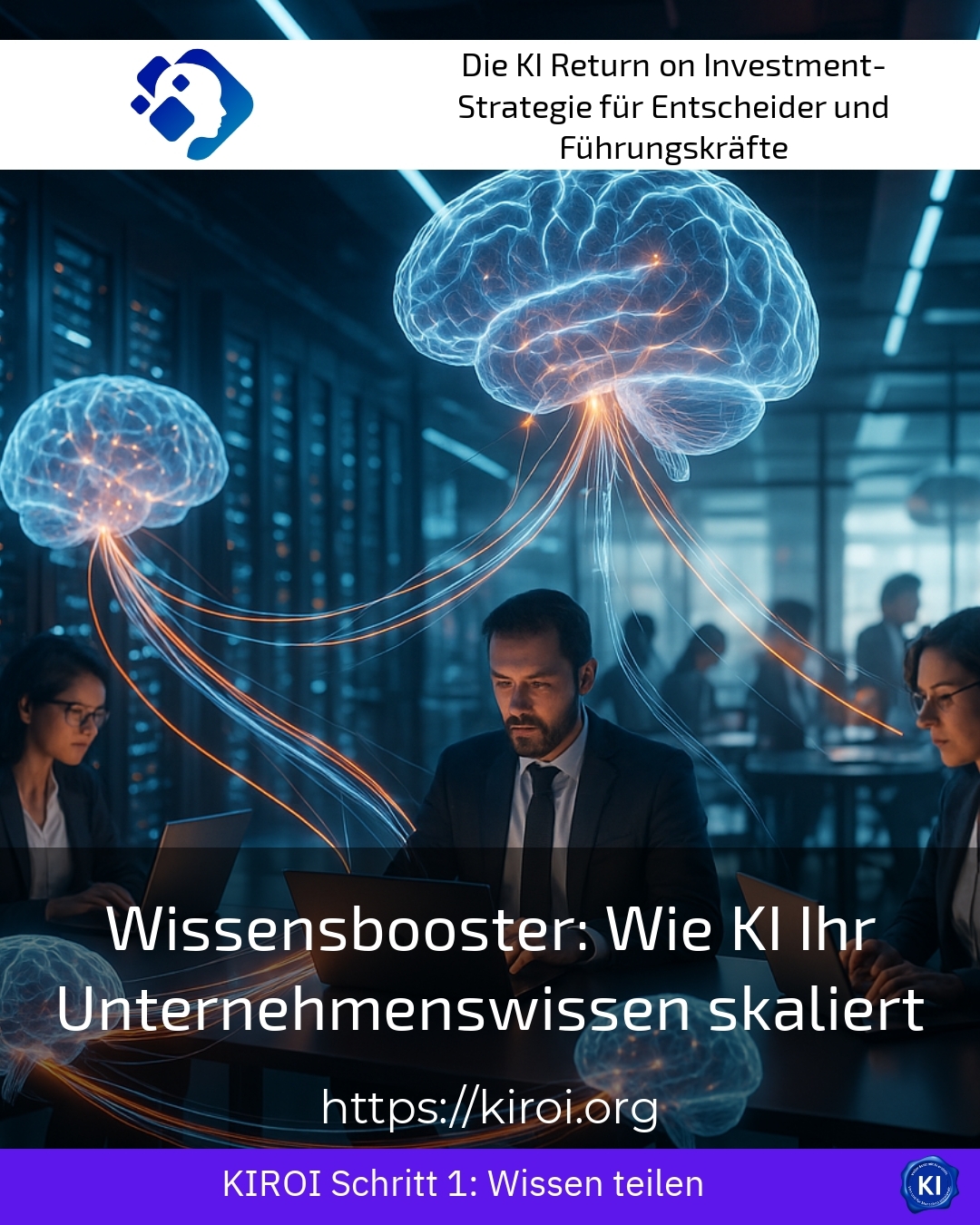
Have you ever wondered why some companies seem to effortlessly access all the knowledge of their organization, while others are left drowning in a sea of scattered documents, forgotten emails, and the dreaded departure of key employees? The answer lies in a fundamental change we are currently experiencing: Knowledge booster, which revolutionizes the way organizations capture, structure, and make their collective knowledge accessible to every employee. In an era where a company’s knowledge often represents its most valuable asset, the ability to intelligently scale that knowledge determines long-term success or gradual failure in the competition.
The hidden knowledge crisisʼ in modern organizations
Every day, companies lose valuable knowledge. This knowledge disappears in email trails and personal notebooks. It is lost forever with departing employees. Studies show that up to 70 percent of organizational knowledge remains implicit [1]. This implicit knowledge exists only in the minds of individual individuals. The consequences are serious and often underestimated.
Imagine an experienced project manager leaving the company. She brings fifteen years of experience with complex client relationships. Her successor has to start from scratch. He repeats mistakes that were long ago resolved. He overlooks opportunities that his predecessor would have noticed immediately. This scenario repeats itself thousands of times every day. It costs companies billions and slows down innovation.
In retail, this problem is particularly evident. Here, staff changes more frequently than in other industries. A fashion house regularly loses employees with deep product knowledge. New colleagues have to painstakingly learn new fabric qualities and fit specifications. The customer service department suffers significantly during this transition period. Similarly, electronics retailers face significant challenges with their complex product specifications. Food retailers are also struggling with the loss of knowledge about regional suppliers.
The knowledge booster: Intelligent systems as a catalyst
Modern intelligent systems function as powerful Knowledge booster for organizations. They not only collect information from various sources. They understand connections and can proactively provide relevant knowledge. Unlike traditional databases, these systems continuously learn to do this. They adapt to the specific needs of the users.
A hardware store, for example, can capture the entire product knowledge of its most experienced employees. The system then not only understands which dowel is suitable for which wall. It also recognizes which additional products are often needed together. This intelligence is then available to every employee. This way, even newcomers can be expertly advised. The customer no longer notices any difference between veteran and newcomer.
In pharmacies, this technology supports complex consultation situations. The system can indicate interactions that even experienced pharmacists might overlook. Drugstores use similar approaches for skin care consultations. Libraries rely on it to provide reading recommendations based on deeper understanding of genres. Wherever expertise makes a difference, the Knowledge Booster delivers its full effect.
Best practice with a AIROI customer
A medium-sized textile retailer with twelve branches faced a special challenge. Three of its most experienced sales consultants retired at the same time. These employees had decades of experience in style consulting. They knew the peculiarities of different fabric qualities down to the smallest detail. As part of our transruptive coaching, we developed a strategy for knowledge retention. First, we conducted structured interviews with the retiring experts. These conversations were not simply recorded but systematically analyzed. The implicit knowledge was translated into explicit rules and decision trees. An intelligent system then learned from this structured data. Today, new employees can consult the system in complex consulting situations. The system does not respond with rigid text blocks, but rather in context. It takes into account the customer’s body shape, the occasion, and the available budget. Customer satisfaction remained stable despite the massive staff turnover. The onboarding time for new employees was reduced by more than half. The CEO reports that this knowledge booster transformed his company.
Practical application areas in the business environment
The applications are diverse and touch almost every business area. In purchasing, intelligent systems can analyze historical negotiation results. They identify optimal ordering times and suggest alternative suppliers. The knowledge of experienced buyers is incorporated into algorithmic recommendations. New colleagues immediately benefit from this accumulated expertise.
In a wholesaler’s warehouse management, there is similar potential. Long-time warehouse managers intuitively know how to place goods optimally. They are familiar with seasonal patterns and regional peculiarities. This knowledge can be captured and systematized. The system then learns to optimize the storage spaces autonomously.
The customer service department also plays a role Knowledge booster significant impact [2]. A furniture store can document frequent reasons for complaints and successful solutions to them. The system then recognizes patterns in customer inquiries. It suggests the most likely solution to the service representative. The average processing time decreases, while customer satisfaction increases.
Implementation strategies: The path to scalable knowledge
The successful implementation of such systems requires more than just technical expertise. It requires a deep understanding of organizational culture. Employees must be willing to share their knowledge. They must not be afraid to become superfluous through knowledge sharing. This is where professional support comes in, which we offer as transruptive coaching.
For example, a supermarket operator must first identify which knowledge is critical. Is it expertise in fresh food counters or the management of local supplier relationships? Perhaps the knowledge about optimal shelf placement is the most valuable? This prioritization determines the success of the entire project.
In the second phase, systematic knowledge acquisition takes place. Experienced employees are supported in articulating their implicit knowledge. This is done through structured interviews and observations. Sometimes the most valuable insights emerge in seemingly random actions. A skilled knowledge manager recognizes these hidden treasures.
The third phase involves the technical implementation and training of the systems. It is crucial to connect the right data sources. A garden center must link its plant knowledge with seasonal data. An optician connects his advice knowledge with product databases. This integration requires both technical and professional expertise.
Challenges and how to overcome them in the Wissensbooster
Of course, there are obstacles along this path that should not be underestimated. Data privacy concerns play a central role. When the knowledge of individual employees is captured, sensitive data sets are created. These must be protected and used responsibly. Transparent communication about the use of this data creates trust.
Another obstacle is the quality assurance of the knowledge captured [3]. Not every experience that a long-time employee has had is universally applicable. Some practices are outdated or even counterproductive. The system must learn to distinguish between valuable and outdated knowledge. This requires continuous maintenance and updating.
In the field of sports equipment, a specific challenge arises. Product cycles are particularly short here, and trends change rapidly. The system must be constantly updated with current knowledge. At the same time, fundamental knowledge of body mechanics remains essential. Finding the balance between being up-to-date and possessing timeless expertise is challenging.
Best practice with a AIROI customer
A bookstore chain with branches in several German cities approached us with a specific problem. The quality of the book recommendations varied greatly between individual locations. Some branches had passionate literature enthusiasts, others not so much. The transruptive coaching began with an analysis of the existing consulting practices. We identified the employees with the highest customer satisfaction. Then we systematically examined what made these advisors different. It turned out that they not only knew books, but also understood reading preferences. They asked the right questions and recognized patterns in the answers. This knowledge was translated into an intelligent recommendation system. The system learned to distinguish between different reader types. It took into account not only genre preferences but also reading speed and emotional needs. Today, even less experienced employees can provide high-quality recommendations. They are supported by the system without losing their human touch. Customer retention increased measurably, and the knowledge booster became the centerpiece of the consulting quality.
The human component: Technology as a catalyst
A fundamental misunderstanding must be cleared up here. Intelligent knowledge systems do not replace humans; they enhance their capabilities. The experienced wine seller remains indispensable. But now he can share his knowledge with colleagues without being constantly available.
In perfumeries, this synergy is particularly impressive. The ability to describe scents and interpret customer preferences remains deeply human. However, background knowledge about ingredients and fragrance families can be systematized. The result is a consultation that combines both human empathy and comprehensive factual knowledge.
Jewelry dealers benefit in a similar way from this combination. The system knows the technical details of gemstones and settings. People understand the emotional significance of an engagement ring. Together, they create a consulting experience that no one could achieve alone [4].
Future prospects: Where is knowledge work evolving?
The development of intelligent knowledge systems is still in its infancy. Future systems will be even better at capturing implicit knowledge. They will recognize subtle patterns in human communication. Perhaps one day they will learn directly from observing successful interactions.
For the retail sector, this means a fundamental change in the dynamics of competition. It is no longer just location and product range that will determine success. The ability to scale and leverage knowledge becomes the key differentiator. Companies that miss this opportunity risk losing their edge.
A toy retailer that scales up the knowledge of its passionate employees creates unique shopping experiences. A department store that intelligently makes its nutrition knowledge accessible becomes a trusted go-to place. A travel agency that systematically organizes the insider tips of its expert women differs from the online competition.
My AIROI Analysis
After intensive discussion on the topic of knowledge scaling through intelligent systems, a clear picture emerges. The Knowledge booster It is no longer a futuristic concept, but a present reality. Companies that act now gain sustainable advantages. This is not about introducing software, but about cultural change. This change requires professional guidance and strategic foresight.
From my consulting practice, I know that clients often report how surprised they were by the depth of the knowledge available. This knowledge often lay dormant within the organization. The right methods were needed to make it visible and usable. This is where our work comes in and provides the impetus for sustainable transformation.
Investment in intelligent knowledge systems typically pays off quickly. Reduced onboarding times, reduced error rates, and increased customer satisfaction are measurable results. But the greatest value lies in the intangible: the collective knowledge of an organization becomes a permanent asset. It survives individual employees and grows with each new experience.
For companies in the retail sector, I recommend a step-by-step approach. Start by identifying your most critical knowledge holders. Launch pilot projects in selected areas. Learn from the first experiences and then scale them systematically. Transruptive coaching can accompany and support you on this journey. It provides the framework for a successful transformation.
Further links from the text above:
[1] McKinsey: The Social Economy and Knowledge Management
[2] Harvard Business Review: Insights on Knowledge Management
[3] Gartner: Knowledge Management Research
[4] Forrester: Knowledge Management in the Digital Age
For more information and if you have any questions, please contact Contact us or read more blog posts on the topic Artificial intelligence here.






 Deutsch
 English (UK)