
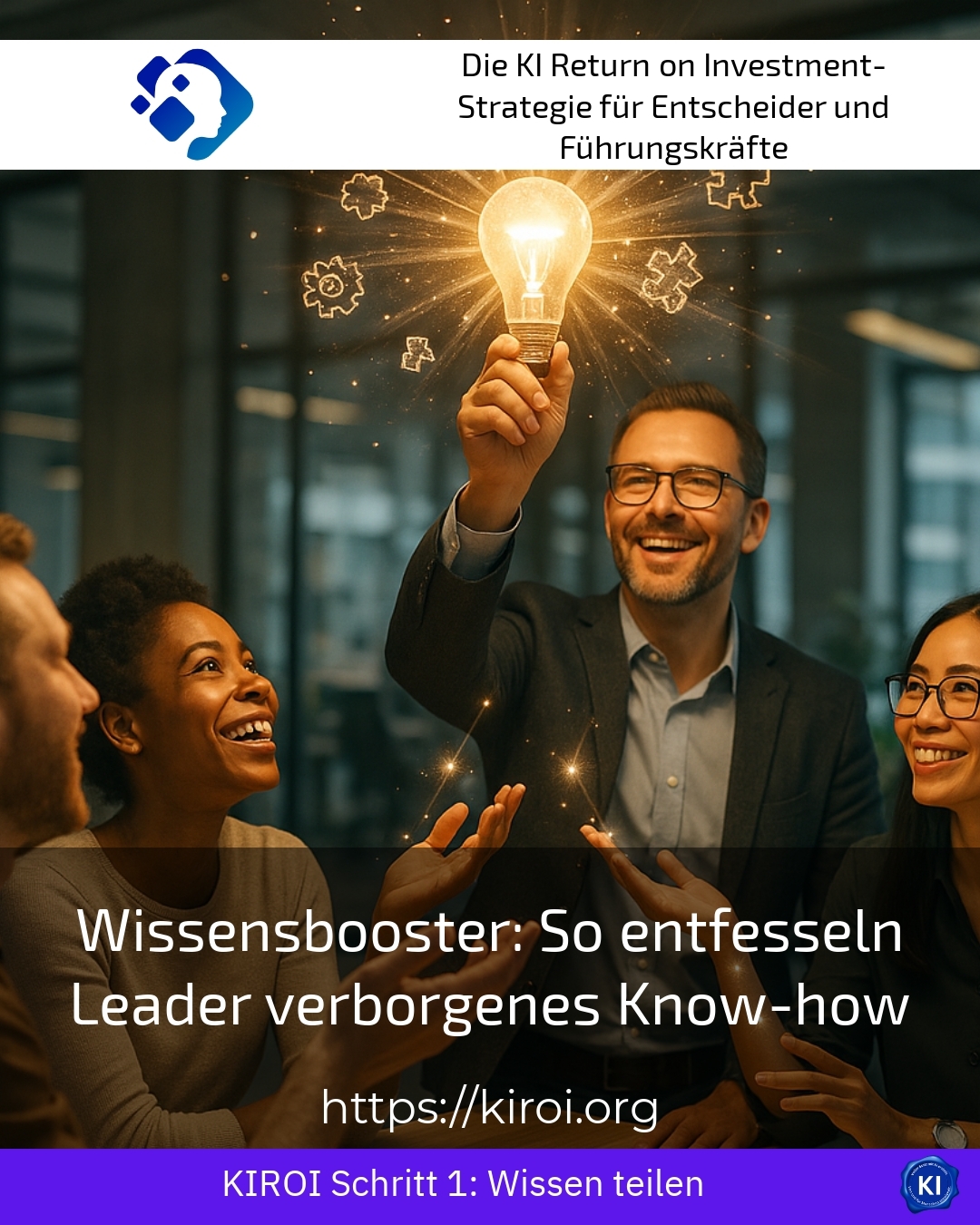
Imagine that your company has hidden treasures that no one unearths simply because they remain invisible. This is precisely where Knowledge booster For leaders today face the challenge of systematically identifying hidden know-how and making it usable for everyone. While valuable insights disappear daily in emails, remain unspoken in meetings, or are lost in the minds of departing employees, visionary leaders are seeking ways to sustainably secure this intellectual capital. The good news is that there are proven methods available to help bring implicit knowledge to the surface and transform it into usable resources. This article will show you how, as a leader, you can become the catalyst that activates hidden expertise within your team, thereby creating a genuine competitive advantage.
The Invisible Goldmine: Why Hidden Knowledge is the Underestimated Success Factor
In almost every company, there is a considerable gap between documented and actual knowledge. Studies show that up to eighty percent of organisational knowledge remains hidden in the minds of employees [1]. This implicit knowledge includes experiential values, intuitive assessments, and best practices. It is acquired through years of professional experience and is difficult to capture in manuals. For instance, an experienced production manager instinctively knows when a machine needs maintenance. A long-serving sales assistant can tell from the tone of voice whether a customer is ready to buy. And an IT administrator knows system shortcuts that are nowhere documented.
The consequences of these knowledge gaps often only become apparent at critical moments. When a key employee leaves the company, years of expertise can disappear within weeks. Projects are delayed because teams have to reinvent the wheel. Mistakes are repeated, even though colleagues have long found solutions. This is why many clients report that they only recognised the true value of their human capital when it was too late. Leaders who take action early therefore gain a significant advantage in the market.
Knowledge Boosters in Practice: How Leaders Activate Hidden Expertise
The first step to unleashing knowledge is to establish a culture of sharing. This sounds simple but requires profound changes in leadership practice. Successful leaders create spaces where employees can share their knowledge without fear of criticism. They establish regular formats such as internal knowledge cafés or lunch-and-learn sessions. Furthermore, they explicitly reward active knowledge management in performance reviews. For example, a medium-sized mechanical engineering company introduced so-called expert interviews, where junior staff systematically question experienced colleagues. The results were recorded in an internal knowledge database and made accessible to everyone.
Another effective approach is to establish mentoring programmes that extend beyond traditional hierarchies. In these programmes, it's not just the younger learning from the older, but also vice versa. Particularly in the area of digital skills, younger employees often possess valuable know-how that enriches older managers. Such reverse mentoring programmes promote knowledge transfer in both directions. At the same time, they strengthen cohesion between generations within the company. A logistics company successfully implemented this concept and reported significantly improved collaboration. Staff turnover noticeably decreased because all employees felt valued.
Best practice with a AIROI customer
An internationally operating trading company approached us because they were struggling with significant knowledge loss. Several key individuals were facing retirement, and no one knew precisely which critical processes existed only in their heads. As part of our ‘transruption’ coaching, we supported the management team in developing and implementing a structured knowledge transfer programme. Initially, we jointly identified critical knowledge areas through systematic interviews with the affected employees. Subsequently, we developed a shadowing concept, where successors accompanied their predecessors in their daily work for several months. In parallel, we documented the key findings in weekly reflection sessions and transferred them into an accessible knowledge database. The unique aspect of this project was the emotional component, as the long-serving employees felt valued by the process. They experienced that their knowledge was not simply disappearing but was being passed on. After the programme concluded, the company reported significantly smoother transitions and increased morale throughout the team. The investment in systematic knowledge management paid off measurably within a few months, as errors were avoided and processes were accelerated.
The Knowledge Booster as a Strategic Leadership Tool
Modern leaders no longer see knowledge management as an administrative task, but as a core strategic competency. They integrate the Knowledge booster-approach into their daily management practice and thereby create sustainable competitive advantages. This begins with the design of meetings that deliberately offer room for knowledge sharing. It continues with the selection of collaboration tools that make implicit knowledge visible. And it is reflected in personnel development, which specifically promotes and networks knowledge carriers. For example, a financial service provider implemented an internal wiki system that is maintained independently by employees. Managers actively encouraged their teams to use it and led by example themselves.
Technological support plays an important, but not a decisive, role. Many companies invest large sums in knowledge management software which is then hardly used. The reason usually lies not in the technology itself, but in the lack of cultural integration [2]. Successful leaders therefore start with the question of "Why": Why should employees share their knowledge? What benefits do they gain from it? How is knowledge sharing recognised within the company? Only when these questions have been answered can technical solutions reach their full potential. For this reason, a pharmaceutical company first conducted workshops on knowledge culture before introducing new software.
Overcoming barriers: What blocks knowledge transfer in organisations
The biggest obstacles to effective knowledge transfer are rarely technical. Rather, they are psychological and organisational barriers that are deeply rooted in corporate culture. Many employees fear becoming replaceable by sharing their knowledge. Others simply don't have time because their performance objectives do not include capacity for knowledge management. Still others have had bad experiences and feel their contributions are not valued. These hurdles can only be overcome through consistent leadership action. An energy provider addressed this issue by explicitly including knowledge transfer in its objective agreements. This gave employees time and recognition for their contributions to collective knowledge.
Siloed thinking represents another common barrier, as departments often function as knowledge islands. Information flows vertically within the hierarchy, but rarely horizontally between departments. The most valuable innovations often arise at the interfaces of different disciplines and departments. Leaders can counteract this phenomenon by promoting cross-departmental projects and assembling interdisciplinary teams. For example, a car parts supplier established regular cross-functional meetings where representatives from different departments presented their current challenges. Solutions often came from unexpected quarters and simultaneously fostered mutual understanding.
Knowledge boost through targeted discussion formats
Structured conversation formats are among the most effective tools for uncovering hidden knowledge. This is not about superficial information transfer, but about profound exchange of experience. The so-called After-Action Review originally comes from the military sector and has proven its worth in numerous industries [3]. After each completed project or milestone, the team gathers to reflect systematically. What was planned, and what actually happened? What went well, and what can we improve? What lessons have we learned for future projects? A construction company introduced this format after each construction project and was able to significantly reduce typical errors as a result.
Storytelling is another powerful approach to knowledge transfer because stories are memorable. When experienced employees share their most impactful professional experiences, they naturally convey implicit knowledge. Those listening learn not only facts but also contexts and emotional nuances. A hospital utilised this principle in onboarding new nurses and reported significantly faster integration. The new staff understood not only processes but also the underlying culture and unwritten rules. Regular storytelling evenings became a valued ritual that strengthened team cohesion.
Best practice with a AIROI customer
A medium-sized software company approached us because they were suffering from chronic knowledge drain. Employee turnover in the IT industry is notoriously high, and with every departure, critical codebase knowledge and customer relationship expertise disappeared. As part of our transruption coaching, we jointly developed a multi-stage programme for knowledge retention and activation. Initially, we introduced a knowledge map, which visualised where knowledge was located within the company. This overview revealed critical dependencies on individual employees and highlighted areas requiring action. Subsequently, we established so-called Knowledge Tandems, where two employees each acted as mutual knowledge partners. They collaboratively documented their core competencies and mutually trained each other in critical areas. In parallel, we introduced a peer review system for code, which not only improved quality but also fostered knowledge transfer between developers. After one year, the company reported significantly fewer productivity dips during staff changes. The onboarding time for new employees had been halved, as documented knowledge greatly simplified their entry into the company. Particularly pleasing was the increased employee satisfaction, as everyone felt part of a learning network.
Sustainability in Knowledge Management: From One-Off Initiatives to a Learning Organisation
Individual knowledge management initiatives often fizzle out ineffectively if they are not embedded within a larger framework. Sustainable impact only arises when the Knowledge booster becomes an integral part of the corporate culture. This requires continuous commitment from senior management and consistent resource allocation over extended periods. It also means viewing knowledge management not as a project with a defined end, but as an ongoing process. For example, an insurance company appointed a Knowledge Champion in each department, who was responsible for knowledge retention. These individuals received special training and regular opportunities to exchange ideas with each other. This created a network of knowledge multipliers that had a far-reaching impact throughout the organisation.
The learning organisation describes the ideal of a company that systematically learns from experience and continually develops [4]. Leaders play a key role in this, as they create the framework for organisational learning. They promote a positive error culture, in which mishaps are viewed as learning opportunities. They encourage experimentation and accept that not all attempts will be successful. And they themselves demonstrate a willingness to learn by openly discussing their own knowledge gaps. For example, a media company introduced so-called Failure Fridays, where teams presented their failed projects. Instead of assigning blame, the focus was on joint analysis of what could be learned from the failure.
Technological support for the Knowledge Booster
Modern technologies can significantly support knowledge management if used correctly. Collaboration platforms enable asynchronous knowledge sharing across time zones and locations. Internal social networks make expert knowledge discoverable and foster spontaneous networking. Artificial intelligence can help deliver relevant knowledge to the right people at the right time. For example, a consulting firm implemented an AI-powered system that automatically identified relevant past projects and responsible experts for client inquiries. This allowed consultants to access existing know-how more quickly and avoid duplication of effort.
Video-based knowledge management is gaining increasing importance because it conveys implicit knowledge better than text. When experienced employees record their working methods on video, nuances and contextual information also become visible. A plant manufacturer had its service technicians record short videos of complex repairs and collect them in an internal library. This allowed new technicians to benefit from the experience of their colleagues, even if they were working on the other side of the world. The quality of the repairs improved noticeably, and the onboarding time was significantly reduced.
My AIROI Analysis
The systematic activation of hidden knowledge represents one of the most important leadership tasks of our time. Companies that ignore this potential are squandering valuable resources and risk significant competitive disadvantages. The Knowledge boosterThis approach offers a tried-and-tested methodology to make implicit knowledge accessible and usable for the entire organisation. It consistently becomes apparent that technological solutions alone are not sufficient. Rather, the commitment of the management level and a company culture that values and rewards knowledge sharing are crucial.
In my consulting practice, I regularly see how transformative a systematic knowledge management approach can be. Managers who dedicate themselves to this topic report increased innovativeness and higher employee satisfaction. They experience their teams collaborating more efficiently and spending less time on redundant tasks. At the same time, dependence on individual knowledge carriers decreases, which significantly increases organisational resilience. Transruption coaching supports companies in tackling this change in a structured way and anchoring it sustainably. It provides impetus for the development of tailor-made knowledge management strategies and supports their implementation. The best practices described show exemplary successes that are possible. Every company must find its own way, but the fundamental principles of successful knowledge management are universally applicable.
Further links from the text above:
[1] McKinsey Insights on Organisational Knowledge Management
[2] Harvard Business Review – Knowledge Management
[3] Association for Project Management – After Action Review
[4] MIT Sloan – Building a Learning Organisation
For more information and if you have any questions, please contact Contact us or read more blog posts on the topic Artificial intelligence here.






 Deutsch
  English (UK)