
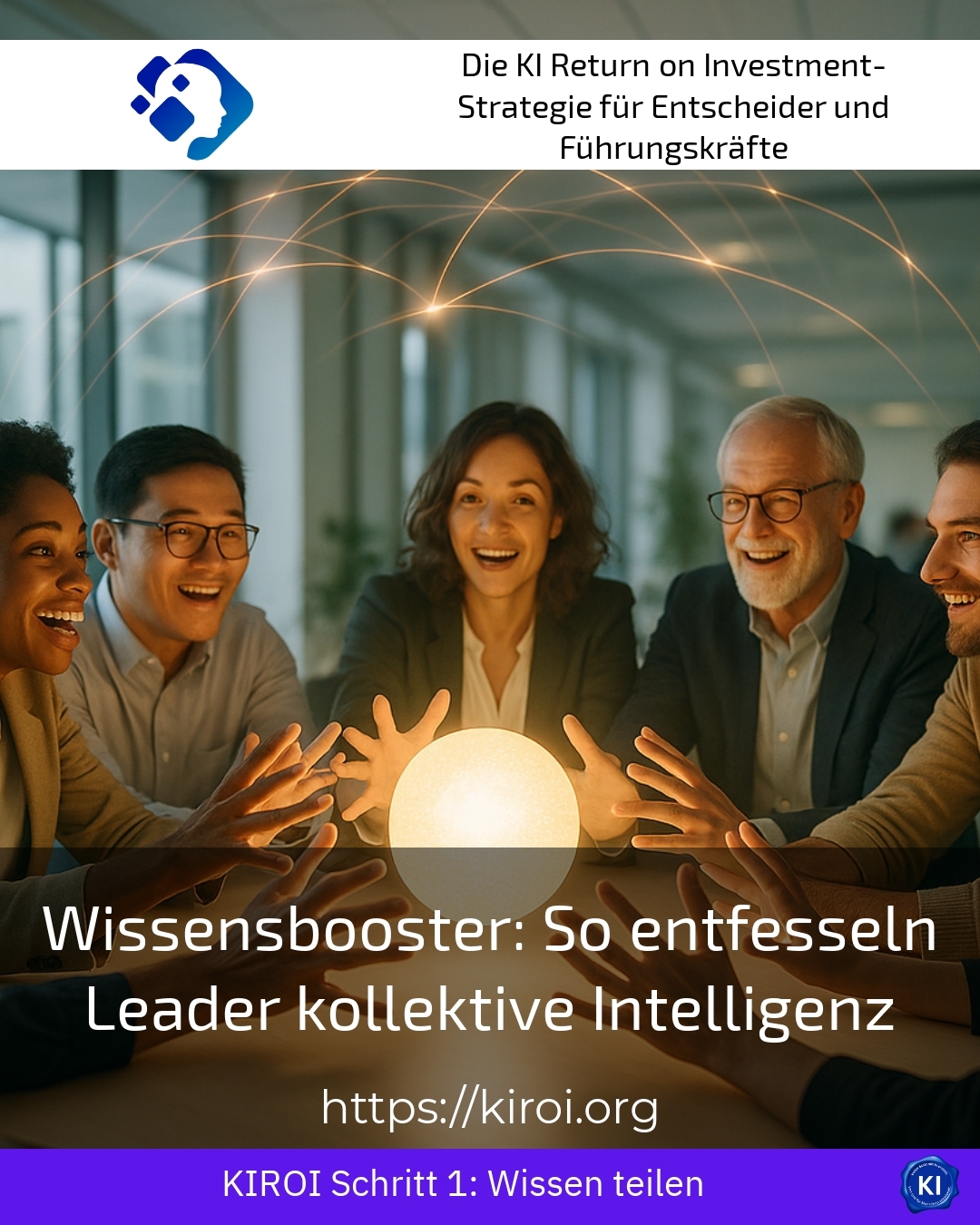
Imagine your company possesses a hidden treasure that no one is systematically tapping into – the collective knowledge of all employees, which dissipates in meetings, gathers dust in email inboxes, and slumbers in the minds of individual experts. This Knowledge booster waits to be activated, and this is precisely where modern leaders come in, by understanding that true competitive advantage does not arise from isolated geniuses, but from the orchestrated collaboration of many bright minds. The ability to unleash collective intelligence distinguishes average managers from transformative leaders who empower their teams to achieve extraordinary results. But how is this leap from individual expertise to shared brilliance achieved?
Recognising the hidden potential in organisations
Almost every company possesses untapped knowledge reserves that managers can systematically exploit. For example, a medium-sized mechanical engineering firm discovered that its service technicians had decades of experience that were not documented anywhere [1]. These silent knowledge bearers often repaired complex machinery intuitively, without ever articulating their implicit know-how. Similarly, in a pharmaceutical company, laboratory assistants made minor improvements to processes that never made it into official protocols. A logistics service provider, in turn, found that its dispatchers resolved bottlenecks through informal networks that were not described in any manual.
The first step in unleashing collective intelligence is to make these hidden streams of knowledge visible. Leaders who regularly engage in dialogue with employees at all hierarchical levels recognise patterns and connections. They understand where valuable experiential knowledge lies dormant and how it could be made usable for the entire organisation. This process requires humility, curiosity, and the willingness to question one's own assumptions.
The knowledge booster through psychological safety
Collective intelligence only unfolds in a climate that guarantees psychological safety. In its famous Project Aristotle, Google investigated the success factors of teams and found that psychological safety is the most important predictor of team effectiveness [2]. An automotive supplier subsequently implemented regular retrospectives in which mistakes could be openly discussed. A financial services provider introduced anonymous idea channels through which employees could share critical observations. An insurance company established monthly learning forums in which failed projects were constructively analysed.
The Knowledge booster works particularly effectively when people are not afraid of negative consequences. Leaders who show vulnerability themselves and admit their own mistakes build trust. They encourage others to express unconventional thoughts and take risks. This atmosphere of openness forms the foundation for genuine knowledge exchange.
Best practice with a KIROI customer
An international industrial company with over three thousand employees approached transruptions-Coaching because internal collaboration between sites was increasingly faltering, and valuable expertise was being siloed. The management level recognised that, despite state-of-the-art technology, the real challenge lay in the corporate culture, which unconsciously hindered knowledge sharing. As part of the support provided by KIROI Masterclasses, we jointly developed a multi-stage programme that initially raised awareness among managers about their role as knowledge multipliers. In intensive workshops, we identified the unconscious behaviours that were blocking knowledge flow and how alternative communication patterns could be established. Clients in such processes particularly often report their surprise at how much implicit knowledge lies dormant in their teams. After six months, the company had built a vibrant network of internal knowledge communities that regularly exchanged best practices and collaboratively worked on solutions to complex challenges. Employee satisfaction rose measurably, and the speed of innovation increased noticeably.
Create structures for the knowledge booster
Spontaneous knowledge sharing is rarely sufficient to fully exploit the potential of collective intelligence. Leaders need well-thought-out structures and formats that enable and encourage regular exchange. A technology group established so-called Knowledge Cafés, where experts from different departments discussed in a relaxed atmosphere [3]. A consulting firm introduced peer-learning tandems, which met weekly for mutual competence exchange. A retail chain set up digital communities of practice in which store managers learned from each other across locations.
These structures do not need to be designed to be complicated or resource-intensive. Often, small, consistent rituals that stimulate knowledge sharing are sufficient. The voluntary nature of participation and the relevance of the topics to those involved remain important. Leaders take on a moderating role here, creating space rather than compulsion.
Diversity as a catalyst for collective intelligence
Homogeneous groups tend towards groupthink and blind spots, whereas diverse teams bring more varied perspectives. Research shows that cognitive diversity – meaning different thinking styles and problem-solving approaches – increases a group's collective intelligence [4]. A chemical company intentionally began assembling interdisciplinary project teams that brought together engineers, biologists, and business economists. A media company deliberately sought out voices from interns to board members for strategic decisions. A bank invited customer service representatives to strategy meetings because they knew customer needs best.
Leaders who wish to unleash collective intelligence consciously pay attention to the composition of their teams. They actively seek out differing opinions and encourage constructive dissent. They understand that friction and differences are not disruptions, but valuable resources for better decision-making.
Technology as an Enabler of the Knowledge Booster
Digital tools can significantly support and accelerate knowledge exchange. An energy provider implemented an internal platform where employees maintained expertise profiles and could find the right contacts for specific questions. A construction group used project management tools that automatically fed in relevant experience from previous projects. A healthcare provider used chatbots that made frequently requested knowledge immediately available.
However, technology alone does not solve cultural challenges. The best tools remain ineffective if employees feel no incentive or willingness to share. Leaders must therefore work on the company culture in parallel with technology implementation and become role models for active knowledge management.
Best practice with a KIROI customer
A medium-sized manufacturing family business faced the challenge of experienced skilled workers retiring and threatening to take their knowledge with them. Management recognised that traditional documentation was insufficient to secure this implicit experiential knowledge. In transruptions coaching, we jointly developed a mentoring programme that elevated knowledge transfer to a strategic priority and recognised older employees as valuable sources of knowledge. We supported the managers in establishing a culture of mutual learning, where young and old benefited from each other. Implementation was carried out in stages and optimised through regular reflection loops, generating valuable impetus for continuous improvement. After one year, both experienced and younger employees reported increased job satisfaction and a deeper understanding of the company's history. Critical knowledge had now been secured in stories, videos, and interactive formats and made accessible to everyone, significantly shortening the onboarding time for new colleagues.
The role of the leader as a knowledge curator
Modern leaders increasingly see themselves as knowledge curators, filtering, connecting, and making relevant information accessible. This role requires a deep understanding of strategic priorities and existing knowledge gaps. A software company established the position of Chief Knowledge Officer, who coordinated knowledge flows across departments. A consumer goods manufacturer trained its team leaders in moderation techniques for effective knowledge sharing. A logistics company conducted regular knowledge audits to identify blind spots.
The Knowledge booster it is particularly effective when managers actively create connections between people and ideas. They recognise who knows what and bring the right people together at the right time. This networking function is becoming increasingly important in complex organisations.
Designing incentives for knowledge sharing
Traditional remuneration systems often reward individual performance, thus fostering competition rather than cooperation. Managers who wish to promote collective intelligence are fundamentally rethinking their incentive systems. A technology company integrated knowledge sharing as an evaluation criterion in employee reviews. An auditing firm awarded bonuses for particularly helpful contributions to the internal wiki. An industrial group honoured teams that had successfully learned from each other.
Intrinsic motivation plays at least as important a role in this as extrinsic incentives. People enjoy sharing knowledge when they feel valued and experience the benefit of their contributions. Leaders can foster this intrinsic motivation through recognition, feedback, and visibility.
My KIROI Analysis
Unlocking collective intelligence is one of the most powerful levers available to leaders to make their organisations future-proof and achieve sustainable competitive advantage. My experience from numerous accompanying projects shows that the decisive factor lies not in technology or processes, but in the attitude of the leaders themselves, who must be willing to relinquish control and place their trust. Organisations that the Knowledge booster successfully activate, are characterised by a special combination of psychological safety, well-thought-out structures, and a culture of curiosity, which is modelled from the top.
The biggest obstacles to collective intelligence often arise from unconscious behaviours that reward knowledge hoarding or penalise admitting ignorance. In my work, I frequently encounter leaders who have intellectually understood the importance of knowledge sharing but still cling to old patterns emotionally. This is where transruptive coaching comes in as support for projects aiming for profound cultural transformation, rather than superficial measures. The path to a learning organisation requires patience, perseverance, and a willingness to constantly work on one's own blind spots.
For leaders wishing to embark on this journey, I recommend three concrete steps: firstly, an honest analysis of their own role-modelling in knowledge sharing; secondly, the creation of an initial experimental space for psychologically safe dialogue; and thirdly, patiently tolerating initial difficulties until the new culture takes root. The investment is worthwhile, as organisations with high collective intelligence are more resilient, innovative, and attractive to talented employees.
Further links from the text above:
[1] Harvard Business Review: The Hard Truth About Innovative Cultures
[2] Google re:Work: Understanding Team Effectiveness
[3] McKinsey: Insights into People and Organisational Performance
[4] MIT Sloan Management Review: How to Increase Diversity in Your Organisation
For more information and if you have any questions, please contact Contact us or read more blog posts on the topic Artificial intelligence here.











 Deutsch
  English (UK)