
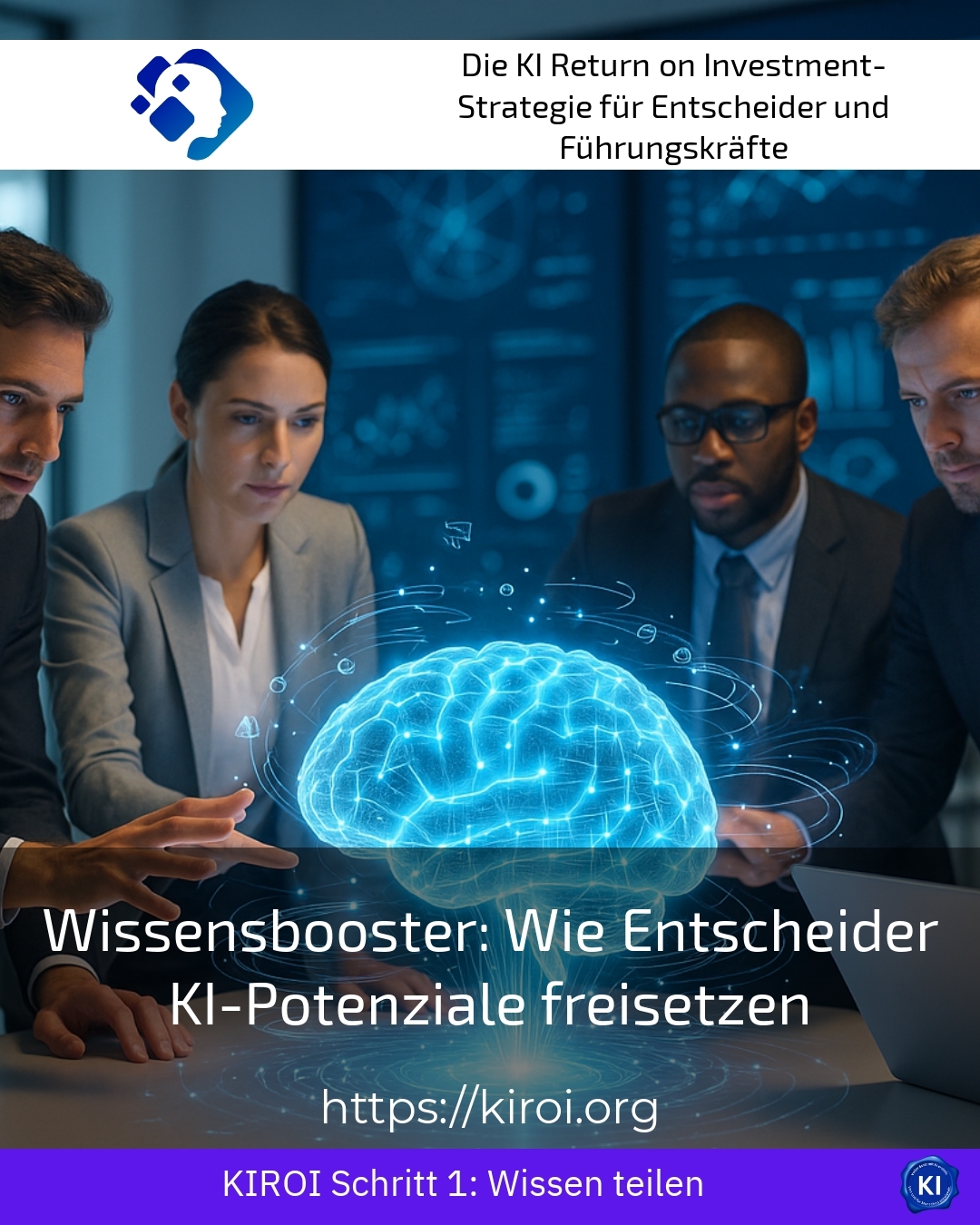
Have you ever wondered why some leaders seemingly master digital transformation effortlessly, while others, despite significant investments, struggle to make progress? The answer lies not in the technology itself, but in the way decision-makers build their knowledge of modern systems and strategically apply it, because this is where the decisive Knowledge booster This is the difference between stagnating development and real breakthroughs. In a time when intelligent algorithms are penetrating almost every business sector, the ability to assess technological possibilities in depth becomes the indispensable core competence for every decision-maker who wants to make their company future-proof.
The strategic importance of in-depth technology knowledge for modern leaders
Executives today face a paradoxical situation. They are supposed to make decisions about technologies that they often do not fully understand. At the same time, they cannot rely solely on expert knowledge. The complexity of modern systems requires a new understanding of leadership competencies. This Knowledge booster For decision-makers, it begins with the realization that superficial buzzword knowledge is not enough.
For example, a medium-sized machine manufacturer faced the challenge of optimizing its production planning. The management had heard about predictive maintenance. But they initially lacked a concrete understanding of the possibilities. Through targeted further training, the decision-makers recognized the true potential. They suddenly understood how sensor data can predict machine failures. Subsequently, they invested specifically in the right areas.
A logistics company used a similar approach in route optimization. The senior management first learned the basic principles of intelligent algorithms. This knowledge enabled in-depth discussions with technology providers. The company was thus able to avoid overpriced solutions. Instead, they chose a suitable solution for their specific requirements.
This dynamic is also evident in the healthcare sector. A network of clinics trained its management in the basics of imaging analysis procedures. The newly acquired understanding fundamentally changed the investment strategy. The decision-makers recognized which applications truly offered added value. At the same time, they were better able to discern unrealistic promises made by providers.
Best practice with a AIROI customer
An international automotive supplier turned to transruptive coaching with a specific question regarding the strategic direction of its digital initiatives. During the coaching, the management team found that despite significant budgets for technology projects, the expected efficiency gains were lacking and employees increasingly reacted frustratedly to ever new system implementations. In the guidance provided by the AIROI-Masterplan- framework, we first analyzed the existing knowledge gaps at the leadership level, revealing that although the decision-makers formulated ambitious goals, they only had a superficial understanding of the technical foundations of the systems deployed. Transruptions coaching helped to develop a tailored training program for senior management that linked technological fundamentals with strategic business perspectives, enabling decision-makers to ask informed questions of their technology partners. After six months, participants reported a significantly increased confidence in technology decisions, and the investment efficiency improved measurably because executives could now distinguish between genuine innovation potential and mere marketing.
Knowledge booster: Practical methods for competence development
The development of technology expertise at the leadership level follows certain principles. Decision-makers do not need programming skills. However, they do need a conceptual understanding of the possibilities and limitations. This knowledge building works best through hands-on learning formats. Abstract theory seminars often fail to achieve their goal.
For example, a trading company established regular technology briefings for its executives. Every month, an expert presented a concrete application. The decision-makers thus gradually became familiar with the possibilities of demand forecasting. This format proved particularly effective. The executives were able to ask questions and understand the connections. At the same time, the time commitment remained manageable.
An insurance company chose a different approach for its Knowledge booster. She established an internal innovation lab. There, executives could experiment with intelligent systems themselves. The direct experience created a deeper understanding. The decision-makers recognized both the strengths and weaknesses of the technology. This experience profoundly influenced their later strategic decisions.
An energy provider implemented peer learning between executives from different departments. The IT manager explained technical concepts in understandable language. The sales manager introduced practical application questions. This exchange significantly enhanced mutual understanding. Communication between the specialist departments and IT improved significantly. Projects subsequently ran much more smoothly.
From theory to practice: developing decision-making skills
Theoretical knowledge alone is not sufficient for well-informed technology decisions. Decision-makers must learn to ask the right questions. They should be able to critically question provider promises. At the same time, they must develop realistic expectations regarding project results. This competence arises through practical experience and reflective guidance.
A pharmaceutical company implemented a structured mentoring program. Experienced technology decision-makers mentored their colleagues on important projects. This knowledge transfer significantly accelerated the development of competencies. The new decision-makers learned from real-life situations. They developed an understanding of typical pitfalls. At the same time, they recognized success patterns and best practices.
A construction company used pilot projects as a learning ground for its executives. Small, manageable initiatives served as experimental spaces. The decision-makers experienced the entire project cycle up close. They understood why some projects were successful. They also recognized the reasons for delays and problems. These experiences shaped their approach to larger investments.
A telecommunications provider established regular project reviews with participation from management. The decision-makers analyzed completed technology projects together. They identified success factors and potential for improvement. This structured reflection process promoted organizational learning. This prevented the company from repeating past mistakes.
Cultural prerequisites for technological excellence
The effective deployment of intelligent systems requires more than technical knowledge. Decision-makers must also shape the cultural framework conditions. A learning-friendly corporate culture forms the foundation for successful transformation. Employees need psychological security to experiment with new technologies.
A financial services provider fundamentally transformed its culture of error. Previously, failures in technology projects were kept secret. Now teams openly share their learnings with the entire organization. This transparency significantly accelerated the learning process. Other areas benefited from the insights gained. The success rate of new projects increased measurably.
One media company explicitly promoted collaboration between generations. Younger employees often brought more technological expertise. Experienced executives possessed valuable business knowledge. The structured exchange combined both perspectives profitably. This synergy proved particularly valuable in complex transformation projects.
A manufacturing company established cross-functional innovation teams. Employees from different departments worked together on technology topics. This diversity of perspectives led to more creative solutions. The leaders learned from their own teams. The cross-functional exchange strengthened mutual understanding and trust.
Best practice with a AIROI customer
A leading chemical company sought guidance from transruptive coaching because digital transformation had stalled despite ambitious goals, and management suspected that cultural barriers played a significant role, which was confirmed in the following analysis sessions. The AIROI-Masterplan- framework helped to make hidden resistance at the leadership level visible, because many middle managers felt overwhelmed by the technological development and unconsciously blocked progress because they saw their own position at risk. The transruptions coaching accompanied the company in developing a comprehensive qualification strategy that not only conveyed expertise but also addressed the emotional aspects of change and provided leaders with a secure framework for their learning journey. Often, clients in such situations report a mix of curiosity and fear, which is why it was important to take both feelings seriously and create a protected space for honest conversations. Following the coaching, the company successfully implemented several data-driven optimization projects, and the leadership demonstrated a significantly greater openness to further technological initiatives.
Knowledge boosters as a strategic competitive advantage
Companies with technology-savvy leadership make better investment decisions. They recognize real opportunities faster than their competitors. At the same time, they avoid costly misjudgments. This strategic competence does not develop overnight. It requires continuous investment in the further education of the leadership level.
A textile manufacturer used its technological expertise to optimize its supply chain. The management understood the possibilities of demand forecasting. They invested specifically in corresponding analysis systems. The result was a significant reduction in excess inventory. At the same time, the delivery capability to customers improved significantly.
A tourism company recognized the potential of personalization early on. The management understood the principles of recommendation systems. It consistently prioritized appropriate development projects. The personalized offerings led to higher customer satisfaction. Repeat booking rates increased significantly.
An agricultural technology company used technological knowledge for product development. The management understood the potential of sensor technology and data analysis. They developed intelligent agricultural machines for precise applications. This innovation gave the company a significant market advantage.
My AIROI Analysis
The intensive engagement with numerous transformation projects repeatedly reveals a recurring pattern that determines success and failure in the use of intelligent systems. Decision-makers who actively engage with the fundamentals of modern technologies not only make better investment decisions, but they also create an environment in which innovation can thrive, because their teams sense that the senior leadership understands and appreciates the challenges. Knowledge booster For leaders, this is not a one-time event, but a continuous process that requires humility, curiosity, and a willingness to learn throughout life.
In my work with AIROI the Masterplan framework, I often see that the greatest breakthroughs occur when decision-makers honestly admit their knowledge gaps and actively work to close them. This openness is not a weakness but a strength that distinguishes modern leadership. Transruptive coaching can provide valuable insights and accompany leaders on their learning journey. Companies that invest in the technological competence of their leadership team will be better positioned in the long run. They can seize opportunities more quickly and assess risks better. The future belongs to those who understand that knowledge is the most important resource in the digital age.
Further links from the text above:
[1] AIROI-Master plan framework for strategic technology decisions
[2] transruptions-Coaching for Digital Transformation
[3] Harvard Business Review: Technology Leadership Insights
[4] McKinsey Digital: Executive Technology Competence
For more information and if you have any questions, please contact Contact us or read more blog posts on the topic Artificial intelligence here.







 Deutsch
 English (UK)