
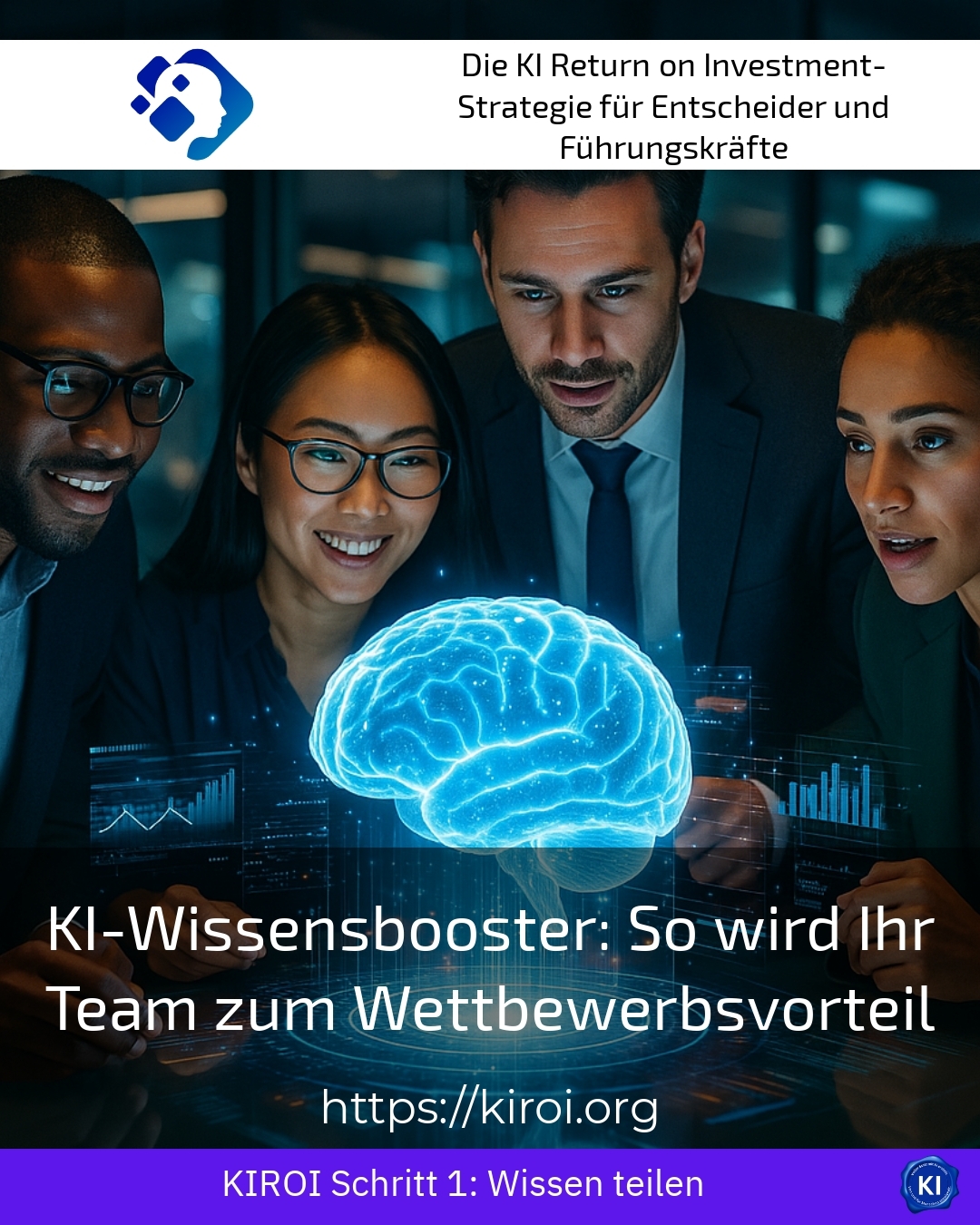
Imagine your employees could perform complex analyses in seconds while simultaneously developing creative solutions that remain hidden from your competitors. AI Knowledge Booster makes exactly that possible, transforming average teams into high-performing units that make a crucial difference in the market. In an era where speed and precision determine success or failure, the systematic integration of intelligent technologies offers an unprecedented opportunity for differentiation. But how can this transformation be achieved in practice, and what steps lead from vision to lived reality within your company?
The transformation begins in the mind: Mindset as the foundation for success
Before technological tools can reach their full potential, a fundamental shift in mindset needs to occur. Teams that view intelligent systems merely as a replacement for existing processes squander enormous potential and fall behind the possibilities. The true strength lies in the combination of human intuition with machine precision, with both sides contributing their unique abilities. A medium-sized company from the manufacturing sector impressively demonstrated this when it realigned its quality control, reducing error rates by more than sixty percent [1]. What was crucial was not the technology alone, but the willingness of the workforce to accept new ways of working and actively shape them.
The introduction of AI Knowledge Booster-Programmes first require an honest assessment of existing competencies and knowledge gaps. Many organisations underestimate the importance of continuous further training and instead rely on one-off training sessions which quickly become ineffective. A retail company with several hundred branches recognised this challenge and developed a phased learning programme that takes different experience levels into account. The results spoke for themselves: within a few months, the adoption of new digital tools increased from under thirty to over eighty percent. At the same time, employee satisfaction improved significantly because people felt more competent and valued.
Best practice with a AIROI customer
An international logistics service provider approached our transruption coaching team with a complex challenge that is likely familiar to many industries. Employees in operational areas showed significant resistance to new digital systems, fearing job losses. Together, we developed a support programme that combined technical training with psychological support, putting people at the centre. We introduced regular feedback sessions where concerns could be openly addressed without fear of repercussions. Managers received additional training in empathetic communication during change processes and learned to take concerns seriously. After six months of intensive support, more than seventy percent of participants reported increased confidence in their own future viability. Warehouse productivity increased measurably, while employee turnover significantly decreased and new talent was attracted. This example impressively demonstrates that successful transformation can never be solely a matter of technology, but always requires people.
AI Knowledge Booster in Practical Application: From Concept to Implementation
The practical implementation of intelligent systems ideally follows a structured approach that takes into account both technical and human factors. Many organisations make the mistake of wanting too much too quickly, thereby overwhelming their workforce and existing infrastructure. A proven approach is to start with clearly defined pilot projects that have measurable success and can serve as a beacon for further initiatives. For example, an insurance company began with the automated processing of standardised claims and gradually expanded the scope of application [2]. The claims handlers were not replaced; instead, they could finally concentrate on complex cases that require human judgment.
The selection of suitable application areas is crucial for the success of a AI Knowledge Booster-programs and should be carried out strategically. Processes with a high degree of repetition that are simultaneously error-prone and resource-intensive are particularly promising. A pharmaceutical company identified document review in the approval process as an ideal starting point and reduced processing time by more than half. The team used the freed-up capacity for more intensive research work and the development of new product lines. Another example is a telecommunications provider that supplemented its customer service with intelligent chatbots, thereby ensuring round-the-clock availability [3]. The human service employees subsequently took on more demanding consultation calls, thus measurably increasing customer satisfaction.
Knowledge transfer as a key element of the AI Knowledge Booster concept
The sustainable success of technological investments depends crucially on how knowledge is shared and developed within the organisation. Traditional training formats often reach only a fraction of the workforce and get lost in day-to-day operations before they can have an impact. Modern approaches, instead, focus on continuous learning in small units that are directly integrated into the daily work routine. A mechanical engineering company introduced so-called micro-learning units that employees could complete daily in five to ten minutes. This significantly improved knowledge acquisition, and what was learned was immediately applied. An energy provider went a step further and established a mentoring programme where technically proficient employees supported their colleagues.
The role of leaders in knowledge transfer can hardly be overstated, as they act as role models and multipliers. When department heads are themselves competent in using new technologies, this signals to the workforce that learning is not a weakness, but a strength. A financial institution invested specifically in the further training of its leadership level, and as a result, experienced an acceleration of its digital transformation by several months. The managers became active proponents of change and cleared away obstacles before they could become blockades. At the same time, informal networks emerged in which best practices were exchanged and challenges were solved collaboratively.
Best practice with a AIROI customer
A medium-sized automotive supplier approached our transruption coaching team with a typical challenge that many industrial companies will recognise. The company had invested considerable sums in modern analysis software, but usage rates remained far below expectations. Management was frustrated and was already considering writing off the project as a failure and accepting the losses. In our collaboration, we jointly identified the causes and developed a tailor-made transformation plan. It turned out that the initial implementation had occurred without sufficient involvement of the end-users and had ignored their needs. We accompanied the company in the re-design of the rollout and placed the users at the centre of all decisions. Additionally, we established a system of ambassadors in each department who acted as the first point of contact for questions and problems. Usage rates increased from below twenty to over seventy-five percent within four months, and the software finally began to deliver the expected added value. The investment paid for itself faster than originally planned, and the company is now planning to expand to further sites.
The human factor: why technology alone is not enough
Despite all enthusiasm for technological possibilities, it must never be forgotten that machines are tools designed to support, not replace, humans. The most valuable skills in the modern working world remain deeply human: creativity, empathy, ethical judgment, and the ability to intuitively grasp complex contexts. A healthcare provider recognised this early on and deliberately positioned its intelligent systems as assistants that allow professionals more time for patient contact. Nursing staff reported higher job satisfaction because administrative tasks were automated, creating more space for interpersonal interaction [4]. An architectural firm used generative design tools to arrive at initial drafts more quickly, but retained creative refinement as a purely human domain.
The combination of human and machine intelligence only reaches its full potential when clear responsibilities are defined and continuously reviewed. Companies that neglect this demarcation risk both quality issues and ethical irregularities that can cause long-term damage. A media company therefore established an ethics committee to review all new use cases and develop guidelines for responsible deployment. Employees were encouraged to openly voice concerns without fear of negative consequences. A consulting firm took a similar approach, intensively training its teams in the critical evaluation of automatically generated analyses.
Sustainable Skills Development through the AI Knowledge Booster
The speed of technological developments necessitates a rethink in corporate training that goes far beyond traditional concepts. Knowledge is becoming obsolete faster than ever, which is why continuous learning must become a core competency that enables all other skills. Successful organisations therefore not only invest in specific technology training but also promote a fundamental learning culture. One software company allocated ten percent of working hours to each employee for self-directed learning, reaping impressive leaps in innovation as a result. A retail group established internal academies where experts shared their knowledge with colleagues, gaining new perspectives themselves in the process.
Measuring learning success presents many organisations with challenges, as traditional metrics often fall short. Modern approaches combine quantitative data with qualitative observations and consider both individual and collective progress. A technology company developed a dashboard that linked learning activities, application frequency and business results, thus making the value contribution visible [5]. The insights directly informed the further development of the learning programmes and enabled continuous improvements. A chemical group supplemented this data with regular surveys that captured subjective competence assessments and learning needs.
My AIROI Analysis
The integration of intelligent technologies into team structures presents organisations with fundamental decisions that go far beyond mere technology selection and lay the groundwork for future competitiveness. My experience from numerous accompanying projects clearly shows that success is significantly dependent on the quality of preparation and the involvement of all stakeholders. Companies that underestimate the human factor and focus exclusively on technical excellence regularly fall short of their potential and waste valuable resources.
I particularly frequently observe a discrepancy between the ambitious goals of the leadership and the actual willingness of the workforce to change. This gap can only be bridged through authentic communication, genuine participation and, above all, visible role models. Transruption coaching supports organisations in building these bridges and anchoring sustainable changes, rather than igniting short-term flash-in-the-pan initiatives. In my experience, investing in guidance pays off multiple times, as costly mistakes can be avoided and resistance can be recognised early on.
Whoever AI Knowledge Booster- This approach, pursued consistently, not only creates short-term efficiency gains but also builds long-term competitive advantages that are difficult to replicate. The true value lies not in the technology itself, but in the unique capabilities that teams develop when they learn to combine human strengths with machine precision. Organisations that take this path become attractive employers for talent seeking development opportunities and wanting to be part of something significant. The future belongs to those who invest in their people today and give them the tools to achieve the extraordinary.
Further links from the text above:
[1] McKinsey: The Economic Potential of Generative AI
[2] Accenture: AI Insights and Research
[3] Gartner: Artificial Intelligence Research
[4] WHO: Ethics and Governance of Artificial Intelligence for Health
[5] Deloitte: Global Human Capital Trends
For more information and if you have any questions, please contact Contact us or read more blog posts on the topic Artificial intelligence here.









 Deutsch
  English (UK)