
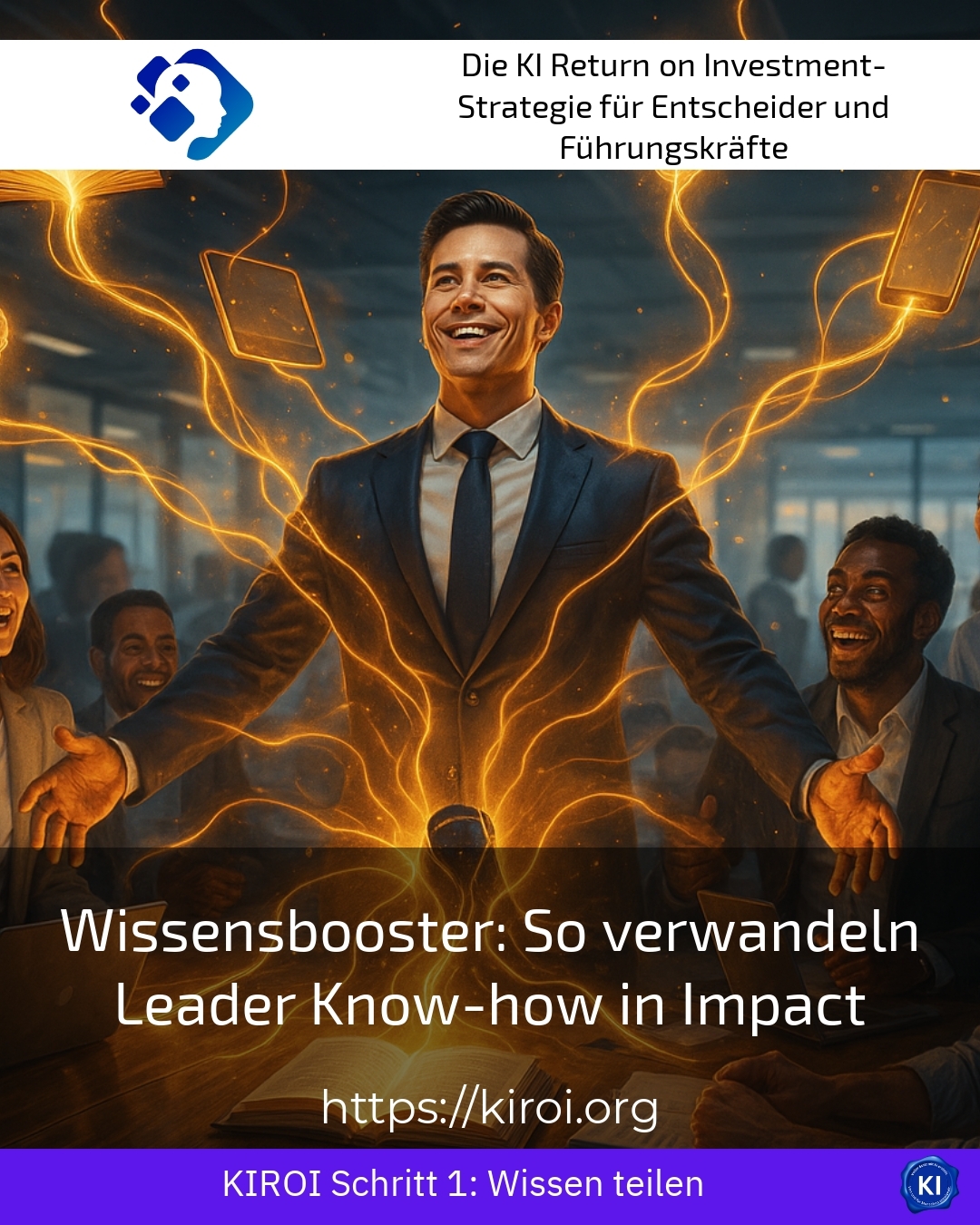
Imagine possessing an arsenal of brilliant insights, but they gather dust in your mind because no one learns about them or benefits from them. This is precisely the phenomenon we observe in numerous leaders who have immense expertise but fail to take the crucial step from mere knowledge possession to tangible impact. Knowledge Booster: How Leaders Turn Know-how into Impact describes a transformation process that determines success and failure in the modern world of work. This is because knowledge alone is no longer enough to inspire teams, drive projects forward and initiate sustainable change. The true art lies in using existing expertise in such a way that it resonates with other people and produces real results.
The gap between expertise and measurable impact
Clients often report feeling unheard despite extensive qualifications. They invest years in further training, collect certificates, and continuously deepen their expertise. Nevertheless, their ideas remain unheeded in meetings or get lost in endless email chains. This discrepancy between competence and influence is not only frustrating for those concerned. It also harms organisations that leave untapped potential unused.
This problem is particularly evident in the area of digital transformation. An IT manager might possess a deep understanding of modern cloud architectures. However, if they cannot communicate this knowledge comprehensibly, the migration stalls. The same applies to project managers who master agile methodologies but fail because they cannot inspire their teams for new ways of working. Sales managers are also very familiar with this dilemma. They are aware of the benefits of digital sales channels, but fail to gain acceptance from their employees.
The causes of this gap are manifold and often deeply rooted in corporate structures. A lack of psychological safety prevents open exchange between hierarchical levels. Siloed thinking blocks the flow of knowledge between departments. And overloaded calendars leave no room for reflective conversations.
Best practice with a KIROI customer
A medium-sized logistics company faced the challenge of modernising its dispatch operations. The head of transport planning had extensively researched AI-powered route optimisation and was fully aware of its potential. However, he repeatedly encountered scepticism from management because he phrased his arguments in too technical a manner. As part of the transruption coaching support, we developed a new communication strategy together. He learned to translate his expertise into business performance indicators. Instead of talking about algorithms, he now spoke about fuel savings and delivery reliability. Within a few weeks, he received approval for a pilot project. Subsequently, drivers reported shorter shifts for the same workload. Management recognised the added value and rolled out the system to all locations. This case illustrates how crucial the bridge between specialist knowledge and stakeholder understanding is.
Knowledge Booster: How Leaders Turn Know-how into Impact Through Targeted Communication
The ability to explain complex issues in an accessible way is what sets effective leaders apart from mere subject matter experts. This does not mean simplifying or, worse still, distorting the content. Rather, effective communication means seeing things from the other person’s perspective and meeting them on their own terms. A data scientist does not need to explain to their board how neural networks work. Instead, they should demonstrate which business problems this technology can solve.
Storytelling proves to be a powerful tool for sustainable knowledge transfer. Stories embed themselves in memory and create an emotional resonance. A change manager can present theoretical change models without reaching anyone. Or they can talk about a team that reduced overtime through new working methods. The second option sticks and motivates imitation.
Visual representations also significantly and sustainably support knowledge transfer. Diagrams make complex processes easier to understand. Dashboards make abstract key figures tangible. And well-designed presentations guide listeners through lines of thought, rather than overwhelming them.
The role of active listening in the knowledge booster
Paradoxically, effective knowledge transfer does not begin with speaking, but with listening. Managers who want to turn their expertise into impact must first understand. They need to recognise which questions are truly on their stakeholders’ minds. A production manager looking to introduce lean methods should first find out what concerns their staff have. Are they worried about job cuts? Do they feel overwhelmed by new processes? Only once these concerns have been addressed will knowledge find fertile ground.
"Transruption coaching" supports leaders with precisely this challenge. Together, we analyse typical communication patterns and identify blind spots. It often becomes apparent that perceived resistance is frequently based on misunderstandings. A department manager, for example, may interpret silence as rejection, even though their team is simply overwhelmed. Targeted reflection leads to new courses of action and fresh perspectives.
Creating structures for sustainable knowledge transfer
One-off knowledge transfer quickly fades in the hustle and bustle of everyday work. Therefore, organisations need structures that enable and promote continuous exchange. Regular formats such as lunch-and-learn sessions or internal barcamps create spaces for knowledge flow. Mentoring programmes connect experienced leaders with emerging talent. And digital knowledge platforms make expertise accessible to all stakeholders at any time.
In the realm of software development, code reviews have established themselves as a valuable learning tool. Senior developers pass on their knowledge to juniors while jointly analysing code. This approach can be transferred and adapted to other areas. A legal department could conduct contract reviews in tandem and benefit from it. A marketing team could jointly discuss campaign analyses and learn from each other.
Best practice with a KIROI customer
A financial services provider wanted to completely overhaul its knowledge management system. There was a risk that the expertise of its experienced consultants would be lost due to a wave of retirements. At the same time, younger staff often felt left to their own devices when dealing with complex client cases. As part of our support, we developed a multi-stage approach for the systematic transfer of knowledge. We began by conducting structured interviews with key knowledge holders and documenting their wealth of experience. We then implemented a buddy system that linked new employees with experienced colleagues. In addition, we established monthly case reviews where difficult advisory situations were analysed together. The results significantly exceeded management’s expectations. The induction period for new consultants was reduced by almost a third compared to before. At the same time, employee satisfaction increased measurably because everyone involved felt valued. The experienced colleagues found meaning in passing on their knowledge and embedding it within the company.
Digital tools as knowledge boosters: how leaders turn expertise into impact
Modern technologies offer diverse opportunities to multiply knowledge and make it broadly accessible. Internal wikis store process descriptions, best practices, and lessons learned for all employees. Video conferencing tools enable cross-location exchange between spatially distributed teams. And AI-powered systems can answer questions that previously only individual experts could.
However, these tools do not replace face-to-face interaction. They merely support it and create additional channels for the flow of information. A manager who communicates solely via email will struggle to build relationships. Face-to-face conversation remains essential for building trust and fostering meaningful dialogue.
In the context of remote work, hybrid formats are gaining importance for effective knowledge transfer. Virtual coffee chats enable informal exchange despite the spatial distance between team members. Online whiteboard tools make collaborative thinking visible and comprehensible for all participants. And asynchronous video updates allow knowledge acquisition independent of time zones and work rhythms.
The personal dimension of effective leaders
Besides structural and communicative aspects, personality plays a crucial role. Leaders who translate knowledge into impact are characterised by certain qualities. They demonstrate authenticity by also reporting on their own mistakes and learning processes. They practice humility by recognising that others also possess valuable knowledge. And they show patience because behavioural changes take time and cannot be forced.
In the field of organisational development, this is clearly demonstrated when introducing new methods. A Scrum Master who wants to push through agile practices generates resistance and rejection. A Scrum Master who experiments together with the team creates acceptance and engagement. The inner attitude determines the external success of change initiatives.
Self-reflection forms the basis for this personal development of leaders. Regularly pausing and questioning one's own actions sharpens awareness of their impact. Feedback from colleagues and employees complements self-perception with valuable external perspectives. And professional support through coaching can reveal blind spots that would otherwise remain hidden.
Best practice with a KIROI customer
A manager from the mechanical engineering sector came to transruptions coaching with a typical concern. She felt technically competent, but often misunderstood and not recognised interpersonally. Her suggestions for improvement were ignored, even though they were sound and well-thought-out. During the coaching process, we discovered a pattern together that she hadn't been aware of before. She always presented ideas as finished solutions, leaving no room for co-creation. Her colleagues felt overlooked by this and reacted with passive resistance to her proposals. We developed a new approach to her communication with the team. Instead of announcing solutions, she began asking questions and involving others. She invited colleagues to develop her ideas further and enrich them with their own experiences. The result surprised her the most and filled her with joy. The quality of the solutions improved because different perspectives were incorporated and considered. At the same time, the willingness to implement grew because all parties involved felt like co-authors. This manager had learned that shared knowledge achieves more than hoarded expertise.
From individual knowledge to a learning organisation
The ultimate Knowledge Booster: How Leaders Turn Know-how into Impact lies in thinking beyond individual success. Truly effective leaders design systems that institutionalise and sustain learning. They create cultures where knowledge sharing is rewarded, not punished. And they build structures that function and endure even without their personal presence.
In practice, this means establishing routines that promote collective learning. Post-project reviews systematically identify valuable insights for future initiatives. Error analyses conducted without assigning blame encourage the team to deal openly with setbacks. And regular strategic discussions link operational knowledge with the organisation’s long-term direction.
Transruptions coaching does not merely support individual managers in their personal development. It also helps teams and organisations to create and develop environments that foster learning. Together, we identify key levers where small changes can have a significant impact. This leads to lasting improvements that extend beyond individual people and stand the test of time.
My KIROI Analysis
The transformation of knowledge into action represents one of the central challenges of modern leadership. It repeatedly becomes clear that technical expertise alone is not sufficient to initiate sustainable changes. Additional competencies in communication, relationship building, and self-reflection are required to make knowledge effective. The examples described from various industries illustrate how diverse the starting points for improvements can be and how individual the solution paths are.
What strikes me as particularly noteworthy is the realisation that knowledge transfer is primarily a relational phenomenon. Technical solutions and structures can support the process, but they cannot replace it. The quality of interpersonal relationships determines whether knowledge flows or stagnates. That is why it is worth investing in building trust and psychological safety within teams.
Practice also shows that many leaders underestimate their own effectiveness [1]. They focus on content and neglect the communication of this important content. A change in perspective towards the recipient's perspective often opens up surprising opportunities for effective action. Transruptive coaching provides impulses for precisely this expansion of perspective and accompanies concrete projects related to knowledge transfer and leadership effectiveness. Those who are prepared to question familiar patterns can transform their existing knowledge into tangible results and inspire others sustainably [2].
Further links from the text above:
[1] Harvard Business Review – Leadership and Management
[2] McKinsey – Insights on People and Organisational Performance
For more information and if you have any questions, please contact Contact us or read more blog posts on the topic Artificial intelligence here.











 Deutsch
  English (UK)