
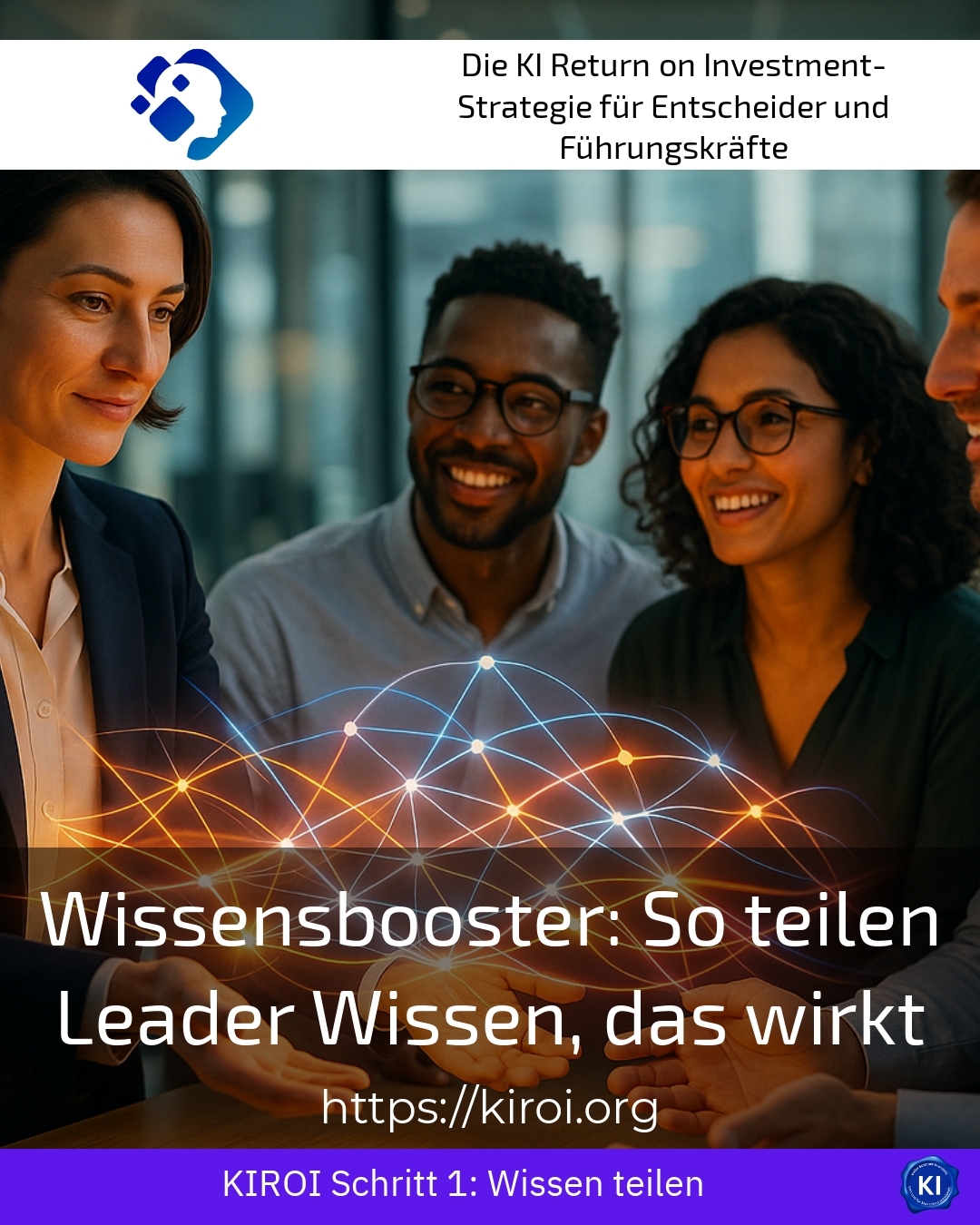
Imagine your most valuable insights wouldn't gather dust in folders, but would move like a catalyst through your entire organisation, sparking real change. This is precisely where the decisive knowledge booster comes in: this is how leaders share knowledge that has an impact and enables sustainable transformation. In a world where information is abundant, excellent leadership is distinguished by the ability to bring relevant knowledge to the right people at the right time. This article will show you which strategies truly support this.
Why traditional methods of knowledge transfer often fail
Many leaders invest significant resources in documenting their expertise. They create extensive manuals, presentations, and training materials. Despite this, employees often report being unable to find the knowledge they need. The cause often lies in the way information is prepared and shared.
For example, a medium-sized company in the manufacturing sector had established a comprehensive quality management system. The documentation comprised more than three thousand pages. Nevertheless, the same errors occurred repeatedly. The problem was not a lack of knowledge, but rather its accessibility.
Another example comes from the healthcare sector. A clinic conducted regular continuing education for its nursing staff. Participants consistently rated the training positively. However, there was hardly any change in behaviour in everyday practice. The knowledge conveyed remained theoretical and was not applied.
This pattern is also clearly evident in retail. Store managers received detailed instructions on customer service. However, implementation varied significantly between individual locations. The centrally created materials did not reach the teams in a format that enabled practical action.
The Knowledge Booster: How Leaders Share Knowledge That Works in Practice
Successful leaders understand knowledge transfer as a continuous dialogue. They use various channels and formats to embed their messages, paying particular attention to the needs of their target audience. This holistic approach fundamentally distinguishes effective from ineffective knowledge transfer.
In the field of business consulting, the method of Storytelling proven [1]. Experienced consultants tell stories from past projects. They make abstract concepts tangible and memorable as a result. The emotional component significantly enhances retention.
In software development, teams often use so-called Knowledge Sharing Sessions. Team members regularly present their learnings from current projects. The informal setting encourages open exchange and honest reflection.
The financial sector is increasingly focusing on Peer-learning formats. Experienced analysts work closely with junior colleagues. Knowledge flows in both directions and enriches everyone involved.
Best practice with a KIROI customer
An internationally operating logistics company approached us with a specific challenge. The management team possessed a wealth of experience, but this knowledge remained siloed. As part of the transruption coaching, we jointly developed a multi-stage concept for knowledge transfer. First, we identified the critical knowledge holders within the company through structured interviews. Subsequently, we established a format called Leadership Circles, where managers share their biggest learnings monthly. These sessions were intentionally kept short and focused on concrete recommendations for action. After six months, participants reported significantly improved collaboration between departments. The documentation of the sessions in short video snippets proved particularly valuable. New employees were able to access collective knowledge more quickly as a result. The company estimates that the onboarding time for new managers could be reduced by approximately thirty percent.
The role of emotional intelligence in knowledge transfer
Knowledge cannot be copied from one computer to another like a file. People absorb information when they are emotionally ready for it. Leaders who understand this tailor their communication accordingly. They first create an atmosphere of trust.
A technology company from the renewable energy sector impressively illustrates this approach. The management introduced so-called Failure Fridays ein [2]. Employees openly share their mistakes and the lessons learned from them. Psychological safety enables profound organisational learning.
We are observing similar developments in the pharmaceutical sector. Research teams are deliberately documenting failed experiments as well. This negative knowledge prevents others from hitting the same dead ends.
The automotive industry is focusing on Lessons Learned Workshops following project completions. These structured reflections capture both positive and areas for improvement. The insights are fed directly into subsequent projects.
Knowledge Booster: How Leaders Share Knowledge That Works Through Digital Tools
Modern technologies open up entirely new possibilities for knowledge transfer. It is not about the tools themselves, but about their sensible integration into existing processes. Digitalisation should complement human interaction, not replace it.
For example, a trading company could use an internal podcast platform. Executives share short audio insights on current developments there. Employees can consume these during their commute. The format adapts to the target audience's daily routine.
In the construction industry, Video Tutorials has established itself for manual activities [3]. Experienced masters demonstrate complex work steps. The visual representation surpasses any written instruction in its effectiveness.
The insurance industry is experimenting with Artificial intelligence In knowledge management, chatbots answer frequently asked questions and refer to relevant documents. This allows human experts to concentrate on more complex queries.
Best practice with a KIROI customer
A medium-sized mechanical engineering company faced a particular challenge in the area of knowledge transfer. Several experienced technicians were approaching retirement, and their specialist knowledge was at risk of being lost. As part of our support, we developed a comprehensive concept for knowledge preservation. We began by conducting in-depth expert interviews and documenting the implicit insights of the long-serving employees. These recordings were professionally processed and integrated into an internal knowledge database. Additionally, we established a mentoring programme in which each departing expert intensively supported a younger colleague. The transruption coaching helped to identify the correct matching criteria. After one year, management reported that critical service cases could still be resolved competently. The younger technicians felt well-prepared and valued. The programme will now be continued as a permanent part of personnel development and continuously advanced.
Overcoming barriers and transforming resistances
Not all employees readily share their knowledge. Some fear becoming replaceable as a result. Others simply have no time for additional tasks. Managers must take these concerns seriously and address them.
A media company solved this problem with clear incentives. Knowledge sharing became an integral part of performance objectives. Employees who regularly provided valuable content received special recognition.
In the public sector, we observe similar dynamics. A city council introduced an internal Wiki System The initial reluctance gave way to lively participation after a few months. The key lay in the support from the management.
The food industry uses Communities of Practice for interdisciplinary exchange [4]. Experts from various plants meet virtually on a regular basis. The informal nature encourages open communication and mutual learning.
The art of context-appropriate knowledge transfer
Knowledge only unfolds its effect in the right context. The same information can be valuable in one situation and irrelevant in another. Leaders develop a feel for when what knowledge is needed.
A consulting firm practices the concept of Just-in-Time Learning. Employees receive knowledge impulses precisely when they need them. The high relevance significantly increases their willingness to absorb information.
The importance of context-specific knowledge transfer is clearly evident in the hotel industry. New service staff don't learn everything at once, but rather in stages during their daily work. Experienced colleagues support them as informal mentors.
The telecommunications industry relies on Microlearning formats. Short learning modules of no more than five minutes convey focused content. The compact format suits the employees' working realities.
Knowledge Booster: How Leaders Share Knowledge That Lasts
Sustainable knowledge transfer requires a systematic approach and continuous nurturing. One-off actions quickly fizzle out. Only embedding it within the company culture ensures long-term success.
A chemical company established its own Corporate University. This internal academy bundles all continuing education activities and promotes exchange. Institutional anchoring underscores the strategic importance of the subject.
In the banking sector, Reverse Mentoring Programme proven [5]. Younger employees share their digital know-how with experienced leaders. The two-way exchange strengthens collaboration between generations.
The aviation industry uses Debriefs as a standardised reflection format. After every flight, crews systematically discuss their experiences. This practice has been shown to contribute to improved safety.
My KIROI Analysis
The experience of supporting numerous organisations with their knowledge transfer projects has provided me with important insights. The key success factor doesn't lie solely in technology or processes. It's much more about the attitude of leaders and their willingness to view knowledge as a shared asset. Organisations that understand this develop a learning culture that endures beyond individual people.
The transruption coaching has proven to be valuable support. The external perspective helps to recognise blind spots and to break new ground. Clients frequently report that through the collaboration, they have truly recognised their own strengths. The structured framework provides impetus without ignoring the individual situation.
The integration of knowledge transfer into everyday management seems particularly significant to me. Separate initiatives often remain foreign bodies and fizzle out after initial enthusiasm. Only when sharing insights becomes a matter of course does the full effect unfold. The examples presented here show that this change is possible. It requires patience, consistency, and the willingness to see setbacks as learning opportunities.
The future belongs to organisations that nurture and develop knowledge as a strategic resource. The Knowledge Booster: How Leaders Share Knowledge That Works is not a one-off project, but a continuous journey. I invite you to consciously shape this journey and benefit from the experiences of others.
Further links from the text above:
[1] Harvard Business Review – Knowledge Management
[2] McKinsey – Insights on People and Organisational Performance
[3] Association for Talent Development – Insights
[4] Etienne Wenger – Introduction to Communities of Practice
[5] Forbes – Leadership
For more information and if you have any questions, please contact Contact us or read more blog posts on the topic Artificial intelligence here.











 Deutsch
  English (UK)