
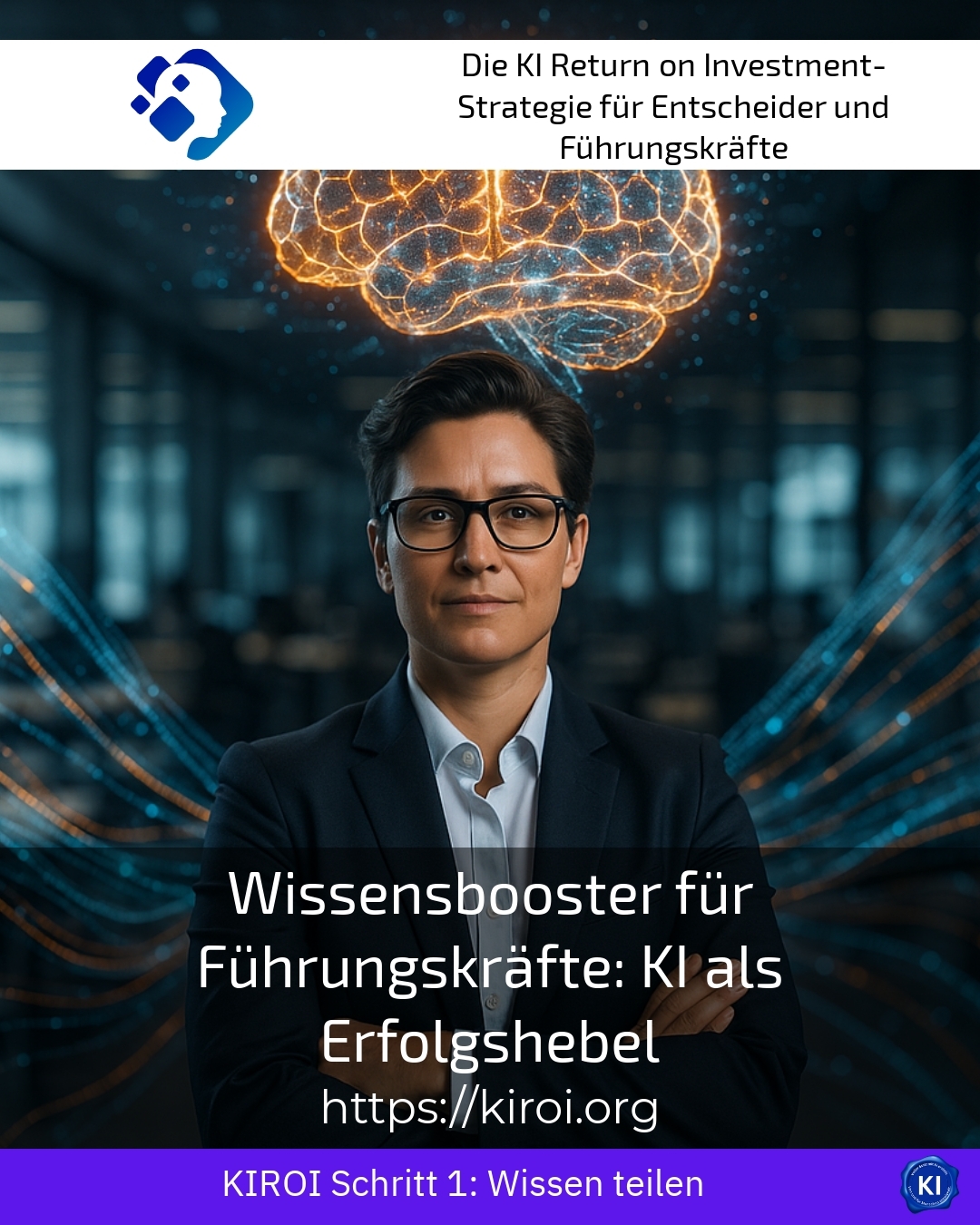
Imagine starting every morning with a personal advisor who has already analysed all relevant market data. This advisor knows your strategic priorities and provides you with precise recommendations for action. This is exactly what the Knowledge booster for executives: AI as a lever for success in today's business world. Many decision-makers come to me with similar challenges. They feel overwhelmed by the flood of information and are looking for ways to work smarter. At the same time, they want to inspire their teams and position them for the future. In this post, you will learn how modern technologies can sustainably support your leadership work.
Why traditional leadership models are reaching their limits
The pace of change has dramatically increased in recent years. Today, executives have to make decisions in a fraction of the time previously available. The consequences of these decisions are often far-reaching, more so than ever before. A medium-sized mechanical engineering company recently told me about this problem. Management spent more than twenty hours a week just sifting through reports and analyses. Despite this enormous expenditure of time, those responsible often felt insufficiently informed. I encounter such situations regularly in my consulting practice. A financial services provider from Frankfurt described similar challenges in the area of risk analysis. The sheer volume of data made a well-founded assessment nearly impossible. A logistics company from Hamburg also approached me with comparable questions. Route optimisation and capacity planning overwhelmed the existing structures. These examples clearly show that conventional methods are reaching their natural limits.
The Knowledge Booster for Managers: AI as a Success Lever in Practice
Modern technologies today offer possibilities that were unimaginable just a few years ago. They can analyse complex datasets in fractions of a second and recognise patterns that remain hidden to the human eye. This is not about replacing human leadership. Rather, tools are emerging that effectively support decision-makers. For example, a manufacturing company from Bavaria uses intelligent systems to predict maintenance needs. This has reduced unplanned downtime by more than forty percent. An insurance company uses similar approaches to process claims more quickly. The average processing time has fallen from several days to a few hours. Impressive examples of applications are also found in retail. A fashion chain optimises its inventory levels with data-driven forecasts, thereby reducing overproduction. These developments illustrate the transformative potential for almost all industries.
Best practice with a AIROI customer
A medium-sized company in the food industry faced a tremendous challenge. Management had to make daily decisions about production quantities and raw material orders. Up until now, these decisions were based on empirical values and gut feeling. As part of our collaboration, we implemented an intelligent forecasting system. This system analyses historical sales data and external factors such as weather data and public holidays. It also takes into account seasonal fluctuations and current market trends. After an introductory phase of three months, the first measurable successes became apparent. Food waste was reduced by an impressive thirty-two percent. At the same time, delivery reliability improved to over ninety-seven percent. The managers report a significantly more relaxed working atmosphere. They can now focus on strategic tasks instead of juggling operational details. The transruption coaching accompanied this transformation process over a total of eight months. The close involvement of all management levels in the change process was particularly important.
Data-driven decision-making as a new core competency
The ability to meaningfully interpret large volumes of data is becoming a crucial leadership skill for today. This isn't about becoming a data expert yourself. Instead, leaders need to understand what questions they should ask and how they can contextualise results. A pharmaceutical company from the Rhineland has consistently implemented this insight [1]. Its leaders have undergone comprehensive data literacy training. Today, they make decisions based on well-founded analyses rather than on hunches. A construction company from North Rhine-Westphalia took a similar approach to project planning. Intelligent systems there analyse past construction projects and identify typical risk factors. This provides project management with early warnings of potential delays or cost increases. A media company from Berlin is also using data-driven approaches for its editorial work. Analysing user behaviour helps them publish relevant content at the right time.
Knowledge Booster for Leaders: AI as a Lever for Success in People Management
Particularly in the area of personnel management, fascinating new possibilities are opening up. Intelligent systems can help to identify and optimally deploy talent. For example, a large retail company relies on data-driven analyses when assembling project teams. The results show a significantly higher success rate for teams assembled in this way [2]. A consulting firm from Munich uses similar approaches for personnel development. Individual learning paths are created based on skills analyses and career goals. Innovative applications are also found in healthcare. A chain of clinics is optimising the shift planning of its nursing staff with intelligent systems. Staff satisfaction increased measurably, and staff turnover decreased. These examples illustrate how technological support can complement human leadership.
The role of transruption coaching in digital transformation
Technology alone does not solve leadership problems or replace interpersonal skills. This is why guidance from experienced coaches is so valuable in transformation projects. Transruptions Coaching positions itself as a reliable partner for leaders in change processes. This is not about quick fixes, but about sustainable development. Clients often report initial uncertainties in dealing with new technologies. These uncertainties are perfectly normal and part of any transformation process. An energy supplier from Southern Germany sought our support precisely for this reason. The management team wanted to understand how data-driven decision-making could be integrated into their workflow. A textile company also sought impetus for the reorientation of its leadership culture. An automotive supplier approached us with questions about digital strategy and its implementation.
Best practice with a AIROI customer
An international logistics service provider faced the challenge of fundamentally modernising its leadership culture. The previous decision-making processes were lengthy and slowed down by numerous hierarchical levels. At the same time, the company possessed enormous amounts of data that remained largely unused. As part of the transruption coaching, we developed a new vision together with the management team. This vision combined technological innovation with a more agile leadership philosophy. Initially, we identified three pilot areas for testing data-driven decision-making processes. Freight forwarding planning, fleet management, and customer service were selected as test fields. For each area, we developed specific key figures and success criteria. The managers received intensive support in interpreting the new data analyses. After six months, impressive results were evident in all three pilot areas. Customer satisfaction increased by eighteen percent, while operating costs decreased by eleven percent. Particularly noteworthy was the positive feedback from the management team itself. The managers felt empowered rather than replaced by the new tools. This experience reinforces our approach of careful but consistent transformation.
Practical implementation steps for your organisation
The introduction of intelligent systems into leadership processes requires a well-thought-out approach. Hasty implementations often lead to frustration and rejection among those involved. Therefore, I recommend a step-by-step approach with clear milestones. First, you should identify the most pressing challenges in your leadership work. For example, a chemicals company from the Ruhr region began by analysing its decision-making processes. This revealed that there was particular potential for optimisation in supply chain management. A telecommunications provider, on the other hand, focused on improving its customer analytics [3]. A hotel chain prioritised optimising its pricing and occupancy management. These different starting points illustrate that there is no one-size-fits-all approach. Every organisation must find and shape its individual transformation path.
Knowledge booster for leaders: AI as a lever for success in strategy development
Modern technologies can also provide valuable impetus for strategic planning. They enable the simulation of various scenarios and their potential effects. For instance, a consumer goods group uses such simulations for its expansion planning. The analysis of market data and competitor behaviour supports well-founded location decisions. A financial institution employs similar approaches in the development of new product strategies. The evaluation of customer behaviour and market trends provides valuable insights for product development. A technology company from Dresden also reports positive experiences in strategic planning. The identification of innovation fields there is increasingly based on data-driven analyses. These examples show how the knowledge booster for executives: AI as a lever for success can also be effective at the highest strategic level.
My AIROI Analysis
The integration of intelligent systems into leadership represents one of the most significant transformations of our time. My AIROI analysis clearly shows that technological competence alone is not enough. Successful transformation always requires further development of leadership culture and interpersonal skills. The examples described illustrate the enormous potential that lies in the intelligent combination of people and technology. Leaders who embrace this change often report a new quality to their work. They can concentrate on the essential strategic and human aspects of their role. Routine tasks and data analyses are increasingly being taken over by intelligent systems. At the same time, the importance of empathy, creativity, and visionary thinking is growing. These skills cannot be replaced by any technology. My work with numerous leaders from a wide range of industries confirms this assessment. The future belongs to those who utilise technological opportunities without neglecting their human leadership competence. Transruption coaching offers you the guidance you need for this demanding path. I would like to encourage you to take the first step and actively shape the opportunities of this development.
Further links from the text above:
[1] McKinsey – The Data-Driven Enterprise of the Future
[2] Harvard Business Review – Artificial Intelligence Insights
[3] Gartner – Artificial Intelligence Research
For more information and if you have any questions, please contact Contact us or read more blog posts on the topic Artificial intelligence here.







 Deutsch
  English (UK)