
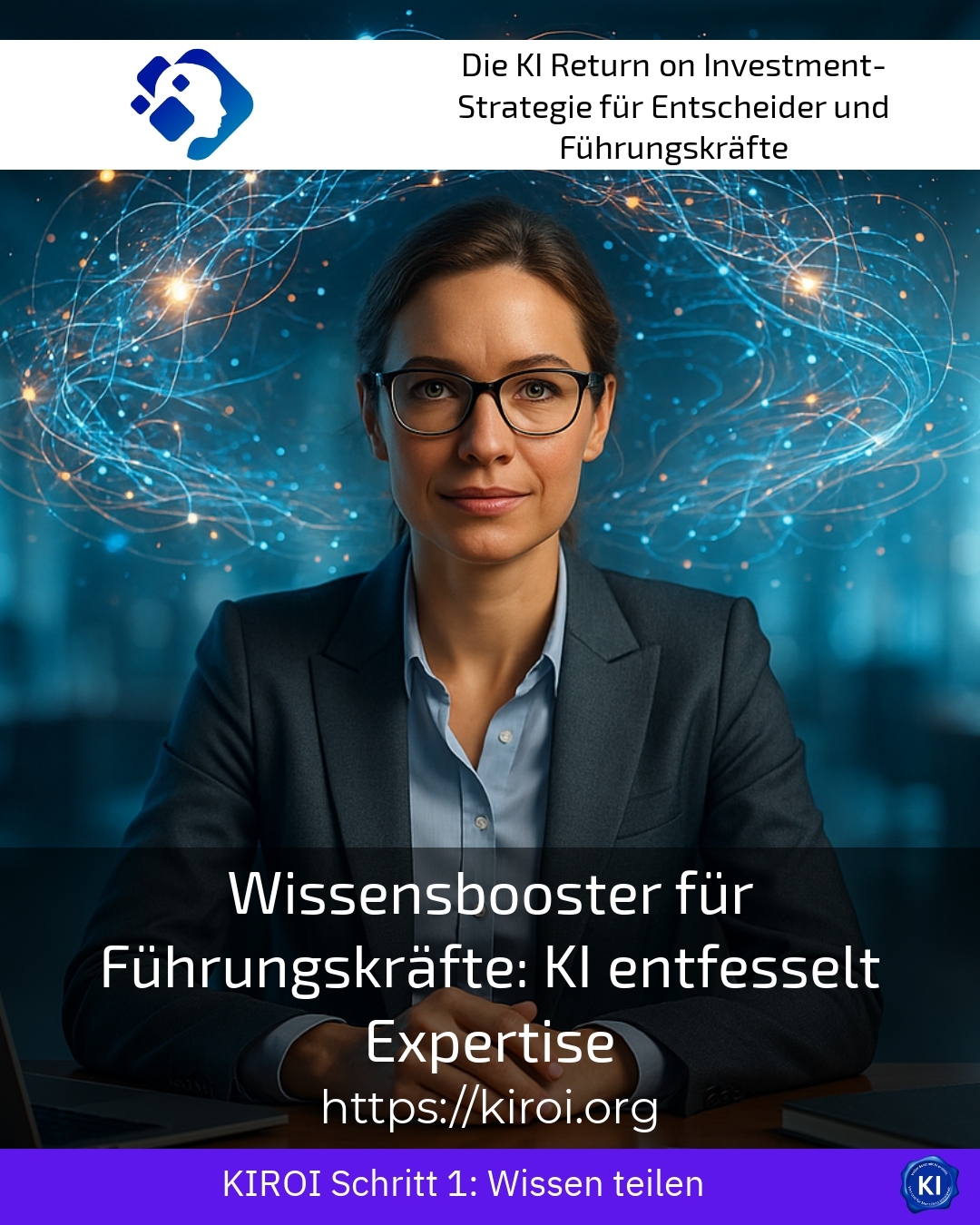
Imagine being able to access all of your organisation's expertise in seconds and use it for strategic decision-making. The Knowledge Booster for Leaders: AI Unleashes Expertise revolutionises the way decision-makers access critical information. While traditional methods of knowledge acquisition often take hours or days, modern technologies enable a whole new dimension of information processing. In an ever-accelerating business world, access to relevant knowledge becomes a crucial competitive advantage. Leaders face the challenge of filtering truly important insights from a flood of data. This is precisely where intelligent systems come in, which not only collect information but also process it contextually and present it in an actionably relevant way.
The new era of knowledge management in companies
Digital transformation has fundamentally changed the foundation of corporate knowledge work. Leaders often report difficulty in obtaining relevant information in a timely manner. In the automotive industry, for example, production managers have to analyse hundreds of quality data points daily. Intelligent assistance systems can pre-filter these data volumes and automatically highlight anomalies. This frees up valuable time for decision-makers to focus on strategic tasks. A sales manager in mechanical engineering, for instance, uses analysis tools to predict customer behaviour. The results help in prioritising sales opportunities. In the retail sector, forecasting systems, in turn, aid in inventory planning. These examples demonstrate the wide range of current application possibilities.
The Knowledge Booster for Leaders: AI Unleashes Expertise in a way that was unthinkable just a few years ago. Financial controllers in banks can perform complex risk analyses in minutes rather than weeks. HR managers gain insights into employee satisfaction through automated text analyses. Marketing directors better understand market trends by evaluating social media. These applications accompany daily work and provide valuable impetus for decisions.
Practical application scenarios in everyday leadership
In healthcare, hospital directors use intelligent systems to optimise schedules. The software takes into account qualifications, preferences, and legal requirements equally. Logistics companies rely on route optimisation, which incorporates traffic, weather, and delivery priorities. Energy providers analyse consumption patterns to predict grid load. These systems continually learn from new data and steadily improve their forecasts. In the construction industry, digital assistants support project planning and resource allocation. They identify potential delays before they become critical. This allows project managers to take proactive countermeasures.
Best practice with a KIROI customer
A medium-sized manufacturing company in the metal processing sector faced a significant quality assurance challenge. Management reported increasing complaint rates and dissatisfied key clients. As part of our transruption coaching support, we jointly analysed the existing processes and identified optimisation potential. The company introduced an intelligent image recognition system for surface inspection. This system detects micro-cracks and material defects that often escape the human eye. Implementation was carried out in stages over six months. Initially, we supported management in developing a clear digital strategy. Subsequently, we trained team leaders in handling the new analytical tools. Production staff also received needs-based further training. Clients often report initial resistance within the team. Here too, there were reservations towards the new technology. However, these concerns were resolved through transparent communication and employee involvement. After one year, a significant reduction in the complaint rate was evident. Customer satisfaction increased measurably. At the same time, management gained valuable time for strategic tasks. Today, the system delivers daily reports with quality key figures. This information sustainably supports continuous process improvement.
Knowledge Booster for Executives: Strategic Competence Development
The development of digital competencies in leadership requires a structured approach. Many decision-makers come to us for coaching with similar questions [1]. They want to understand which technologies are relevant for their company. Often, there is not enough time to delve into technical details. This is where our support comes in, by making complex correlations understandable. For example, the managing director of a chain of craft businesses wanted to optimise order processing. Together, we developed a digital roadmap for his company. In the pharmaceutical sector, we supported a research manager in introducing text analysis systems which search scientific publications for relevant studies. In the insurance industry, we assisted with the implementation of claims forecasting models.
The key to success lies in combining technological understanding with leadership skills. Technology alone doesn't solve problems. It needs to be embedded in a clear strategy. And it requires people who can use it effectively. That's why transruptions-Coaching doesn't just focus on tools. We support the development of holistic digital competence. This encompasses strategic thinking as well as practical application skills.
Industry-specific challenges and approaches to solutions
Every industry has its own particularities when it comes to handling knowledge. In the food retail sector, managers must keep an eye on expiry dates, supply chains, and consumer trends simultaneously [2]. Intelligent systems can assist here by aggregating relevant information. In the hotel industry, revenue management systems analyse booking patterns and market data, allowing hotel managers to dynamically adjust their pricing strategies. The aviation industry has been successfully using similar approaches for years. In the education sector, analysis tools help school principals identify areas where additional support is needed. University rectors gain insights into study progress and dropout risks. This information enables preventative measures for student support.
The field of legal advice is developing particularly excitingly. Law firm partners are increasingly relying on document analysis systems. These systems search contract archives for relevant clauses and precedents. This results in significant time savings during research. At the same time, the risk of overlooking important information decreases. In the auditing sector, similar systems are automating routine audits. This allows auditors to concentrate on more complex issues. The quality of audit work has demonstrably increased.
Best practice with a KIROI customer
A regional bank with multiple branches was looking for ways to improve customer consulting. The board reported increasing competitive pressure from direct banks and fintech companies. Customers increasingly expected fast and competent advice on complex financial matters. As part of our transruption coaching support, we developed a digital strategy together. The focus was on supporting the consultants through intelligent assistance systems. These systems prepare customer information in a structured way before the consultation meeting. They identify relevant product offers based on the customer profile. In addition, the consultants receive conversation guides for various consulting scenarios. We intensely supported the implementation over a period of nine months. We first trained the branch managers in using the new tools. They then passed on their knowledge to their teams. This approach significantly promoted the acceptance of the new technology. Clients often report positive feedback from their employees after such projects. The consultants feel better prepared and more competent. Customer satisfaction scores measurably increased in the following months. At the same time, the average conversion rate for consultation meetings rose. The board was very satisfied with the project results. They are now planning to expand the approach to other business areas.
Knowledge Booster for Managers: Implementation in Practice
The successful implementation of new technologies requires more than just technical expertise. Leaders must bring their teams along and foster a willingness to change. In the chemical industry, we supported a plant manager with the digitalisation of his production control. The biggest challenge was not the technology but acceptance within the team. In the textile industry, we assisted with the introduction of trend forecasting systems. Designers and buyers had to learn to integrate data-based impulses into their creative work. The media sector offers further interesting examples of knowledge management. Editorial managers use analysis tools to identify relevant topics. Publishing managers optimise their content strategies based on reader behaviour data.
A particularly important aspect is the ethical dimension of technology use. Leaders bear responsibility for the appropriate handling of data. Transparency towards employees and customers is indispensable in this regard. In human resources, for example, analytical tools must be used with care. They can support personnel selection, but must not discriminate. Finding this balance is an important leadership task. We also support our clients with these sensitive issues. Because technology should serve people, not the other way around.
Sustainable anchoring in leadership practice
The long-term integration of new working methods requires continuous attention. In the consulting sector, partners utilise intelligent systems for project acquisition. These systems analyse public tenders and identify relevant opportunities. In the real estate industry, valuation tools assist with investment decisions. They automatically aggregate market data, location factors, and development potential. Facility managers rely on predictive maintenance systems for building technology. These detect wear and tear before failures occur. In sports management, performance diagnostics systems comprehensively analyse athlete data. Coaches receive data-based recommendations for training design and load management.
The tourism sector also offers exciting use cases. Tour operators personalise offers based on customer preferences. Destination managers analyse visitor flows for better resource planning. Airport operators optimise passenger flows through intelligent process control. All these examples show: The Knowledge Booster for Leaders: AI Unleashes Expertise in almost every industry. Technology is always a means to an end. The real added value comes from smart application and human interpretation.
My KIROI Analysis
After years of supporting executives with digitalisation projects, a clear pattern emerges. Success depends less on the chosen technology and more on the leadership culture. Companies that foster an open learning culture implement new systems significantly more successfully. The role-model function of leaders plays a crucial part in this. When boards and managing directors themselves work with digital tools, teams follow. The most common stumbling blocks are unrealistic expectations and a lack of patience. Technology needs time to unfold its full potential. Furthermore, processes and structures often need to be adapted. These changes require careful planning and cautious implementation.
The combination of top-down strategy and bottom-up innovation is particularly important. Leaders should create frameworks that allow employees to experiment. At the same time, clear strategic guardrails and objectives are needed. The balance between freedom and leadership must be individually calibrated. Every company has its own culture and history. These must be taken into account in transformation projects. Standard solutions rarely work without adaptation. That is why individual support is so valuable. It takes into account the specific circumstances and needs. And it supports leaders in finding their own way. This is the core of our transruption coaching approach.
Further links from the text above:
[1] KIROI-Blog: Articles on Digital Transformation
[2] Bitkom: Digital Transformation in Companies
[3] McKinsey Digital Insights: Strategies for Digital Leadership
For more information and if you have any questions, please contact Contact us or read more blog posts on the topic Artificial intelligence here.











 Deutsch
  English (UK)