
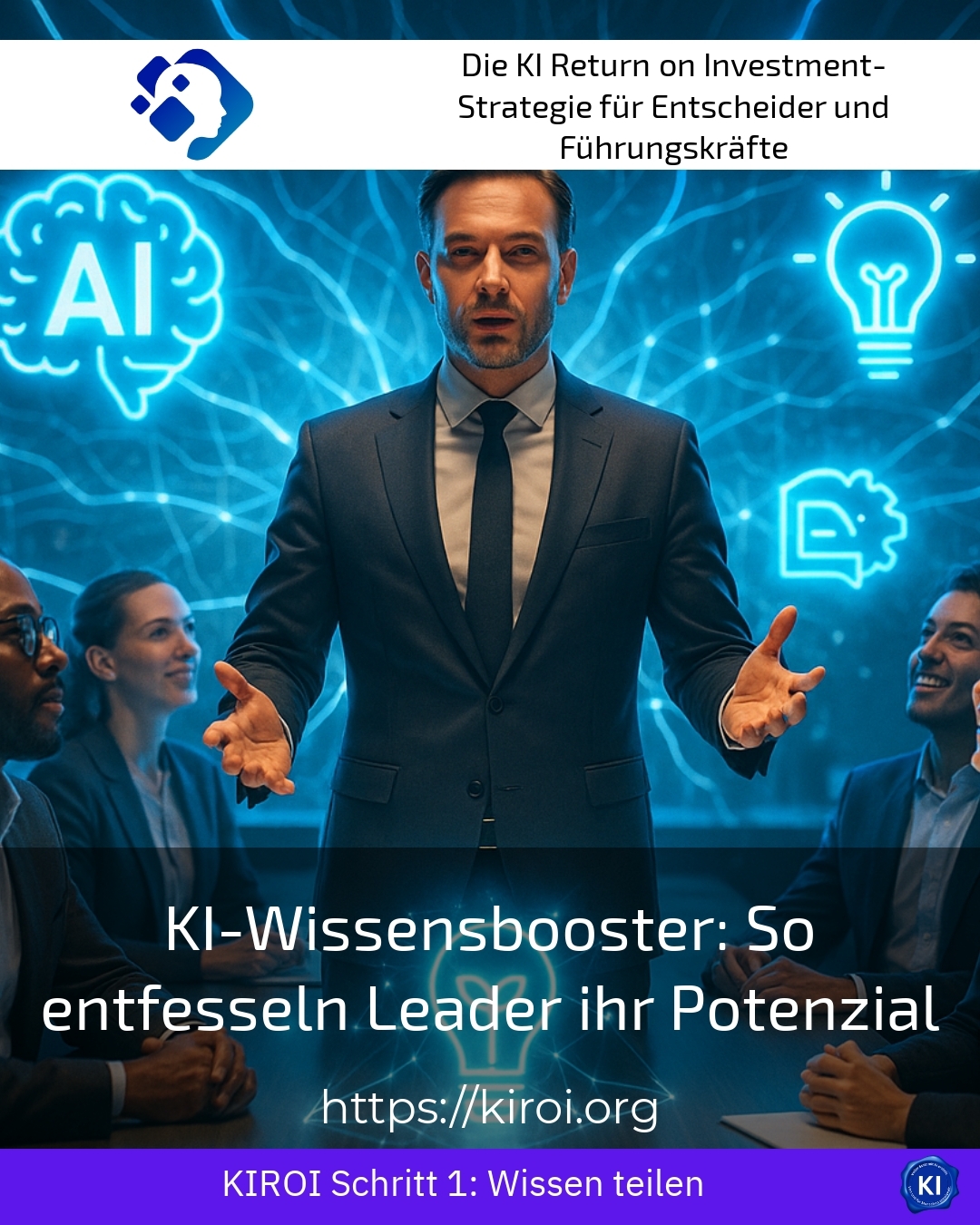
Imagine being able to access the collective intelligence of your entire organisation in fractions of a second, enabling decisions that previously took weeks. The AI Knowledge Booster is currently revolutionising how leaders operate, think, and guide their teams to success. In a time of exponentially increasing information overload and complexity, many leaders yearn for tools to help them stay on top of things. The good news is: these tools already exist, and they are becoming increasingly accessible. But how exactly do successful leaders unleash their full potential with these new capabilities?
Why the AI Knowledge Booster Indispensably Supports Executives Today
The demands on modern leaders have fundamentally changed in recent years. Today, leaders not only need to bring technical expertise. They also need to be able to process vast amounts of data and draw strategic conclusions from it. At the same time, employees expect quick answers and well-founded decisions. This is precisely where the AI knowledge booster comes in and offers support on multiple levels. It functions as an intelligent sparring partner that aggregates and processes knowledge. It by no means replaces human intuition or experience. Rather, it complements these valuable qualities with a data-based perspective.
Many executives report feeling overwhelmed by the sheer volume of information. They grapple with the challenge of distinguishing relevant data from irrelevant data. Time pressure further complicates thorough research and well-founded analyses. In such situations, intelligent technology can provide valuable impetus. It helps to recognise patterns and make connections visible. This creates new perspectives that would have remained hidden without this support.
Practical areas of application in daily management work
The potential applications of intelligent knowledge systems in leadership are both diverse and impressive. In the area of strategic planning, for example, leaders can conduct market analyses in minutes rather than days. The technology searches thousands of sources and summarises the relevant findings. For personnel decisions, intelligent systems assist through objective data analysis and skills matching. In customer communication, they enable personalised approaches based on comprehensive behavioural analysis. They also provide valuable insights into market trends and customer needs in product development.
A particularly exciting area of application lies in internal knowledge transfer. Many companies struggle with the problem that valuable expert knowledge lies dormant in the minds of individual employees. When these individuals leave the company, this knowledge is often lost irretrievably. Intelligent systems can offer support here by capturing and making knowledge accessible in a structured way. This transforms implicit knowledge into explicit knowledge, which is then available to all employees.
Best practice with a KIROI customer
A medium-sized manufacturing company with over three hundred employees faced a particular challenge in internal communication. Management realised that important information wasn't reaching all levels of the company. At the same time, team leaders felt overloaded because they constantly had to answer the same questions. transruptions coaching supported the company in implementing an intelligent knowledge management system. First, we collaboratively analysed the existing information flows and identified critical bottlenecks. Then, we developed a strategy for how frequently asked questions could be answered automatically. The system was introduced gradually, with employees involved from the outset. After six months, team leaders reported a significant reduction in their daily workload. The average time taken to answer internal queries decreased by over forty per cent. It was particularly noteworthy that employee satisfaction measurably increased during this period. People felt better informed and more autonomous in their daily work.
The human element: Why technology alone is not enough
For all the enthusiasm for technological possibilities, a crucial aspect must not be forgotten. Technology is only ever as good as the people who use and shape it. The AI knowledge booster only unfolds its full potential in combination with human expertise and judgement. Leaders must learn to critically question and contextualise the results of intelligent systems. They must understand where the limits of these technologies lie and how they can meaningfully complement them.
Clients often report having initially had inflated expectations of new technologies. They hoped for solutions that would, almost automatically, resolve all their problems. These expectations were, of course, not met, leading to frustration and disappointment. In coaching, we therefore work intensively on developing realistic expectations. We help to see technology for what it is: a powerful tool. And like any tool, it must be used correctly to realise its benefits.
Developing leadership skills further in the age of intelligent systems
The integration of intelligent technologies into everyday leadership requires new competencies and ways of thinking. Leaders must learn to ask the right questions to obtain meaningful answers. They must be able to distinguish between correlating and causal relationships [1]. The ability to combine algorithmic recommendations with human intuition is becoming increasingly important. At the same time, leaders need a basic understanding of how these systems work. They don't need to be able to program themselves, but they should understand the logic behind them.
In the insurance industry, for example, executives use intelligent analysis tools for risk assessment. In the healthcare sector, similar systems assist with diagnoses and treatment planning. In retail, they enable precise predictions about customer behaviour and demand trends. In the education sector, they help to personalise learning materials and analyse learning progress. These examples demonstrate how widespread the application possibilities already are across industries.
Best practice with a KIROI customer
A leader from the financial services sector came to transruptions coaching with a specific concern. They felt overwhelmed by the technological developments in their industry and uncertain in their role. Younger team members seemed much more familiar with new tools than they were. This situation was eroding their self-confidence and their authority as a leader. Together, we first carried out an honest assessment of their current competencies. This revealed that their strategic experience was of enormous value. The challenge was to integrate this experience with new technological skills. We developed a personalised learning plan tailored to their specific needs. In parallel, we worked on their attitude towards change and new technologies. After a few months, they reported significantly increased confidence in dealing with intelligent systems. They had learned to use their experience as a compass, while technology provided them with additional data. Today, they see themselves as a bridge-builder between traditional values and modern technology.
The AI knowledge booster as a catalyst for continuous learning
One of the most fascinating characteristics of intelligent knowledge systems lies in their ability to support individual learning. This allows leaders to specifically close knowledge gaps and expand their competency profile. The system adapts to the individual learning style and pace of the user. It recognises strengths and weaknesses and offers tailor-made learning paths. This way, lifelong learning becomes not an obligation, but an opportunity for personal development.
In the automotive sector, executives use these systems to keep abreast of new drive technologies. In the pharmaceutical industry, they help to present complex research findings in an understandable way. In banking, they assist in navigating regulatory requirements and compliance specifications [2]. These examples illustrate how versatile learning support can be. At the same time, they show that industry-specific knowledge increasingly needs to be supplemented by general analytical skills.
Overcoming resistance and creating acceptance
The introduction of new technologies into organisations rarely proceeds smoothly and without resistance. Many employees fear for their jobs or see their expert status threatened. Others perceive the changes as a threat to their usual ways of working and routines. Leaders face the task of taking these fears seriously and dealing with them constructively. They must develop a vision that shows how humans and machines can work together.
In coaching, we often encounter leaders who themselves have ambivalent feelings towards these developments. On the one hand, they recognise the opportunities, but on the other, they also feel their own insecurities. This ambivalence is completely normal and humanly understandable. What is crucial is how we deal with it and use it constructively. Because it is precisely this ability to reflect that distinguishes good from outstanding leaders.
Best practice with a KIROI customer
A logistics company planned to introduce an intelligent route planning system for its fleet of drivers. Management commissioned us to support this change process through transruption coaching. Initially, we held intensive discussions with employees from all areas of the company. It became clear that resistance to the new system was deeply rooted. Many long-serving drivers felt their expertise was not valued and feared being controlled. We then developed a concept that explicitly incorporated the drivers' experience. The system was configured to make suggestions rather than give instructions. The drivers could contribute their local expertise, thereby continuously improving the system. This participative approach led to a significantly higher level of acceptance than originally expected. After the implementation phase, even sceptical employees reported positive experiences. They particularly appreciated that their opinions were heard and taken seriously. The project became a model for further digitalisation initiatives within the company.
Ethical considerations and responsible deployment
With great power comes great responsibility – this principle also applies to the use of intelligent technologies. Leaders must be aware of the ethical questions these systems raise [3]. Issues such as data protection, transparency, and fairness are increasingly important. It is not enough to simply deploy technology because it is available. Instead, every application must be critically examined and measured against ethical standards.
In HR, for instance, managers must ensure that algorithmic decision-support tools do not reinforce discriminatory patterns. In marketing, the line between helpful personalisation and inappropriate surveillance must be maintained. In customer service, it must be clearly communicated when customers are interacting with automated systems. These examples show that responsible technology use requires active design. Managers have a particular responsibility here for their organisations and for society.
My KIROI Analysis
The integration of intelligent knowledge systems into leadership work represents a profound change that goes far beyond purely technical aspects. In my many years of working with leaders from a wide variety of industries, I have observed that the success of this transformation depends significantly on the inner attitude of the individuals involved. Those leaders who are willing to engage in a genuine learning process benefit the most. They understand that it is not about mastering technology, but about integrating it meaningfully into their own daily leadership.
I find it particularly noteworthy how the quality of management decisions can be improved through the conscious use of these tools. Managers often report an increased sense of confidence when making complex decisions. At the same time, I experience that the successful use of these technologies paradoxically makes the human qualities of leadership even more important. Empathy, intuition and ethical judgment are not replaced, but rather complemented and enhanced. The best results emerge where technological possibilities and human wisdom converge.
My recommendation to all leaders is therefore: view this development as an invitation to grow. Take time to explore and try out the new possibilities. Remain critical and reflective, but also open and curious. The path to the effective use of intelligent knowledge systems is an individual process that deserves guidance and support. As a coach, I see my role as helping to shape this path and supporting leaders in unlocking their full potential.
Further links from the text above:
[1] Harvard Business Review – Decision Making and Problem Solving
[2] McKinsey Digital Insights
[3] World Economic Forum – Artificial Intelligence and Robotics
For more information and if you have any questions, please contact Contact us or read more blog posts on the topic Artificial intelligence here.











 Deutsch
  English (UK)