
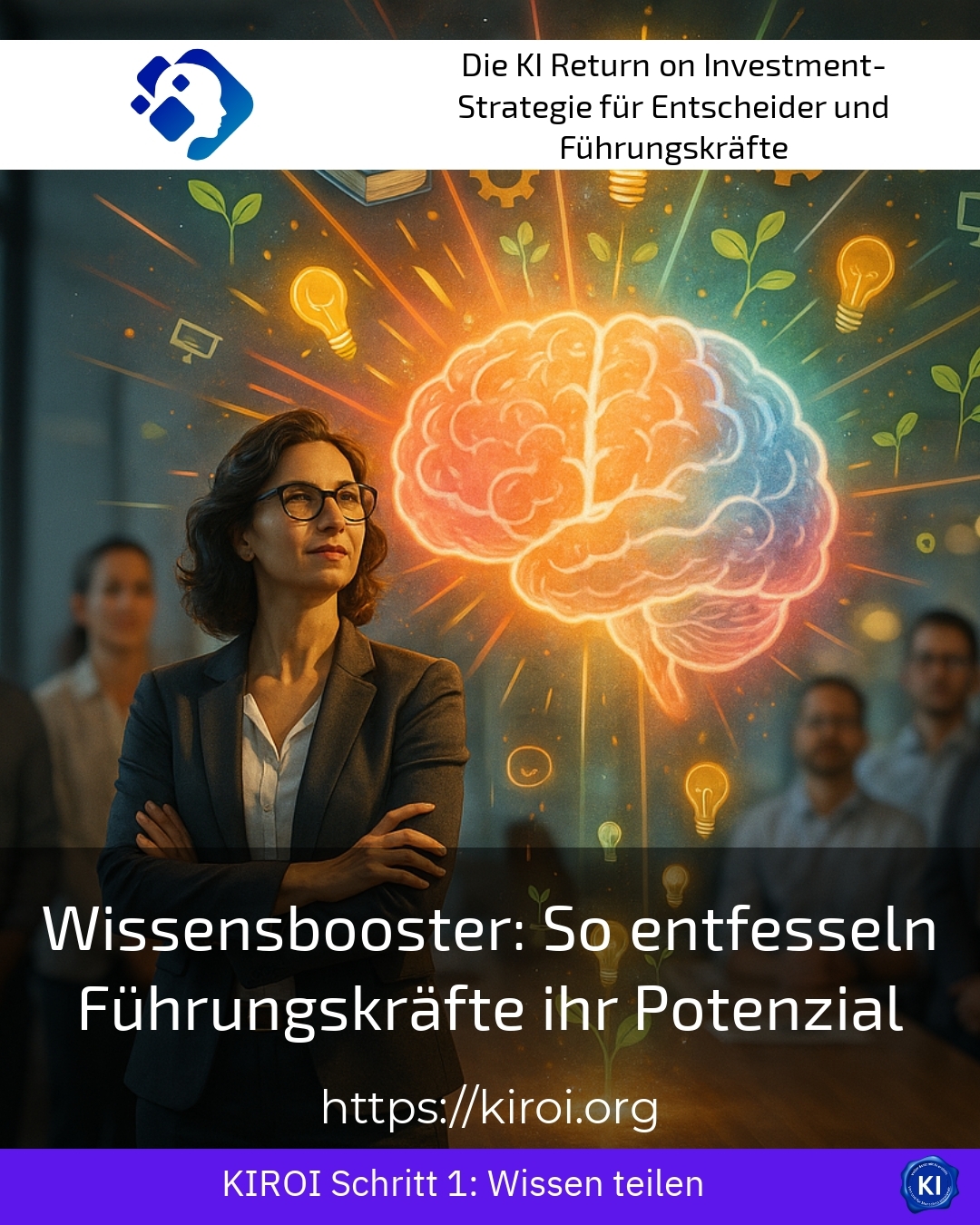
Imagine being able to make decisions within weeks that advance your business by years. This is precisely what leaders experience when they systematically their Knowledge Booster: How Leaders Unleash Their Potential to activate and thereby open up entirely new ways of thinking. The business world is changing rapidly. Those who lead today must already be thinking anew tomorrow. This isn't about simply absorbing information. It's about transforming knowledge into genuine competence to act. Many decision-makers report that, despite years of experience, they sometimes feel blocked. They are looking for new impulses and fresh perspectives. This is precisely where structured support comes in, which doesn't preach but empowers.
The Hidden Power of Systematic Knowledge Expansion
Leaders today face complex challenges that classic management methods can often no longer adequately address. Digitalisation is fundamentally changing business models, while employees expect a new way of working together. Customers demand personalised experiences. In this area of tension, decision-makers need a genuine Knowledge Booster: How Leaders Unleash Their Potential through continuous learning and reflection. Transruption coaching supports this by assisting with projects related to personal and organisational development. It's about questioning thought patterns and discovering new courses of action.
A managing director in the automotive supply industry faced the task of digitally transforming his company. He had read all the relevant studies and attended conferences, yet he lacked the decisive impetus for implementation. It was only through structured reflection processes that he recognised his own blockades. A sales director in mechanical engineering struggled with her team's motivation. She invested in training, but the results were lacking. The solution lay not in more information, but in changed communication. A CFO reported similar experiences when introducing new controlling systems. Clients often report that the breakthrough came when they stopped collecting information and started integrating it.
Best practice with a KIROI customer
A medium-sized company in the logistics sector was looking for ways to strengthen its leadership for future challenges. Management had realised that technical knowledge alone was no longer sufficient to remain competitive. As part of a transruptive coaching process, we jointly developed a customised development programme for the senior management team. The focus was not on imparting facts, but on activating existing resources and opening up new perspectives. The participants learned to view complex situations from different angles and to develop innovative solutions. After six months, all managers reported significantly increased decision-making confidence. Employee satisfaction improved measurably because the managers communicated more authentically and clearly. The company was able to successfully complete two critical transformation projects that had previously stalled repeatedly. Particularly remarkable was the change in how uncertainty was handled, with managers now perceiving it as an opportunity rather than a threat.
Knowledge Booster: How Leaders Unleash Their Potential Through Reflection
The ability to self-reflect distinguishes good leaders from outstanding ones. Many decision-makers spend their time on operational tasks. They react to demands rather than proactively shaping things. Yet, this is precisely where the key to unlocking potential lies. Those who regularly pause and critically examine their actions develop continuously. However, this practice requires structure and often external support. Transruption coaching offers precisely this framework for in-depth reflection processes.
In the healthcare sector, we particularly often encounter leaders struggling with the balance between economic demands and ethical values. A hospital manager sought support in balancing patient welfare with budget targets. Through targeted reflection exercises, she found an authentic leadership style. A chief physician described how he was able to motivate his team better through new ways of thinking. A Head of Nursing discovered previously untapped resources in her communication. These examples show that potential development is not a question of age or position.
The difference between information and transformation
Many executives consume trade literature, podcasts, and online courses daily. Nevertheless, their leadership behaviour often doesn't change sustainably. The reason lies in the way knowledge is absorbed. Passive reading activates different brain regions than active application. Only when new knowledge is linked to personal experiences does true competence emerge. This integration rarely succeeds on its own and requires structured support.
An example from the retail sector impressively illustrates this difference. The regional manager of a retail chain had read numerous books on change management. However, when he was tasked with carrying out a store restructuring, he felt uncertain. During the coaching process, he realised it wasn't knowledge he lacked, but self-confidence. A marketing director in e-commerce had similar experiences. She knew all the current trends but couldn't translate them for her team. The guidance helped her find her own voice. A purchasing manager learned to translate his specialist knowledge into convincing negotiation strategies [1].
Practical strategies for sustainable development
The development of leadership potential follows certain proven patterns. First, it's about honestly assessing the current situation. What strengths are already present? Which areas require development? This stocktaking demands courage and openness. Subsequently, concrete development goals are defined. These should be challenging yet achievable. The Knowledge Booster: How Leaders Unleash Their Potential unfolds its effect through consistent implementation.
In the tech industry, we often encounter leaders with considerable specialist expertise. However, they sometimes lack the emotional intelligence for complex team dynamics. A CTO of a software company learned to combine their analytical skills with empathy. An IT consulting project manager developed new competencies in stakeholder management. A development lead discovered how to foster innovation through psychological safety. These developments do not happen overnight but require continuous work and support.
Best practice with a KIROI customer
An internationally operating pharmaceutical company faced the challenge of fundamentally modernising its leadership culture. The previous hierarchical structure no longer suited the demands of a dynamic market environment. We accompanied the top management over a period of nine months in an intensive development process. Each leader received individual coaching sessions, supplemented by group formats. The focus was on developing a learning organisation in which knowledge is shared and multiplied. The leaders learned to ask questions rather than give answers, thereby strengthening their teams' sense of ownership. Work on personal beliefs that had previously blocked development steps proved particularly effective. Participants reported a new ease in dealing with complexity and ambiguity. The company subsequently recorded a significantly increased rate of innovation alongside increased employee retention. The leaders became true multipliers of a new learning culture throughout the entire group.
Knowledge Booster: How leaders unleash their potential in everyday life
Integrating new insights into everyday leadership presents many decision-makers with challenges. Schedules are full, and demands are diverse. Nevertheless, there are effective strategies for continuous growth. Short daily reflection moments can already achieve a lot. Regular exchange with a sparring partner deepens development. Documenting insights makes progress visible and motivates continuation.
In the construction industry, we often see managers working under enormous time pressure. One site manager found time for his personal development despite full project plans. He used his commute times for reflection and short audio impulses. An architect integrated learning moments into her lunch breaks. A managing director of a construction company established weekly reflection sessions with his management team. These examples show that development is not a question of available time, but of setting priorities [2].
The role of feedback and an external perspective
Leaders often operate in a bubble of limited feedback. The higher the position, the less honest feedback they receive. Employees are reluctant to express criticism. Peers are competitors. This situation significantly limits development potential. Transruptive coaching, as support for leadership development projects, creates a safe space for honest reflection.
An example from the energy sector vividly illustrates this dynamic. The board of an energy provider believed they practised a participative leadership style. Only external observation revealed unconscious patterns of directive communication. A department head in the wind power sector discovered blind spots in her delegation behaviour. A project manager in the renewable energy sector learned to adapt his communication situationally. These insights would hardly have been possible without a neutral external perspective.
Obstacles to unleashing potential
The path to greater leadership effectiveness is rarely straightforward. Setbacks and resistance are part and parcel of the development process. Clients often report inner doubts that arise when old patterns are called into question. Reactions from one's environment can also be unsettling. Teams accustomed to previous leadership styles sometimes react with irritation to change. These challenges are normal and surmountable.
In the financial services industry, we encounter particularly pronounced expectations of leaders. A bank director had to learn to accept vulnerability as a strength. A wealth manager struggled with the contradiction between empathy and assertiveness. An insurance manager realised that his need for control was stifling the team. These realisations are sometimes painful, but they enable genuine growth and more authentic leadership [3].
My KIROI Analysis
Supporting leaders in developing their potential requires a deep understanding of individual contexts and systemic connections. In my work with the KIROI approach, I repeatedly experience how transformative it is when decision-makers begin to critically question their own thought patterns and open up new avenues for action. It becomes clear that the most effective changes do not arise from external directives, but from internal processes of insight that are carefully guided. The integration of various sources of knowledge with personal reflection creates a unique dynamic that enables sustainable growth.
What I find particularly remarkable is how different the starting situations are, yet how similar the fundamental challenges are. Whether in the automotive industry, healthcare, or the financial sector, I encounter leaders everywhere who know more than ever before and yet are seeking direction. The solution lies not in more information, but in the ability to integrate existing knowledge and translate it into situationally appropriate action. Transruption coaching offers the necessary framework for this, in which development is possible without judgment.
The future belongs to leaders who embrace continuous learning as part of their identity and are willing to reinvent themselves repeatedly. This attitude requires courage, humility, and the willingness to accept support. Those who embark on this path not only discover new career opportunities but also often experience profound personal enrichment that extends far beyond the work context.
Further links from the text above:
[1] Harvard Business Review – Leadership Insights
[2] McKinsey – People and Organisational Performance
[3] Gallup – Leadership Development Research
For more information and if you have any questions, please contact Contact us or read more blog posts on the topic Artificial intelligence here.











 Deutsch
  English (UK)