
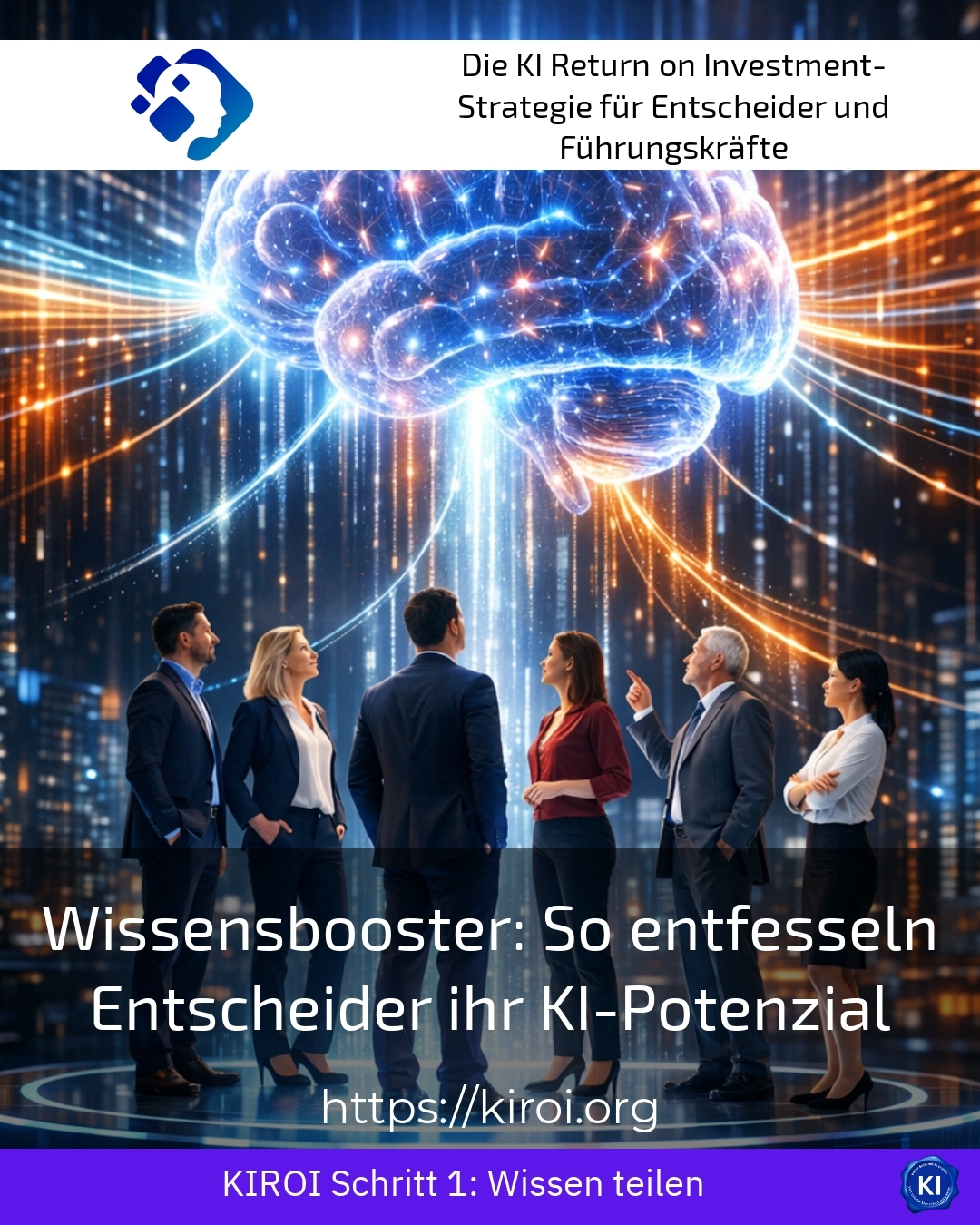
Have you ever wondered why some leaders seemingly master digital transformation effortlessly, while others struggle despite significant investments? The answer often lies not in the technology itself, but in the way decision-makers expand their knowledge and strategically apply it. The decisive Knowledge booster For modern leaders, the key is to systematically learn how intelligent systems work and what concrete added value they can create within their own company. This involves more than superficial buzzword knowledge; it requires a deep understanding that enables real competitive advantages.
Why traditional training often isn't enough
Traditional forms of continuing education quickly reach their limits when dealing with complex technological topics. Many executives report that seminars and workshops provide interesting insights, but rarely lead to successful transfer to their own work routine. This is primarily because generic training courses hardly take into account the specific challenges of individual industries. A manager from the manufacturing sector has completely different requirements than a department manager in the financial sector. This creates knowledge gaps that later prove to be strategic weaknesses.
In the automotive industry, for example, decision-makers need to understand how predictive maintenance systems can minimize production disruptions. At the same time, it is necessary to understand which data sources are relevant for this and how they must be securely processed. In healthcare, however, questions of diagnostic support and ethical responsibility are at the forefront. The logistics industry, in turn, focuses heavily on route optimization and warehouse management. All of these different application areas require tailored learning approaches.
Therefore, transruptions coaching accompanies executives on their individual development journey. It is about jointly analyzing which competencies need to be built and how these can be sustainably anchored. Clients often report that only through this intensive support does the breakthrough occur.
The knowledge booster as a strategic instrument
True understanding of intelligent systems does not develop overnight; it requires a continuous engagement with different perspectives. The Knowledge booster It acts as a catalyst that specifically sets impulses and accelerates learning processes. The key is the connection between theoretical foundational knowledge and practical application cases from the company’s own context. Only in this way is a deep understanding created that enables long-term sustainable decisions.
In retail, progressive companies are already using automated systems for personalized product recommendations. These analyze purchasing behavior and predict future preferences with astonishing accuracy. Banks are using similar technologies to support credit decisions and detect fraud attempts early on. In agriculture, intelligent systems optimize irrigation and fertilizer use based on weather data and soil analyses.
Best practice with a AIROI customer
A medium-sized company in the mechanical engineering sector faced the challenge of qualifying its senior management for the digital future. The management recognized that previous training measures had remained superficial and genuine behavioral changes had not occurred. As part of an intensive follow-up program, the current knowledge level of all involved parties was first analyzed and documented. Subsequently, we developed together an individual learning path that included both theoretical modules and practical experimental spaces. The management received the opportunity to try out various intelligent tools in a protected environment and to reflect on their findings. Particularly valuable was the regular exchange between departments, which led to completely new ideas. After six months of intensive mentoring, not only had the technical understanding improved significantly, but the innovation culture throughout the entire company had also been noticeably transformed. Today, the management team is initiating pilot projects independently and actively driving the digital transformation forward.
Knowledge booster through structured learning formats
Choosing the right learning format is crucial to the success of any continuing education initiative. Some executives prefer intensive workshops, while others are better served by continuous micro-learning offerings. What matters is that the formats fit the personality and time budget of the learners. Only then will they be used regularly and lead to real growth in competence.
In the pharmaceutical industry, it has been shown that short, focused learning units work particularly well [1]. Managers in this sector are often highly involved and appreciate the flexibility of digital formats. The tourism industry, on the other hand, often benefits from intensive in-person workshops where concrete use cases can be demonstrated. Insurance companies are increasingly combining both approaches and creating hybrid learning environments [2].
Transruptions coaching helps companies identify and implement exactly these appropriate formats. In doing so, both the corporate culture and the individual learning preferences of the participants are taken into account.
From knowledge to action: The crucial step
Knowledge alone does not change anything – only consistent implementation creates real added value. Many decision-makers report that they have understood in theory how intelligent systems work, but cannot transfer this knowledge into concrete projects. This implementation gap is widespread and has various causes. Often there is a lack of clear priorities, and sometimes there is also a lack of the necessary support from the team.
In the energy sector, for example, we observe executives launching ambitious projects after intensive learning phases [3]. These range from intelligent grid controls to automated customer service processes. In the media sector, decision-makers are experimenting with content generation and personalized recommendation systems. The construction industry, in turn, focuses on project management and resource planning.
The Knowledge booster It only fully takes effect when it is translated into concrete action steps. Therefore, guidance during the implementation phase is at least as important as the initial knowledge transfer.
Typical challenges and how decision-makers overcome them
The issues that executives come to coaching with are diverse and at the same time characteristic. Many report uncertainty in the face of rapid technological development and the concern of missing important trends. Others struggle with resistance within their own teams or with limited budgets for innovation projects. Some feel overwhelmed by the abundance of opportunities and do not know where to begin.
In commerce, for example, the question often arises as to which processes are suitable for automation at all. In the restaurant industry, it often comes down to the balance between technology and personal service. The manufacturing industry is intensively engaged in quality control and process optimization. All of these questions require individual responses that must be developed in dialogue.
Best practice with a AIROI customer
A traditional family business in the food industry came to us with a specific challenge. The third generation had taken over the management and wanted to position the company for the future. However, they lacked the technological understanding to make informed decisions about investments in intelligent systems. We began with a comprehensive review of the existing processes and together identified the most promising points of approach. In weekly sessions, we worked on specific questions and systematically built up the necessary knowledge. In parallel, we launched a modest pilot project for automated quality control in production. The combination of learning and practical experimentation proved particularly effective. The young management team increasingly developed confidence in technological matters and was able to convey this expertise to the experienced leadership team. The pilot project yielded measurable results and also convinced the skeptical voices within the company.
Sustainable competence development as a competitive advantage
Companies that consistently invest in the further development of their leadership create long-term competitive advantages. The Knowledge booster It acts as a multiplier in this process, because competent decision-makers make better decisions and lead their teams more effectively [4]. This effect increases over time and leads to a positive spiral of knowledge, action, and success.
In the telecommunications industry, this is particularly evident. Companies with well-trained leadership teams implement new technologies faster and more successfully. In the transportation sector, in-depth knowledge leads to innovative business models and more efficient processes. The real estate industry benefits from decision-makers who can competently interpret and strategically utilize data analysis.
Transruptive coaching accompanies this process over extended periods of time and ensures that the acquired knowledge is not lost. Regular reflection loops and adapted learning impulses keep the topic present and drive continuous development forward.
My AIROI Analysis
The intensive focus on knowledge building for decision-makers clearly shows that technological competence is no longer an optional additional qualification, but has become an indispensable prerequisite for successful leadership today. My analysis of the various industries and use cases confirms that the decisive difference between successful and less successful transformation projects lies mostly in the knowledge and attitude of the involved leadership. Companies that systematically invest in the further education of their decision-makers achieve measurably better results in the implementation of new technologies.
What seems particularly remarkable to me is the realization that traditional training formats are often insufficient and that individual guidance makes the crucial difference. The combination of structured knowledge building and practical application in protected experimental spaces has proven particularly effective. Leaders need not only information but also space for reflection and exchange with like-minded peers. The AIROI-model offers a proven framework that meaningfully connects these different elements and enables sustainable development [5]. The future belongs to those who are willing to continuously learn and consistently translate their knowledge into action.
Further links from the text above:
[1] McKinsey: Successful organizational development
[2] Harvard Business Review: Leadership Development
[3] World Economic Forum: AI and Machine Learning
[4] Gartner: What’s New in Artificial Intelligence
[5] AIROI Master Plan for Managers
For more information and if you have any questions, please contact Contact us or read more blog posts on the topic Artificial intelligence here.






 Deutsch
 English (UK)