
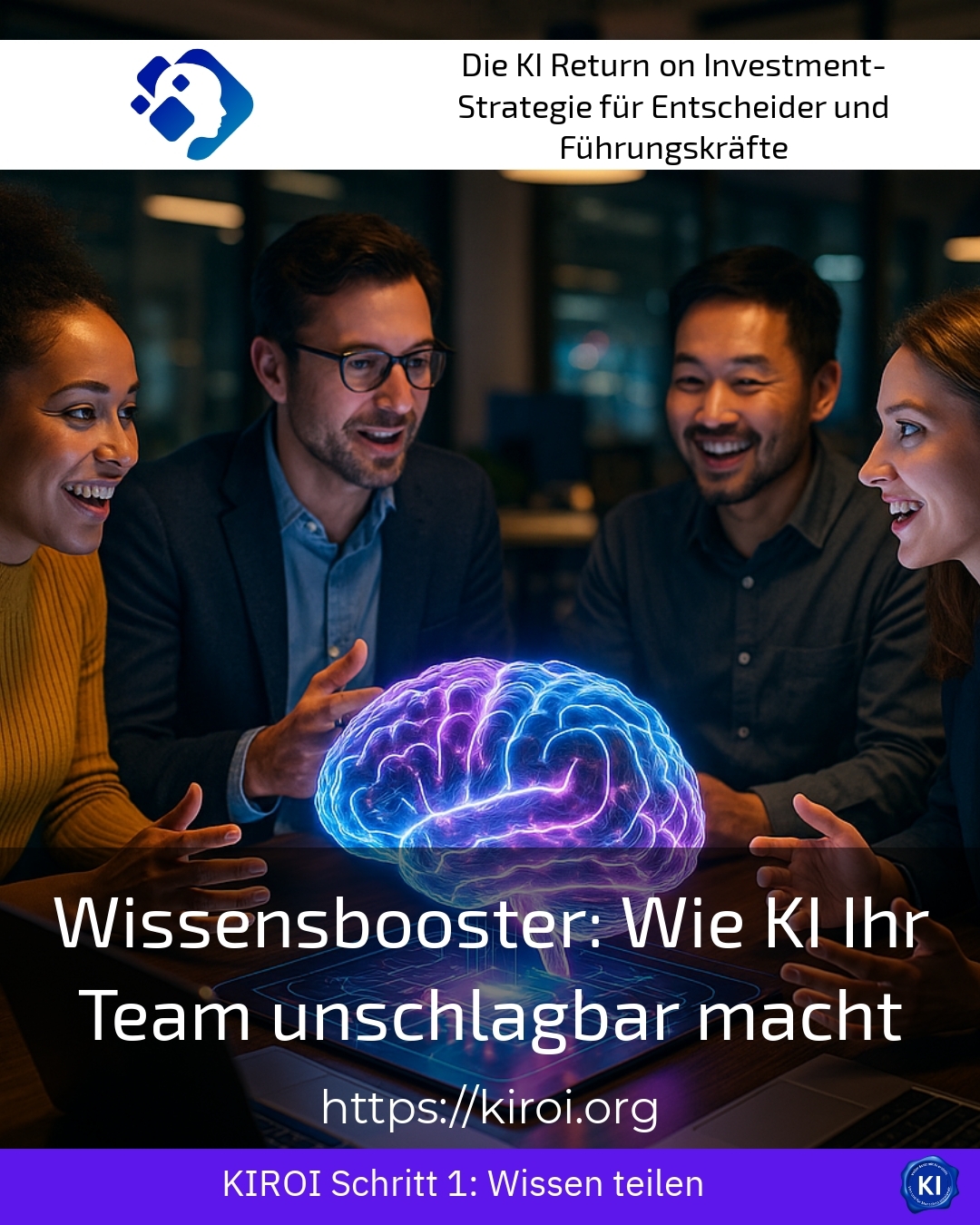
Imagine your employees had access to all company knowledge at any time. This Knowledge booster transforms average performance into exceptional results. The digital revolution is fundamentally changing how we process and use information. Intelligent systems now help to uncover hidden potential. Teams frequently report increased productivity and better collaboration. The following sections outline concrete implementation pathways.
The Knowledge Booster as a strategic advantage
Businesses of all sizes face a common challenge. valuable knowledge is often scattered across different departments and minds. Modern technologies can overcome this fragmentation and create real synergies. This is not about replacing human expertise. Instead, the focus is on intelligently complementing and enhancing existing competencies. Many companies are already using semantic search systems for their internal documentation. Others rely on automated summaries of meetings and project reports. Particularly in customer service, impressive improvements are seen through real-time knowledge support. Employees can answer complex queries more quickly and accurately. The onboarding time for new team members is significantly reduced through structured knowledge bases.
A leading automotive supplier implemented an intelligent document management system. Engineers now find relevant technical specifications in seconds. A medium-sized mechanical engineering company revolutionised its after-sales business with knowledge-based diagnostic tools. On-site service technicians receive context-specific repair instructions on their mobile devices. An international consulting firm uses text analysis tools for extensive market research reports. The analysis time was reduced from weeks to just a few days.
Best practice with a AIROI customer
An internationally operating logistics company faced significant challenges in internal communication. The company employs over three thousand people at twenty different locations worldwide. Valuable process knowledge was regularly lost when experienced employees left the company. The transruption coaching support from the AIROI team began with a comprehensive analysis of existing knowledge flows. Together, we identified critical knowledge gaps and developed a customised strategy. The implemented system now automatically captures relevant information from emails, documents, and project management tools. Employees can ask natural language questions and receive precise answers with source references. The average time for information retrieval decreased by sixty percent. New employees report a significantly improved onboarding experience. Management particularly values the data-driven insights into knowledge bottlenecks. The investment paid for itself after just nine months through increased efficiency.
How the knowledge booster transforms concrete processes
The practical application of intelligent systems extends across almost all areas of business. In sales, analysis tools support the identification of promising leads. Sales teams receive automatic recommendations for cross-selling opportunities based on customer histories. In procurement, forecasting models optimise order quantities and significantly reduce warehousing costs. Human resources departments use text-based analyses for more objective application processes. The legal department benefits from automatic contract analysis and risk assessment.
A major retailer revolutionised its complaints management by analysing the sentiment of incoming messages. Urgent cases are automatically prioritised and forwarded to experienced staff. A pharmaceutical company significantly accelerated its literature search for clinical trials. Relevant publications are automatically identified and presented in order of relevance. An insurance company implemented a system for the automatic assessment of claims in the event of motor vehicle accidents [1]. Photos are analysed and repair costs estimated within minutes.
Knowledge Booster in Quality Management
Intelligent systems are particularly unlocking their transformative potential in the quality sector. Image recognition systems identify production defects more reliably than the human eye. One electronics manufacturer reduced its scrap rate by forty percent with automated quality control. In the food industry, sensors continuously monitor production parameters and warn of deviations early on. A textile company uses colour analysis algorithms to ensure consistent product quality. These examples illustrate the broad applicability of modern technologies.
Best practice with a AIROI customer
A medium-sized manufacturing company in the precision engineering sector approached our team. The quality requirements of their customers from the aerospace industry were continuously rising. At the same time, there was a shortage of qualified skilled workers for manual final inspection. The transruption coaching support involved an intensive six-month collaboration. Initially, we systematically documented the implicit knowledge of experienced quality inspectors. Subsequently, we jointly developed an image-based inspection system with the customer. The system learned to distinguish between acceptable and faulty parts from thousands of categorised sample images. Today, humans and machines work together in a symbiotic relationship. The system makes suggestions, but experienced inspectors make the final decision. The defect rate for delivered products fell by eighty percent. At the same time, employee satisfaction increased as monotonous routine tasks were reduced. Furthermore, the documentation of expert knowledge ensures knowledge transfer for future generations.
Challenges and solutions for implementation
The introduction of intelligent knowledge systems presents companies with a variety of challenges. Technical hurdles often form only the tip of the iceberg. Cultural resistance and fear of change require sensitive communication and involvement. Data protection requirements must be considered from the outset [2]. Integration into existing system landscapes demands careful planning and sufficient resources.
A financial services provider initially failed due to a lack of employee acceptance. Successful implementation was only achieved after extensive training and the involvement of multipliers. A manufacturing company underestimated the importance of clean master data for meaningful analyses. Months of data cleansing were necessary before the first results were achieved. An authority struggled with strict compliance requirements and finally found a data protection-compliant solution. These experiences highlight the importance of holistic project planning.
Knowledge booster and employee development
The human element remains central to the success of any technology implementation. Further training programmes equip employees to handle new tools competently. This often changes the entire requirement profile of certain positions. Routine tasks are automated, but analytical and creative tasks gain in importance. Companies are increasingly investing in the development of these future-relevant skills.
A telecommunications provider established an internal academy programme for data-based decision-making. Over five hundred employees have so far completed the various modules of the programme. A retail company actively promotes the exchange of knowledge between employees with technical expertise and those with strong business experience [3]. Interdisciplinary project teams jointly develop innovative solution approaches for complex business challenges. An educational institution has integrated practical exercises with modern analytics tools into all degree courses. As a result, graduates are better prepared for the demands of the modern job market.
Future prospects of intelligent knowledge utilisation
Technological development is progressing at an impressive speed. Multimodal systems will increasingly be able to analyse text, images, audio, and video together. Personalised learning assistants support individual further education in the workplace. Predictive models anticipate knowledge gaps and proactively suggest relevant resources.
A technology group is already trialling virtual assistants for complex technical support requests. These systems carry out diagnostic steps independently and only escalate when necessary. A healthcare provider is testing decision support systems for medical professionals. The systems analyse patient data and indicate possible diagnoses or interactions. An energy supplier is using predictive maintenance models for its electricity grid. Potential failures are detected and rectified before customers are affected.
My AIROI Analysis
Examining numerous implementation projects reveals recurring patterns of success and pitfalls. Companies that adopt a holistic approach achieve consistently better results. Technology alone does not solve organisational problems and cannot replace a well-thought-out strategy. Involving all stakeholders from the outset significantly reduces resistance and fosters acceptance. Realistic expectations regarding timelines and required investments prevent disappointment. The knowledge booster only unfolds its full potential in combination with cultural change and continuous learning. Successful organisations view technology adoption as an iterative process with regular adjustments.
The 'transruption' coaching support has proven to be a valuable approach for companies across all sectors. External perspectives help to identify blind spots and discover new opportunities. At the same time, organisations benefit from proven methods and experiences from comparable projects. The combination of technical expertise and change management competence creates optimal conditions. However, companies should also systematically build internal expertise for long-term independence. The knowledge booster is becoming a decisive competitive factor in an increasingly knowledge-based economy. Those who lay the foundations today will secure strategic advantages tomorrow over less prepared competitors.
Further links from the text above:
[1] McKinsey – The Economic Potential of Generative AI
[2] Datenschutz.org – Artificial Intelligence and Data Protection
[3] Harvard Business Review – Artificial Intelligence
For more information and if you have any questions, please contact Contact us or read more blog posts on the topic Artificial intelligence here.











 Deutsch
  English (UK)