
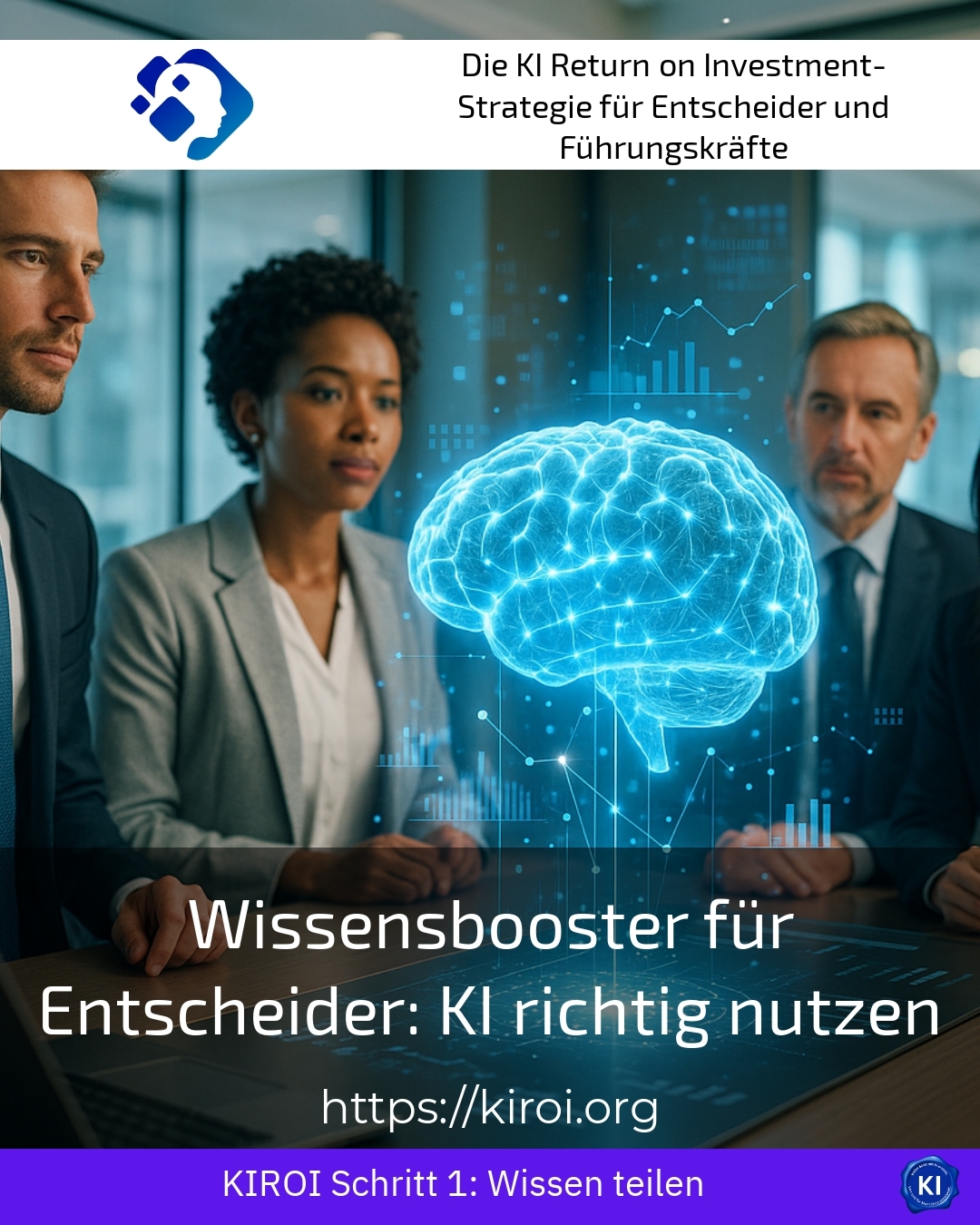
Envision your most important decision next week being based on outdated data. This is precisely the scenario that executives face daily because they lack the crucial Knowledge Booster for Decision-Makers: Using AI Correctly is missing. The speed at which markets are changing is increasingly overwhelming traditional analysis methods. At the same time, intelligent systems offer possibilities that seemed unthinkable just a few years ago. That's why it's worth taking a closer look at the opportunities, but also at the pitfalls. This article will guide you through the most important aspects of modern decision support. It shows concrete applications and provides impetus for your everyday leadership.
Why traditional decision-making processes are reaching their limits
Leaders today face a paradoxical situation. On the one hand, they have access to more information than ever before. On the other hand, they often lack the time to process this flood of data meaningfully. Classic reports often only reach the desk when market conditions have already changed. For example, a manufacturing company might only realise weeks later that supply bottlenecks are occurring. A trading company sometimes recognises seasonal fluctuations too late. Financial service providers may miss market opportunities because analyses are delayed. These delays not only cost money but also competitive advantages. Therefore, more and more decision-makers are looking for ways to expand their knowledge base. Intelligent technologies offer promising approaches here, but they must be used correctly.
Another problem lies in human perception itself. Cognitive biases influence decisions more strongly than many would like to admit. Confirmation bias, for example, leads leaders to preferentially perceive information that supports their opinion. Automated systems can help to balance this out by highlighting contrary data. A logistics company benefits, for instance, when algorithms detect unexpected delivery delays early on. An energy provider receives valuable clues when consumption patterns deviate from expectations. A healthcare provider can better plan patient flows once patterns become visible. These examples illustrate how technological support can compensate for human weaknesses.
The Knowledge Booster for Decision-Makers: Using AI Correctly in Everyday Management
The integration of intelligent systems into decision-making processes requires more than technical understanding. It demands a rethink in leadership culture. Many organisations fail not because of the technology itself, but due to a lack of preparation. Knowledge Booster for Decision-Makers: Using AI Correctly It therefore begins with an honest assessment. Which decisions do you regularly make under time pressure? Where do you lack reliable data foundations? These questions form the starting point for meaningful implementations. A mechanical engineering company found that maintenance decisions were often based on empirical values. After the introduction of predictive analytics, unplanned downtime decreased significantly. A telecommunications provider recognised that customer churn became apparent earlier. A pharmaceutical company improved its research planning through better literature analyses.
Transruptions-Coaching supports executives with precisely these change processes. The introduction of new technologies always raises questions about roles and responsibilities. Who ultimately makes the decision when algorithms and experience provide different recommendations? These areas of tension require clear guidelines and open communication. Clients often report initial scepticism within their teams. This scepticism, however, often turns into enthusiasm as soon as initial successes become visible. An automotive supplier experienced how its engineers reacted distrustfully at first. After a few months, the same employees considered the new tools indispensable. A retail group observed similar dynamics among its buyers. An insurance company found that administrative staff could work more quickly and precisely.
Best practice with a KIROI customer
A medium-sized company in the food industry approached transruptions-coaching with a specific request. The management felt overwhelmed by the flood of information and was increasingly making decisions based on gut feeling. As part of the support, we first analysed the existing information flows and identified critical decision points. It turned out that sales forecasts for seasonal products were particularly unreliable. Together, we developed a concept for the step-by-step implementation of intelligent forecasting tools. We paid special attention to involving experienced employees, whose knowledge was to be incorporated into the system. After six months, the management reported significantly improved planning foundations. Stock levels were reduced by almost a fifth without jeopardising delivery capability. At the same time, satisfaction within the sales team increased because sound figures made daily work easier. The combination of a technological solution and cultural support for the change process proved particularly valuable. The managers learned to critically question algorithm recommendations and combine them with their experience. This example shows how transruptions-coaching can provide support for projects involving intelligent decision support.
Strategic Application Areas for Intelligent Decision Support
The potential applications for intelligent systems span almost all business areas. Applications are particularly effective where large volumes of data need to be processed quickly. For example, a chemical company uses algorithms to optimise its production processes [1]. A construction company relies on predictive maintenance for its machinery fleet. A media company personalises content based on user behaviour, thereby increasing its reach. These examples illustrate the breadth of possible applications. However, the crucial question is always what concrete benefit an implementation provides. Introducing technology for its own sake rarely leads to the desired success.
In HR, intelligent systems support the analysis of job applications [2]. A service company reported that the time to fill a vacancy significantly decreased. At the same time, the quality of hired candidates increased, according to management's assessment. A technology group uses similar tools to identify internal talent for leadership positions. A consulting firm optimises the formation of project teams based on competency profiles. However, such applications require particular sensitivity regarding ethical questions. Automated decisions about people must remain transparent and comprehensible. Transruption Coaching supports managers in developing appropriate guidelines and governance structures.
Risk management as an application area for the knowledge booster for decision-makers
Intelligent systems are particularly effective in risk management. A financial institution can identify suspicious transaction patterns faster than with conventional methods [3]. An industrial company monitors supply chains in real time and reacts proactively to disruptions. An energy provider forecasts grid loads more precisely and avoids outages. These applications share an important commonality: they support human decision-makers, but do not replace them. The Knowledge Booster for Decision-Makers: Using AI Correctly does not mean handing over responsibility to machines. Rather, it is about creating a better foundation for well-informed decisions. A consumer goods company uses early warning systems for reputational risks on social media. A transport company anticipates capacity bottlenecks before seasonal peaks. A tourism provider recognizes booking trends earlier and adapts its offerings accordingly.
The quality of decision support is significantly dependent on data quality. Many organisations underestimate the effort involved in cleaning and structuring data. A mechanical engineering company invested several months in harmonising its master data. Only after this could meaningful analyses be carried out. A retail company discovered that historical sales data had been recorded inconsistently. A healthcare provider first had to resolve data silos between departments. These preparatory tasks may seem tedious, but they form the foundation for successful implementations. Transruption Coaching assists with the realistic assessment of such effort and supports the necessary change processes.
Best practice with a KIROI customer
A family-run industrial company with several hundred employees sought support in modernising its decision-making processes. Management recognised that competitors were reacting faster to market changes and were thus gaining an advantage. In transruption coaching, we first analysed the existing information structures and interviewed managers from various levels. This revealed that valuable knowledge was dormant in the minds of experienced employees but was not being systematically utilised. Together, we developed a concept for knowledge extraction and digitalisation that combined human expertise with algorithmic processing. It was particularly important to involve the workforce from the outset to minimise resistance and promote acceptance. After one year, management reported significantly accelerated decision-making processes and higher accuracy in strategic decisions. Employee satisfaction also increased because decisions could be communicated more transparently and comprehensibly. This project illustrates the importance of combining technological and cultural transformation. Technology alone rarely creates sustainable change if people are not brought along. Transruption coaching supports precisely this holistic perspective in projects related to modern decision support.
Avoiding challenges and common pitfalls
The introduction of intelligent systems also carries risks that leaders should be aware of. Hasty implementations without clear objective definitions frequently lead to disappointment. A retail company invested considerable sums in an analytics system that no one used. A logistics company found that the generated recommendations were impractical for everyday use. A financial services provider struggled with acceptance issues because employees had not been involved. These examples show the importance of careful preparation and support. Knowledge Booster for Decision-Makers: Using AI Correctly requires a strategic approach rather than technological euphoria. Leaders frequently seek guidance with exactly these challenges from transruption coaching.
Another risk lies in the excessive reliance on algorithmic recommendations. Systems can only learn and extrapolate based on historical data. Disruptive changes, such as those occurring in times of crisis, can only be anticipated to a limited extent. A tourism company found that its booking forecasts failed during volatile periods. A retailer experienced algorithms failing to recognise unexpected demand peaks. A manufacturing company underestimated supply chain risks that lay outside historical patterns. Therefore, human judgment remains indispensable. Experienced leaders recognise patterns that are not visible in data. They understand contexts that algorithms cannot grasp. This complementarity constitutes the true value of intelligent decision support.
Ethical Aspects and Responsibility in Leadership
As the use of intelligent systems increases, so does the responsibility of leaders. Algorithmic decisions can reinforce biases if they are based on flawed data [4]. A recruitment agency had to realise that its selection system discriminated against certain groups of applicants. An insurance company recognised that premium calculations exacerbated social inequalities. A credit institution found that historical lending patterns had discriminatory effects. These examples highlight the need for critical reflection. Leaders must understand how their systems work and what assumptions underpin them. Transruption coaching supports the development of ethical guidelines for the use of intelligent technologies. This is not about blanket prohibitions, but about responsible design.
Transparency towards employees and customers is also gaining importance. People want to know which decisions are algorithmically influenced. A telecommunications provider therefore introduced a labelling system for automated recommendations. An online retailer informs customers about how personalised offers work. A healthcare provider explains to patients how AI-assisted diagnostic systems operate. This openness builds trust and promotes the acceptance of new technologies. At the same time, it allows for legitimate criticism and continuous improvement. Leaders who master this balance position their organisations for sustainable success.
My KIROI Analysis
Analysis of numerous projects and support activities reveals a clear pattern: successful implementations of intelligent decision support systems combine technological excellence with cultural transformation. Organisations that rely solely on technical solutions often fail due to a lack of acceptance and integration into existing workflows. Conversely, companies that only aim to change their culture without utilising technological tools fall short of their potential. The key lies in the careful alignment of both dimensions.
Step-by-step implementations with clear learning loops prove particularly promising. Pilot projects in manageable areas allow for the accumulation of experience with limited risk. This experience then flows into the gradual expansion to other business areas. Managers who choose this approach report more sustainable success than those who aim for immediate company-wide rollouts. Support from transruption coaching has proven to be a valuable catalyst, as external perspectives can uncover blind spots.
In conclusion, it can be stated that intelligent technologies have the potential to fundamentally enrich leadership. However, they neither replace human judgment nor the responsibility that comes with decisions. Rather, they create scope for strategic thinking and enable more informed decisions. Leaders who use these tools wisely give themselves and their organisations significant competitive advantages. The path to achieve this requires the courage to change, openness to new ideas, and the willingness to learn from mistakes. Transruption coaching accompanies precisely this journey and provides impetus for sustainable transformation.
Further links from the text above:
[1] McKinsey: Smart Manufacturing and Production Optimisation
[2] Harvard Business Review: Artificial Intelligence in Business
[3] Gartner: AI Glossary and Risk Management Applications
[4] World Economic Forum: Ethics in Artificial Intelligence
For more information and if you have any questions, please contact Contact us or read more blog posts on the topic Artificial intelligence here.











 Deutsch
  English (UK)