
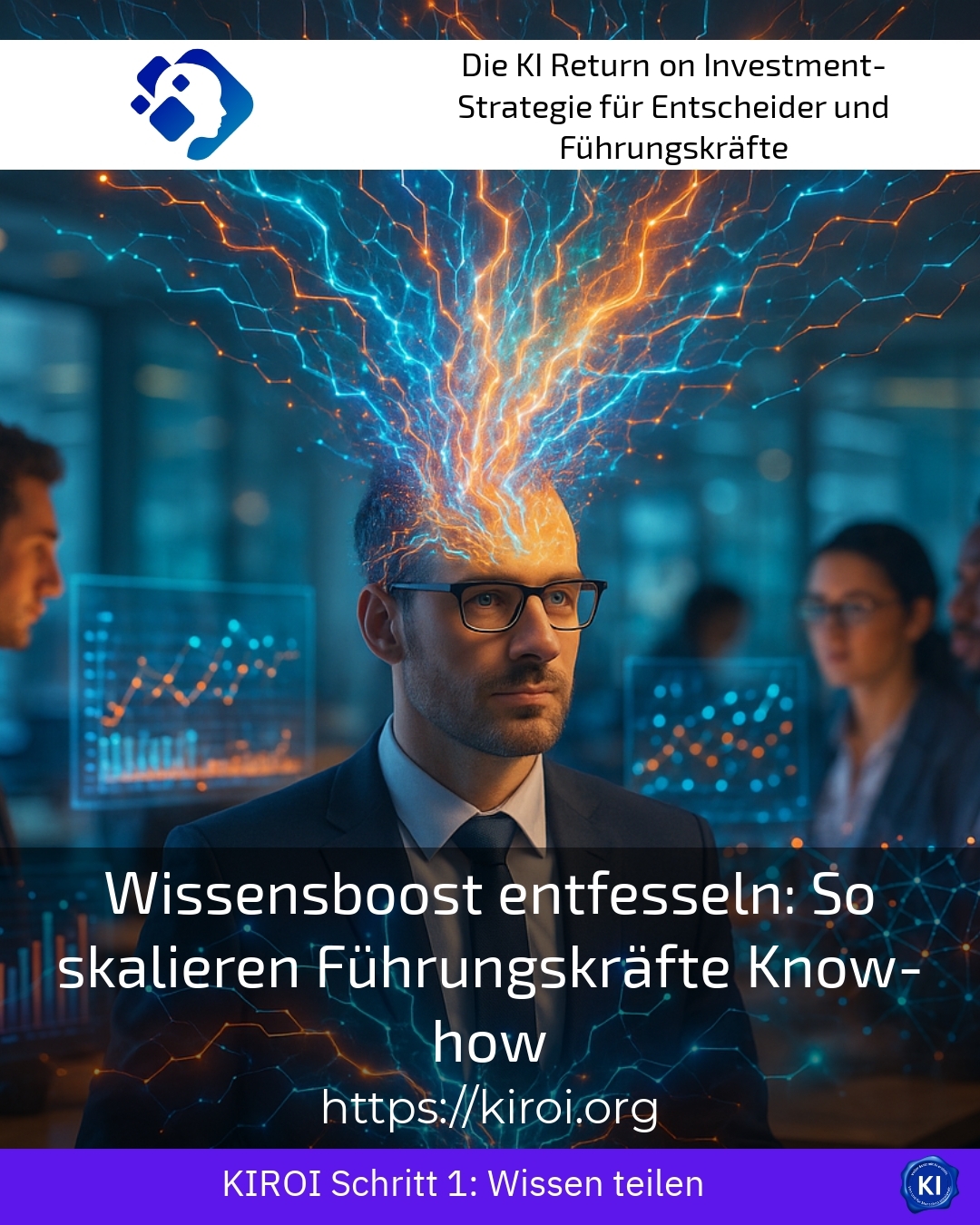
Imagine your entire organisation could double its collective knowledge within weeks. Sounds utopian? Leaders who act strategically today are experiencing precisely this transformation. The crucial lever here lies not in expensive training programmes or endless meetings. Instead, it's about a genuine Unleash a knowledge boost to be able to and systematically scale know-how. This article shows you concrete ways to unlock this potential for your company as a decision-maker.
Why traditional methods are no longer sufficient today
The business world is changing at a speed that would have seemed unthinkable just a few years ago. Traditional further education formats are increasingly reaching their limits in this environment. Seminars planned months in advance can barely reflect current developments. At the same time, the mountain of knowledge in almost all sectors is growing exponentially. An example from mechanical engineering illustrates this impressively: whereas engineers could once use their specialist knowledge for decades, technical know-how today often becomes obsolete within a few years. In the automotive supply industry, managers often report that expertise in electromobility and software is suddenly becoming more important than traditional metalworking knowledge. We are observing similar developments in the financial sector, where regulatory changes and digital business models constantly open up new fields of learning.
Transruptions-Coaching supports leaders in tackling these challenges systematically. Guidance on projects related to organisational learning repeatedly shows that the key does not lie in 'more'. Rather, it's about the 'how' and 'when' of knowledge acquisition. Insights from practical application help to develop individual solution pathways.
Unleashing the knowledge boost: Strategic levers for sustainable growth
To a sustainable Unleash a knowledge boost To be able to do so requires more than just goodwill. Three central levers have proven particularly effective in practice. Firstly, the establishment of a genuine learning culture that understands mistakes as opportunities for development. Secondly, the targeted use of digital tools that make knowledge available at the right time. Thirdly, the networking of knowledge carriers across departmental boundaries.
In retail, for example, employees can be prepared faster for new product lines through short learning modules on mobile devices [1]. Store managers often report that this method can significantly shorten onboarding times. Another example comes from the logistics industry, where warehouse staff can learn complex picking processes more intuitively through augmented reality glasses. In the healthcare sector, too, clinics are increasingly using simulation training to prepare medical personnel for rare emergency situations.
Best practice with a KIROI customer
A medium-sized company in the food industry faced a particular challenge. The workforce possessed enormous experienced knowledge, but it was not documented anywhere. Long-serving skilled workers were approaching retirement and threatened to take their know-how with them. In the course of transruption coaching, the management team developed a structured approach to knowledge retention. First, they systematically identified the critical knowledge carriers in all production areas. They then introduced a mentoring programme that connected experienced employees with junior staff. In parallel, short video tutorials were created in which experts explained their techniques. These videos were made accessible to all employees via an internal platform. The result positively surprised even the most sceptical managers in the company. The onboarding time for new employees was reduced by about a third, according to team leaders. At the same time, employee satisfaction increased measurably because the experienced knowledge now felt valued. The company is now also successfully using this approach for other critical knowledge areas.
Unleashing knowledge boosts through connected learning formats
Isolated learning is a thing of the past. Modern approaches focus on networking and collaborative knowledge. In software development, teams have long practised "pair programming". This involves two developers working together on code and learning from each other. This method can be applied to many other areas. In sales, for example, experienced field sales staff can accompany new recruits to customer appointments. Knowledge transfer then occurs naturally within the workflow.
The chemical industry offers another impressive example of networked learning formats. Here, laboratory teams share their experimental results with colleagues worldwide via digital platforms [2]. Communities of practice are also establishing themselves in the skilled trades, where master craftspeople exchange techniques. Finally, the pharmaceutical industry demonstrates how structured knowledge conferences can bring research results into practice more quickly.
The Leader's Role as a Knowledge Multiplier
Leaders can no longer just manage knowledge. They are becoming active shapers of learning environments. This change in role demands new competencies and an altered self-perception. Instead of providing answers, effective leaders ask the right questions. They create spaces where employees are allowed to experiment and learn from each other.
In the banking sector, we often observe executives becoming learners themselves, attending workshops originally designed for their teams. This attitude signals that lifelong learning is not a one-way street. In the insurance industry, reverse mentoring programmes are becoming increasingly established, where younger employees coach their superiors on digital topics. In the manufacturing sector, too, plant managers report how they gain valuable practical knowledge through regular shop floor discussions.
Practical tips for a knowledge boost in everyday life
Transruptions Coaching provides leaders with practical insights for their daily work. Clients often report that small changes can have a big impact. A weekly learning format of just fifteen minutes can already bear fruit. In this format, team members take turns sharing their latest learning experience with colleagues.
In the telecommunications industry, service teams use short video recordings of solved customer problems. These so-called solution stories are collected in a database and can be accessed at any time. The energy industry relies on digital knowledge maps that show who in the company possesses what expertise. And in the media industry, agile retrospectives have become established, in which teams systematically learn from past projects [3].
Best practice with a KIROI customer
A renewable energy technology company approached us with a specific problem. Management wanted to understand why innovations often stalled within individual departments. During the coaching process, it became clear that knowledge silos were the real issue. Each department had excellent experts, but they rarely communicated with each other. Together, we developed a format called the „Innovation Café,“ which takes place every six weeks. Employees from different areas meet in an informal atmosphere. They present current projects and receive feedback from entirely different professional perspectives. For example, an engineer from development gained valuable input from the sales team, and the marketing department learned technical details that improved their customer communication. After one year, the management team reported significantly improved cross-departmental collaboration. Three new product ideas emerged directly from these café discussions, as documented by the managers.
Overcoming barriers and creating sustainable structures
The path to a learning organisation is rarely straightforward. Resistance is an inherent part of the transformation process and should be taken seriously. Often, leaders come to us for coaching citing a lack of time. The daily workload apparently leaves no room for learning. However, this perspective is shortsighted, as many examples demonstrate.
In the construction industry, forward-thinking companies integrate learning time directly into the workflow. Foremen use short breaks to discuss new safety standards with their teams. The tourism industry demonstrates how seasonal lull periods can be used for intensive further training. And in the catering industry, short training sessions before the start of a shift are becoming increasingly established.
Another common issue in mentoring is the fear of knowledge drain. Some employees worry that by sharing their knowledge, they will make themselves replaceable. This requires a corporate culture that rewards knowledge sharing instead of punishing it. The human resources industry demonstrates how knowledge sharing can become part of performance reviews. In the consulting industry, employees earn points for shared insights, which can be factored into bonus payments.
Technology as a supporter, not a replacement
Digital tools can a Unleash a knowledge boost, when used wisely. However, they never replace the human factor in the learning process. Learning management systems offer structured content and enable individual learning paces. Collaboration platforms connect knowledge bearers across geographical boundaries. And intelligent search systems make hidden knowledge in documents accessible.
The aviation industry impressively demonstrates how virtual reality training can prepare pilots for rare emergency situations. In mechanical engineering, service technicians use tablets with interactive instructions directly at the machine [4]. The textile industry relies on digital twins, where employees can safely test new production processes.
My KIROI Analysis
Following in-depth consideration of the topic of knowledge scaling within organisations, some key findings have emerged. Leaders who are successful today understand learning as a strategic priority. They invest time and resources in building structures that foster learning. Technological possibilities support this process, but cannot replace it.
Transruptions-Coaching supports leaders in this challenging task with individual inspiration. Support for projects involving organisational learning repeatedly shows: There is no one-size-fits-all solution. Every company must find its own path that suits its culture and circumstances. The examples presented from various industries provide inspiration and guidance for this path.
The most important takeaway remains: knowledge is today the decisive competitive factor in almost all industries. Organisations that manage to disseminate and apply knowledge quickly secure their future viability. Leaders play a key role in this as enablers and role models. They create the framework conditions in which employees can grow and develop their potential. Investing in knowledge structures pays off in the long term, as numerous practical examples impressively demonstrate.
Further links from the text above:
[1] McKinsey: Building Capabilities for Performance
[2] Harvard Business Review: Organisational Learning
[3] Gartner: Learning and Development Insights
[4] Deloitte: Global Human Capital Trends
For more information and if you have any questions, please contact Contact us or read more blog posts on the topic Artificial intelligence here.











 Deutsch
  English (UK)