
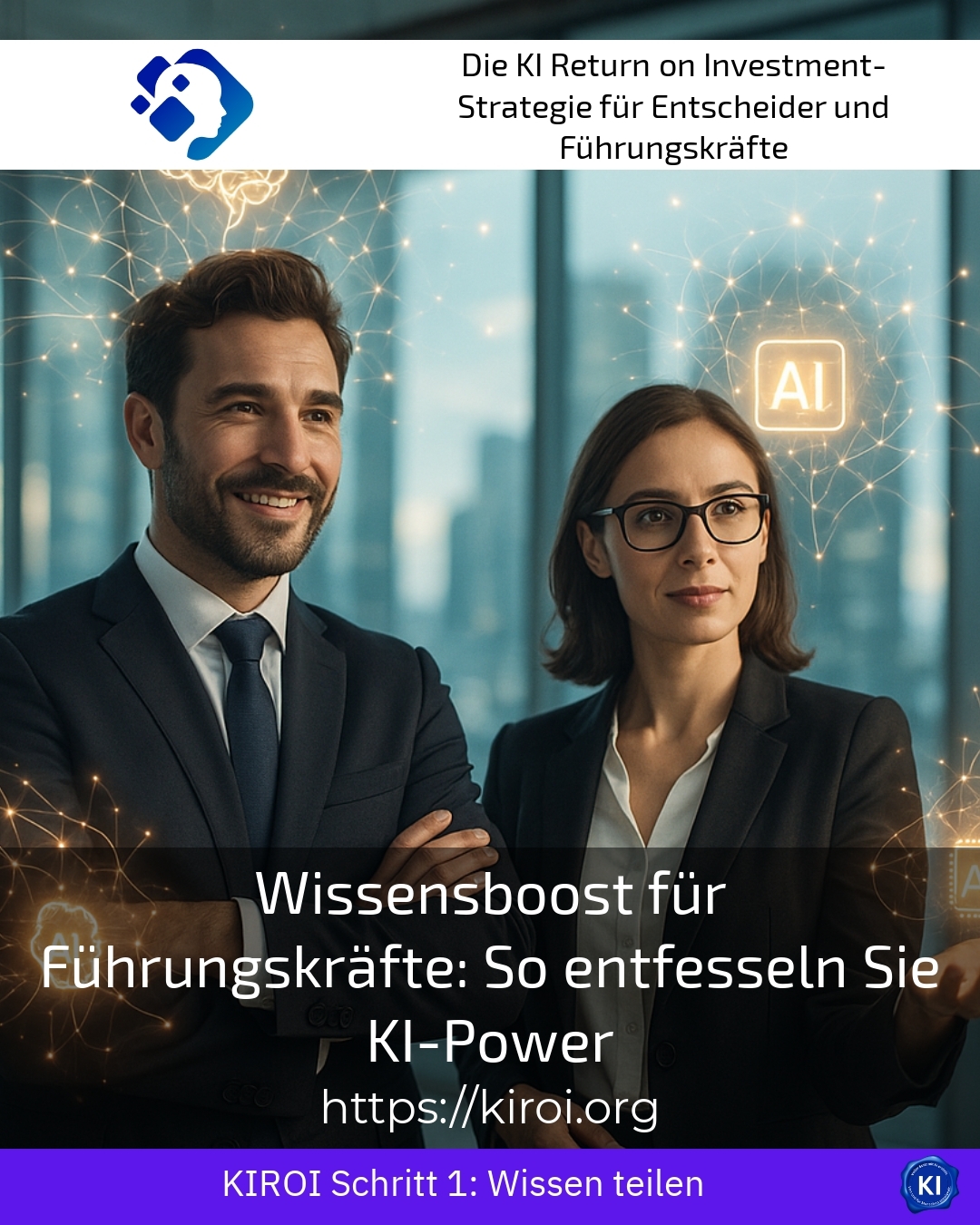
Imagine you could integrate the full innovative power of modern technologies into your daily leadership. This is precisely where the Knowledge boost for leaders The digital transformation is fundamentally changing business models. Decision-makers face entirely new challenges. Those who do not act today will fall behind tomorrow. This is not just about technical understanding. It is about strategic competence and human leadership qualities. This combination determines success or failure. Many leaders come to us with exactly these concerns. They are looking for direction in a rapidly changing world.
Why a knowledge boost for leaders is indispensable today
The business world is evolving at a breathtaking pace. Technological innovations are fundamentally changing established industries. Leaders must not only understand these changes. They must actively shape them and bring their team along. Clients often report feeling overwhelmed by the flood of information. At the same time, the pressure to make quick decisions is growing. This is precisely where transruption coaching can provide valuable momentum.
In the automotive industry, for example, we are experiencing fundamental upheavals. Traditional manufacturers are suddenly competing with technology companies. The production of connected vehicles requires entirely new competencies. A production manager today must understand software development. A sales manager must be able to orchestrate digital customer experiences. An HR manager recruits for job profiles that didn't exist years ago.
We are observing similar developments in the healthcare and finance industries. Hospitals are deploying intelligent systems for diagnostic support. Banks are automating complex investment decisions using learning algorithms. Insurers are analysing risk profiles with unprecedented precision. All these developments require leaders with expanded knowledge.
Best practice with a AIROI customer
A medium-sized machinery manufacturer faced a critical decision. The company wanted to integrate intelligent maintenance systems into its products. Management immediately recognised the potential of this technology. However, the necessary understanding for implementation was lacking. As part of our support, we first developed a shared understanding. We analysed the existing business processes in detail. Subsequently, we identified specific use cases with high added value. The management level received intensive training on the fundamentals. This was not about technical details, but rather about conveying strategic connections and decision-making criteria. After six months, the company was able to launch initial pilot projects. Managers were making well-informed decisions on an equal footing with experts. The entire management team gained confidence and a greater capacity for action. Today, the company offers predictive maintenance as a premium service. Customer loyalty has improved measurably. New revenue streams have been unlocked.
Developing strategic competencies for the digital era
The Knowledge boost for leaders It encompasses more than just fundamental technical knowledge. It includes the ability to identify strategic opportunities. Successful leaders understand how to leverage technology for their goals. They know what questions to ask experts. They can critically evaluate and prioritise project proposals.
In retail, this competence is particularly evident. Managers must intelligently integrate online and offline channels. They strategically deploy personalised recommendation systems. Inventory optimisation is now data-driven and automated. Pricing reacts dynamically to market changes. All of this demands a new understanding of leadership.
In the logistics industry, we are witnessing similar transformations. Route optimisation saves millions of kilometres of transport routes daily. Warehouses are increasingly working with autonomous systems. Demand forecasts are becoming ever more precise and reliable. Leaders must understand and effectively utilise these tools.
The media industry is also undergoing fundamental transformation due to intelligent systems. Newsrooms are using automated research support in their work. Personalised news feeds demonstrably increase reader engagement. Advertising placements are made in real-time according to complex algorithms. Executives in this sector need completely new skills.
Knowledge boost for managers through targeted support
Transruptions-Coaching actively supports leaders through this transformation. We provide impetus for strategic thinking in new dimensions, taking into account the individual industry requirements of our clients. Every company faces its own challenges. One-size-fits-all solutions fall short here.
In the energy sector, for example, it's about intelligent grid control. Consumption forecasts enable more efficient energy distribution in the power grid. Maintenance intervals for wind turbines are optimised based on data [1]. Customer service is increasingly automated and personalised at the same time. Management must be able to steer these developments.
The pharmaceutical industry is using intelligent systems for drug development. Clinical trials are being planned and evaluated more efficiently. Side effects can be detected earlier through pattern analysis. Approval processes are accelerated by intelligent documentation. Here too, managers need expanded knowledge.
Best practice with a AIROI customer
A large trading company wanted to systematically develop its leadership level. The management recognised the need for comprehensive capacity building. Many managers felt overwhelmed by technological developments. They were unable to rigorously evaluate project proposals. Decisions were often postponed due to uncertainty. We developed a tailor-made support programme for the company. First, we analysed the individual knowledge level of each manager. Based on this, we created personalised development plans for all participants. The programme regularly combined group workshops with individual coaching sessions. Practical exercises on real company issues were central. The participants developed their own pilot projects for their respective areas. After one year, the decision-making culture had fundamentally changed. Managers asked precise questions of their technical teams. Projects were evaluated and implemented faster than before. Collaboration between specialist departments and IT improved significantly.
Practical fields of application for advanced leadership skills
The Knowledge boost for leaders It is evident in practical applications. In human resources, intelligent systems support candidate selection. They analyse application documents and identify promising profiles. Managers must be able to critically assess these suggestions [2]. They bear responsibility for fair decision-making processes.
Many companies rely on chatbots for customer service. These answer standard queries automatically and around the clock. More complex issues are passed on to human employees. The quality assurance of these systems requires leadership skills. Customer expectations must be continuously analysed and met.
Controlling benefits significantly from automated reporting systems. Deviations are identified and reported in real time. Forecasts are made more precise through advanced data analyses. Managers must interpret this information and take action. They require an understanding of the underlying methods.
In production, intelligent systems enable predictive maintenance. Machine failures are detected before they occur. Quality control is automated and seamlessly documented. Production plans dynamically adapt to demand fluctuations. Managers coordinate these complex systems daily.
Ethical Dimensions of Knowledge Boosts for Leaders
Technological competence alone is not enough for good leadership. Leaders must also be able to answer ethical questions. What decisions are algorithms allowed to make, and what not? How do we ensure transparency and traceability in decisions? What impact does automation have on employees within the company?
In the insurance industry, these questions are particularly pressing. Risk assessments by intelligent systems can appear discriminatory. Management must recognise and prevent such effects [3]. They bear responsibility for fair pricing. At the same time, they are expected to utilise the efficiency advantages of technology.
Ethical challenges constantly arise in the field of education as well. Personalised learning systems analyse individual strengths and weaknesses. They automatically adapt learning pathways to progress. This creates sensitive data profiles of learners. Leaders in educational institutions must act responsibly here.
The justice system is also experimenting with intelligent decision support systems. These analyse case files and propose judgments. Judges and public prosecutors must critically examine these proposals. The final decision remains with humans for good reason. Managers within the justice administration are involved in shaping these processes.
Best practice with a AIROI customer
An insurance group wanted to raise awareness among its executives regarding ethical issues. The company had already implemented several automation projects, during which unexpected problems with customer perception had arisen. Complaints about opaque decisions were mounting at the company. The executive level sought a systematic approach to solving these issues. Together, we developed an ethical framework for technological projects. This included clear criteria for the use of automated decision-making. Executives learned to evaluate projects from an ethical perspective as well. We conducted workshops on bias detection and fairness. Practical case studies from the insurance industry illustrated the problems. Participants developed checklists for their own projects. After implementation, customer trust improved measurably. Complaints significantly decreased after a few months. The company positioned itself as a responsible innovator in the market.
My AIROI Analysis
Developing leadership skills for the digital age remains central. Our AIROI analysis shows clear patterns in successful transformations. Leaders who actively work on their knowledge make better decisions. They can identify and seize opportunities sooner and more quickly. At the same time, they avoid costly wrong decisions through well-founded understanding.
We consider the combination of technical and strategic knowledge to be particularly important. Purely technical training often misses its mark with managers. Likewise, abstract strategy discussions without practical relevance are of little help. The key lies in the intelligent linking of both perspectives. Transruption coaching supports precisely this integration.
We're noticing that many leaders are coming with similar issues. They are seeking guidance in a complex technological landscape. They want to make informed decisions without a computer science degree. They wish to be able to lead their teams through change processes. They need tools for evaluating project proposals.
The Knowledge boost for leaders This is not a one-off measure. It requires continuous learning and regular reflection. Technologies are constantly evolving at high speed. Leaders must stay on the ball without getting overwhelmed. Professional support can provide valuable impetus here.
Our experience shows: the most important success factor is mindset. Leaders with openness and curiosity benefit the most. They see technology as a tool, not a threat. They understand change as an opportunity for their company. With this attitude, transformation succeeds sustainably and successfully.
Further links from the text above:
[1] Federal Ministry for Economic Affairs - Digitalisation
[2] Bitkom – Digital Transformation
[3] Platform Learning Systems
For more information and if you have any questions, please contact Contact us or read more blog posts on the topic Artificial intelligence here.






 Deutsch
  English (UK)