
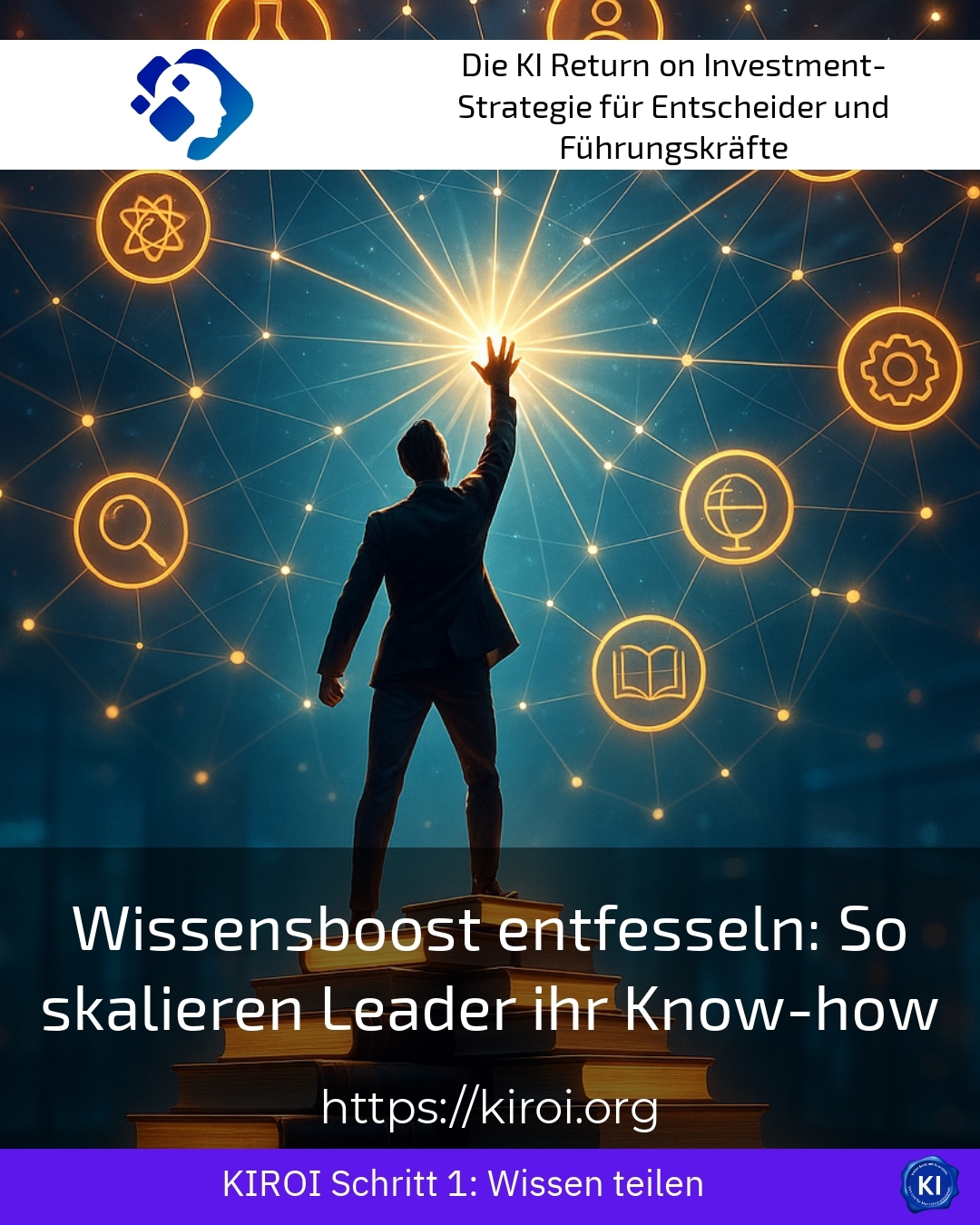
Imagine being able to double your entire range of expertise within a few weeks, while simultaneously elevating your leadership skills to a completely new level. Unleashing a knowledge boost is no longer a utopia, but a concrete strategy that successful leaders are already using today to gain a crucial advantage in an increasingly complex business world. The days when knowledge acquired once was sufficient for an entire career are irretrievably gone. Today, leaders must continuously learn, unlearn and relearn.
The transformation of knowledge acquisition in leadership circles
Leaders today face a paradoxical situation that initially overwhelms many of them, but then drives them towards creative solutions. On the one hand, available knowledge is growing exponentially; on the other hand, the time to absorb and effectively apply this knowledge is shrinking. A managing director of a medium-sized engineering company recently reported that he spends over three hours every day filtering relevant specialist information [1]. This challenge affects leaders in all industries equally.
The answer, however, is not to work even harder or read even faster. Rather, it's about developing more intelligent systems for knowledge acquisition. For instance, a board member from the financial sector has reorganised her entire team. She now uses so-called "knowledge scouts" who pre-digest and prepare relevant information. At the same time, she has established personal learning routines that she consistently carries out every morning.
A similar pattern in knowledge organisation is seen in healthcare. Clinic directors have to keep abreast of medical advancements, regulatory changes and business developments simultaneously. Many of them therefore rely on structured peer-learning groups in which executives keep each other up to date.
Best practice with a AIROI customer
An internationally operating logistics company faced the challenge that its executives were no longer able to keep pace with rapid technological development. Management increasingly noticed knowledge gaps in strategic decision-making. With support from transruptive coaching, we jointly developed a multi-stage concept for knowledge optimisation. First, the executives identified their individual learning styles and preferences. Based on this, personalised learning paths were created that integrated seamlessly into their daily work. The introduction of weekly micro-learning sessions, each lasting only fifteen minutes, proved particularly effective. Participants frequently reported noticeable improvements in their decision-making quality. After six months, internal measurements showed a significant increase in the innovation capability of the entire management team. The executive board described the change as a cultural shift towards a learning organisation.
Unleashing a knowledge boost through systematic networking
The most successful leaders have long recognised that learning in isolation is no longer sufficient in a connected world. Instead, they build strategic knowledge networks which give them access to expertise they could never acquire themselves. In the automotive industry, for example, innovative CEOs maintain close contacts with start-up founders, university professors and industry colleagues from adjacent sectors.
The managing director of a medium-sized supplier has systematically mapped out and maintained his personal expert network. He has at least ten conversations each month with professionals from various disciplines. These conversations follow a structured agenda and are carefully documented, creating a living archive of insights and perspectives.
In retail, progressive leaders are embracing sector-wide learning partnerships. A regional manager from a major retail chain regularly exchanges ideas with leaders from the gastronomy and hotel sectors. This unusual combination provides her with valuable insights into customer experience and staff management.
The pharmaceutical industry offers another impressive example of connected learning. Research directors organise international knowledge exchanges that go far beyond traditional conferences. They initiate joint research projects with academic institutions and maintain dialogues with patient organisations.
Understanding and Utilising the Principle of Knowledge Leverage
A fundamental principle distinguishes average from outstanding leaders when it comes to knowledge building. The latter don't focus on knowing as much as possible, but on knowing the right things at the right time. They develop a keen sense for which knowledge has strategic value. And they invest their limited learning time accordingly and purposefully.
In the construction industry, a project developer has masterfully implemented this principle. They identified the three critical knowledge areas for their business success. These were regulations, financing, and sustainable building materials. In these areas, they developed deep expertise while simultaneously building a network of specialists for all other topics.
The energy sector is currently undergoing a dramatic transformation, which places enormous learning requirements on leaders. A municipal utility's board of directors therefore opted for a radical focus. He personally specialised in decentralised energy systems and consistently delegated other knowledge areas to his extended management team.
Best practice with a AIROI customer
A family business in the food processing sector was undergoing a critical transformation. The third generation took over leadership at a time of massive market changes. The young successors brought fresh knowledge but lacked the industry experience of their predecessors. Within the framework of transruptive coaching support, we developed an intergenerational knowledge transfer programme. The senior generation systematically documented their implicit experiential knowledge in structured interviews. In parallel, the successors learned to use modern analytical tools and digital business models. The result was a bidirectional knowledge flow that enriched all parties involved. Clients frequently reported unexpected synergistic effects between traditional craft knowledge and innovative approaches. This combination gave the company a unique competitive advantage in its market segment. The transformation became a model case for other family businesses in the region.
Technological tools to unleash a knowledge boost
The digital revolution has resulted in a wealth of tools that can assist leaders in systematically building knowledge. Intelligent curation systems filter relevant information from the noise of the daily news deluge. Personalised learning platforms adapt to the individual learning pace and user preferences.
A technology executive from the telecommunications sector uses a sophisticated system of personal knowledge management tools [2]. His digital library contains over ten thousand curated articles, videos, and podcasts. An intelligent algorithm suggests new content to him daily that matches his current projects and interests.
In the banking sector, progressive institutions are experimenting with collaborative knowledge platforms. These systems enable executives to share insights and benefit from the experiences of their peers. A divisional head at a regional bank described such a platform as her most valuable strategic asset.
The media industry is going one step further and is embracing immersive learning formats. Managers can play through complex scenarios in virtual environments, learning from mistakes risk-free. A publishing managing director regularly uses such simulations to test new business models.
The importance of reflection and documentation
Knowledge alone does not create value; it must be processed, reflected upon, and applied. The most successful leaders have understood that structured reflection is an indispensable part of the learning process. They consciously take time to link new insights with existing knowledge.
A CEO from the chemical industry has been keeping a personal knowledge journal for years. Every evening, he notes down the key insights of the day and their potential implications for his company. This practice has helped him to identify patterns that remain hidden to others.
In the insurance industry, an innovative board member has established a team reflection format. After every major project, her leadership team jointly analyses what worked well and what could be improved. These findings are fed into a growing knowledge database.
The aviation industry is known for its rigorous culture of error and systematic learning processes. Leaders in this sector apply these principles to their personal development. They meticulously document decisions and their outcomes, thereby continuously learning from successes and failures.
My AIROI Analysis
Accompanying numerous leaders in their knowledge development has provided me with valuable insights. Unleashing a successful knowledge boost can only be achieved sustainably if it is embedded within holistic personal development. It is not enough to learn more or to learn faster. The quality of learning and its integration into everyday leadership are crucial.
Clients most frequently report the challenge of balancing urgent operational requirements with long-term knowledge development. Transruption coaching can provide valuable impetus and help develop individual strategies here. Support on such projects repeatedly shows that small, consistently implemented changes are often more effective than large transformation programmes.
Another critical success factor is the ability not only to absorb knowledge but also to let go of it. Outdated knowledge can become a burden and hinder openness to new insights. The art of strategic forgetting is therefore an underestimated aspect of successful knowledge work.
In conclusion, I would like to emphasise that the path to excellent knowledge management is an individual process. What works for one leader may be entirely unsuitable for another. A thorough analysis of one's own learning preferences, work contexts, and strategic priorities therefore forms the indispensable starting point for any knowledge optimisation.
Further links from the text above:
[1] Harvard Business Review – Knowledge Management
[2] McKinsey – Developing Workforce Skills on a Large Scale
For more information and if you have any questions, please contact Contact us or read more blog posts on the topic Artificial intelligence here.






 Deutsch
  English (UK)