
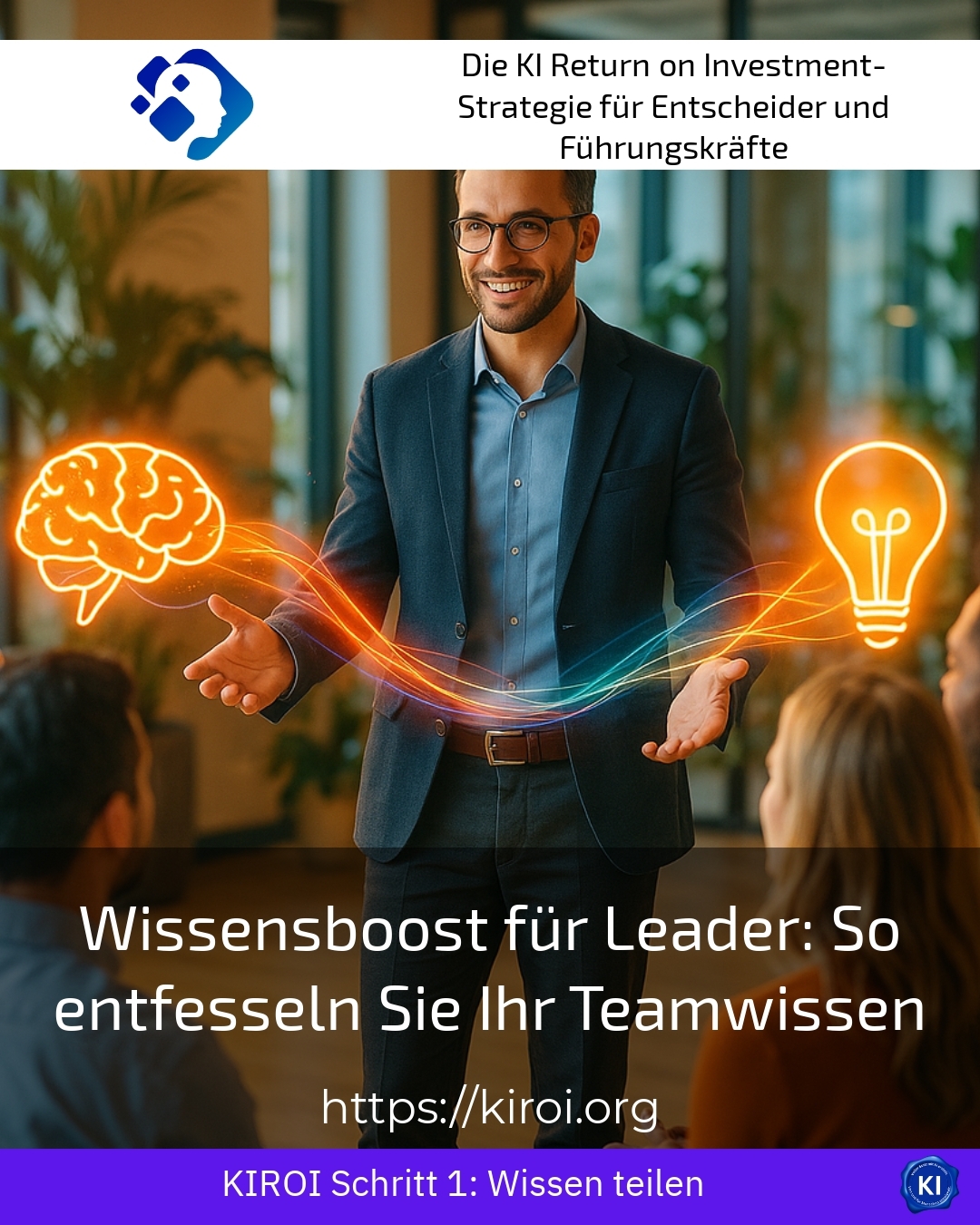
Imagine that within your company there lies a hidden treasure, one that you overlook every day, even though it exists right before your eyes, just waiting to be unearthed. This treasure is comprised of your employees' collective experiential knowledge, countless insights and solutions that lie dormant in the minds of your team members. The crucial Knowledge Boost for Leaders begins precisely here, namely with the systematic development of these often underestimated hidden resources. Many managers report that it was only through structured coaching that they recognised the enormous potential within their teams.
Uncovering the hidden goldmine in your business
In modern organisations, valuable experience accumulates daily, but it is rarely systematically captured or shared. For example, an experienced project manager in the automotive industry has learned over years how to successfully conduct critical supplier negotiations. This implicit knowledge leaves the company as soon as this person retires or takes up a new position. A similar situation occurs in the pharmaceutical industry, where laboratory assistants often develop intuitive methods to optimise processes [1]. These small improvements are rarely documented because they are taken for granted.
The financial services sector also shows impressive examples of untapped team knowledge. Customer advisors develop a fine sense for their clients' needs over the years, but this knowledge often remains tied to individuals. In the logistics industry, experienced dispatchers know tricks for route optimisation that no algorithm can capture. In the healthcare sector, too, nurses report tried-and-tested methods for dealing with difficult situations that are not recorded anywhere [2]. The Knowledge Boost for Leaders This is where it comes in, supporting leaders in making these invisible knowledge streams visible.
Why traditional knowledge management systems often fail
Many companies have already invested in extensive knowledge bases, which, however, are rarely used. The reasons for this are diverse and range from a lack of user-friendliness to a lack of integration into daily work. In the telecommunications industry, for example, there are often several parallel systems that do not communicate with each other. Employees in retail rarely have time to document their findings during the hectic daily business. In the manufacturing industry, knowledge platforms often fail because shift workers do not have easy access to digital systems.
Transruptions-Coaching helps leaders identify these obstacles and develop practical solutions. The aim is not to introduce yet another tool, but to establish knowledge sharing as a natural part of the company culture. In the energy sector, clients often report pressure to always present perfect solutions. This expectation prevents incomplete ideas and partial successes from being shared. The insurance sector struggles with similar challenges due to the prevalence of a strongly hierarchical communication culture [3].
Best practice with a AIROI customer
A medium-sized company from the mechanical engineering sector approached us with a specific challenge: innovation cycles were shortening, and at the same time, several experienced engineers were retiring. Management recognised that valuable design knowledge was at risk of being lost, despite the existence of extensive technical documentation. As part of the transruption coaching, we supported the management team in establishing so-called knowledge bridges, where experienced and junior employees worked together on projects. We introduced structured knowledge interviews that teams could conduct themselves without external consultants. Particularly important was the development of a mistake culture where even failed experiments were recognised as valuable learning sources. After six months, team leaders reported a noticeably improved collaboration between generations. Junior employees felt taken more seriously, while senior employees felt their experience was valued. The onboarding time for new engineers was reduced by about a third because relevant practical knowledge was now systematically shared.
Knowledge boost for leaders through psychological safety
A key success factor in unleashing team knowledge lies in creating an atmosphere of trust where employees can share their knowledge without hesitation. The aviation industry recognised long ago that open communication about errors can be life-saving. The reporting systems established there are based on the principles of anonymity and freedom from sanctions. Similar approaches can also be implemented in other industries, as examples from the chemical industry show [4]. There, companies have introduced special formats for discussing near-miss accidents.
The construction industry also offers interesting impetus for Knowledge Boost for Leaders, because often changing teams work together on complex projects there. Successful construction companies have developed methods for quickly and efficiently transferring project experience to subsequent projects. In the gastronomy sector, however, knowledge sharing is traditionally heavily tied to personal relationships, which brings both strengths and weaknesses. The media industry struggles with the challenge that creative knowledge is often seen as individual capital, which people are reluctant to share.
Practical methods for unleashing knowledge within a team
There are numerous proven methods for activating and leveraging team knowledge. So-called peer learning, where employees train each other, has proven effective in many industries. In the IT industry, code reviews are an established format that not only serves quality assurance but also knowledge transfer. The real estate industry often uses case studies to jointly analyse complex transactions [5]. In the education sector, collegial hospitations have proven to be a valuable tool, where teachers observe each other's lessons.
Transruptions-Coaching helps leaders develop such formats that are a perfect fit for their organisation. We take into account the specific framework conditions of the respective industry and the existing corporate culture. In the tourism industry, for example, we have developed short exchange formats with clients that fit into the seasonal rhythm. Agriculture offers interesting approaches for knowledge exchange between farms, for instance, in the form of machinery rings or experience groups. The craft sector traditionally cultivates the master-apprentice principle, which can be usefully supplemented with modern methods.
Best practice with a AIROI customer
A service company from the consulting sector approached us with the aim of improving collaboration between different locations and making better use of dispersed expertise. The challenge was that similar projects were being worked on in parallel at different locations without the teams being aware of each other. During the coaching process, we worked with the management team to develop a structured format for cross-location knowledge sharing. We established virtual expert circles on recurring themes, which met regularly and documented their findings. Particularly important was the introduction of a uniform language for describing project experiences, so that colleagues at other locations could quickly find relevant information. The managers learned how to act as role models for knowledge sharing themselves and how to encourage their teams to do the same. After one year, the project managers reported significantly less duplicate work and improved quality of client projects. Employee satisfaction also improved because people felt part of a learning organisation.
Knowledge boost for leaders in digital transformation
The ongoing digitalisation is changing the way knowledge flows and is used within organisations. While new technologies offer enormous opportunities for knowledge transfer, they also present managers with new challenges. In the banking industry, for example, modern platforms enable the exchange of market assessments in real time. The fashion industry uses digital tools to consolidate trend observations from different markets. In the sports industry, performance data is systematically analysed and processed as training knowledge [6].
At the same time, there is a risk that digital tools will displace personal communication, which is often essential for genuine knowledge transfer. In the care sector, it is evident that sensitive experiential knowledge in dealing with patients can hardly be recorded in databases. The legal profession faces the challenge that mandate knowledge must remain confidential and can therefore only be shared to a limited extent. Transruption coaching helps managers find the right balance between digital and analogue knowledge formats.
The role of the leader as a knowledge broker
Leaders play a central role in establishing a knowledge-sharing culture within their teams. They must act as role models themselves, demonstrating their willingness to share their knowledge and learn from others. In the advertising industry, agency heads often report the difficulty of getting creative teams to exchange ideas. The cosmetics industry provides interesting examples of how product developers and sales personnel can learn systematically from each other. In publishing, successful leaders have established formats where editors regularly share their market observations with senior management.
The Knowledge Boost for Leaders therefore also includes the development of personal competencies such as active listening and appreciative feedback. In the event industry, leaders often have to decide under immense time pressure which knowledge from past events is relevant. The food industry faces the task of transferring quality knowledge across long supply chains [7]. In the non-profit sector, clients often report that volunteer engagement leads to high fluctuation, resulting in the loss of valuable knowledge.
My AIROI Analysis
The systematic unlocking of team knowledge represents one of the greatest untapped resources in modern organisations, and leaders have a unique opportunity to activate this resource. From my experience in transruption coaching, it repeatedly becomes clear that the critical lever lies not in new technologies or sophisticated processes, but in the attitude of the leadership level. When leaders authentically convey their interest in and appreciation for their employees' knowledge, natural knowledge flows emerge on their own.
The AIROI methodology offers a structured framework for analysing and specifically improving knowledge processes within organisations. In doing so, we consider both the technical prerequisites and the cultural conditions, as well as the individual competencies of those involved. The insight that knowledge sharing is always linked to trust and psychological safety seems particularly important to me. Managers who cultivate an open culture of error and are themselves willing to admit uncertainties create the foundation for genuine knowledge exchange.
The future belongs to organisations that understand how to continuously harness and develop the collective knowledge of their employees. In a world where frameworks are changing ever faster, the ability for organisational learning becomes the decisive competitive advantage. Transruption coaching accompanies leaders on this path and provides impetus for sustainable change. The focus is always on practical applicability, because only what works in everyday life can have a lasting impact.
Further links from the text above:
[1] McKinsey: Unlocking the Potential of Frontline Workers
[2] Harvard Business Review: Knowledge Management
[3] Gartner: Insights on Knowledge Management
[4] Forbes: Leadership and Knowledge Sharing
[5] MIT Sloan Management Review: Knowledge Management
[6] Deloitte Insights: The Knowledge Economy
[7] World Economic Forum: The Future of Work and Knowledge Sharing
For more information and if you have any questions, please contact Contact us or read more blog posts on the topic Artificial intelligence here.








 Deutsch
  English (UK)