
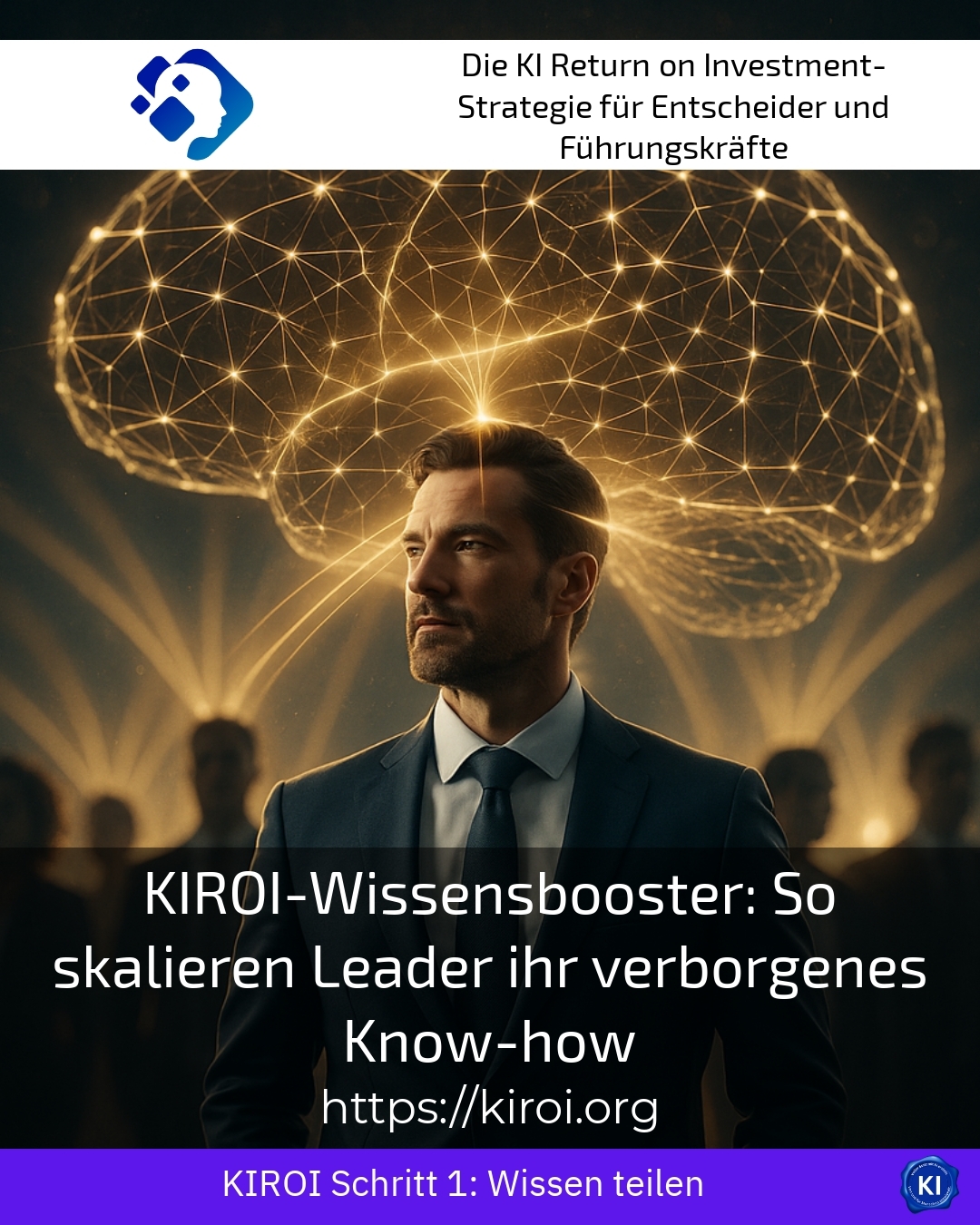
Imagine the most valuable asset of your organisation is lying dormant in the minds of a few key individuals, and no one knows how to systematically unlock this treasure. This is precisely where the AIROI Knowledge Booster as it enables leaders to document and share their hidden expertise in a structured way, thereby sustainably strengthening the entire organisation. In a world where skills shortages and demographic change present companies with enormous challenges, the ability to scale knowledge becomes a decisive competitive advantage. This article shows you how, as a leader, you can transform your implicit knowledge into explicit resources.
Why hidden expertise often remains untapped
Almost every organisation possesses an invisible layer of knowledge that has accumulated over years. This layer consists of experiential knowledge, intuitive decision-making patterns, and proven problem-solving strategies. Clients often report knowing precisely how certain processes work, but struggle to articulate this knowledge comprehensibly. This phenomenon is widespread and affects leaders at all levels equally.
The reasons for this knowledge isolation are diverse and often systemic. A lack of time plays a central role in this, as operational tasks dominate everyday life. Additionally, structured methods for knowledge extraction are often missing. Some managers also greatly underestimate the value of their own know-how. They take their knowledge for granted and do not recognise the added value it represents for others.
This phenomenon is particularly evident in manufacturing companies with experienced master craftspeople. They can interpret machine noises and immediately know when maintenance is required. In consulting firms, senior partners carry customer relationship knowledge that is not documented anywhere. In the healthcare sector, experienced nurses possess observational skills that cannot be found in any textbook.
The AIROI Knowledge Booster as a strategic instrument
The AIROI Knowledge Booster provides a structured framework for identifying and scaling implicit knowledge. It supports leaders in systematically capturing and sharing their expertise. This is not about simple documentation, but a holistic transformation process. Transruptions-Coaching will accompany you on this endeavour and provide valuable impetus for implementation.
The approach is based on the understanding that knowledge exists in various forms. There is explicit knowledge, which can be easily documented. In addition, there is tacit knowledge, which is embedded in actions and routines. Finally, there is embedded knowledge, which is inherent in processes and structures. The AIROI knowledge booster addresses all three forms equally and creates connections between them.
In the financial industry, portfolio managers use this approach to codify their investment philosophy. Law firms employ it to make negotiation strategies accessible to junior lawyers. Tradespeople use it to preserve the knowledge of retiring masters and pass it on to apprentices [1].
Best practice with a AIROI customer
A medium-sized engineering company faced the challenge that three of its most experienced design engineers would retire within two years. These engineers possessed decades of experience in developing bespoke special solutions. Their knowledge was not systematically recorded anywhere and existed primarily in their minds. The company approached us because it feared losing vital expertise after these employees departed. Together, we developed a structured knowledge transfer programme based on the principles of the AIROI Knowledge Booster. First, we identified the critical knowledge areas through intensive interviews and process observations. Subsequently, we created knowledge maps that showed which expertise was anchored where. Then, we began the systematic extraction through moderated knowledge dialogues between the experienced design engineers and their younger colleagues. In parallel, we documented decision-making processes in the form of structured case studies. After twelve months, the company had built a comprehensive knowledge archive that is continuously being expanded. The younger engineers report that they now arrive at good solutions much faster because they can access documented empirical values.
Methods of Knowledge Extraction in the AIROI Knowledge Booster
Extracting implicit knowledge requires specific methods that go beyond traditional documentation approaches. Storytelling techniques have proven particularly effective in this regard. People can often convey their experiences better in the form of stories than in abstract descriptions. Therefore, we work intensively with narrative methods to bring hidden know-how to the surface.
Another effective method is the structured reflection of decision-making processes. This involves accompanying leaders during their daily decisions and asking targeted questions. Why did you choose this option? What alternatives did you consider? What do you pay particular attention to in this type of situation? These questions help to make unconscious decision patterns conscious and documentable.
In architectural offices, we use these methods to capture the design principles of experienced partners. For auditors, we document auditing strategies for complex mandates with them. In the catering industry, these techniques help make the knowledge of top chefs accessible to their teams [2].
Technological support for knowledge scaling
Modern technologies can significantly accelerate and simplify the process of knowledge scaling. Intelligent systems assist in structuring and preparing knowledge. They help to recognise patterns in large knowledge bases and establish relevant connections. However, technology never replaces the human factor in knowledge extraction.
Systems that enable context-aware knowledge queries are particularly valuable. Employees can ask questions and receive answers based on their organisation's documented experiential knowledge. These systems continuously learn and improve with every interaction. They act as intelligent knowledge brokers between experts and knowledge seekers.
A logistics company uses such systems to make scheduling knowledge from experienced employees available. An insurance company uses them to scale claims settlement expertise. A pharmaceutical company uses them for the transfer of regulatory knowledge to new employees.
Cultural prerequisites for successful knowledge scaling
Technology and methods alone are not enough to successfully scale knowledge. A culture that values and promotes knowledge sharing is needed. Clients often report resistance to knowledge transfer within their organisations. Some employees view their knowledge as a power base and are reluctant to share it. Others simply don't have the time for systematic knowledge transfer.
Transruption coaching supports organisations in developing a learning-conducive culture. It assists in creating incentive systems that reward knowledge sharing. It also helps to anchor periods for knowledge exchange in everyday work. Experience shows that cultural changes take time and require continuous attention.
In a law firm, we established a mentoring programme that systematically promotes knowledge transfer. A technology company introduced weekly knowledge circles where experiences are exchanged. A bank created the role of Knowledge Coordinator, who orchestrates knowledge transfer activities [3].
Best practice with a AIROI customer
An international management consultancy was struggling with the problem that project learning was not taking place systematically. Each project team made similar mistakes because experience from previous projects was not accessible. The partners realised they were practically giving away valuable knowledge and turned to us for support. We first analysed how knowledge flowed within the organisation and where barriers existed. We found that time pressure and a lack of incentives were the main obstacles. Consultants had no reason to invest time in knowledge preparation because it was not rewarded. Together, we developed a new evaluation system that explicitly considered knowledge contributions. In addition, we introduced structured project closure rituals where learning experiences were systematically documented. We also created a new platform that simplified knowledge retrieval and contribution. After eighteen months, the knowledge culture had noticeably changed. Consultants reported that they now accessed documented knowledge more frequently and actively contributed themselves. The quality of project work improved measurably, and onboarding times for new employees were significantly reduced.
Practical steps for implementation
Introducing a systematic knowledge scaling approach requires careful planning and a step-by-step process. It begins with an inventory of critical knowledge within the organisation. This involves identifying areas of knowledge that are particularly valuable and simultaneously at risk. At risk means here that the knowledge is held by only a few people or exists solely in their minds.
Following the inventory, the knowledge areas to be addressed first are prioritised and selected. It is advisable to begin with manageable pilot projects to gain experience. These pilots should deliver visible results in order to gain support for the overall project. Successful pilots create motivation for the further expansion of the approach.
A chemical company began by documenting process optimisation knowledge in a single plant. A retail company started with the sales knowledge of its most successful stores. A marketing agency initially focused on the campaign development knowledge of its Creative Directors.
Measuring success and continuous improvement with the AIROI Knowledge Booster
As with any strategic undertaking, measuring success is important for knowledge scaling. It helps to track progress and make adjustments. You should consider both quantitative and qualitative metrics. Quantitative metrics can include the number of documented knowledge building blocks or the frequency of use of knowledge resources.
Qualitative indicators are often more meaningful but harder to capture. These include the perceived quality of documented knowledge or user satisfaction. The speed at which new employees become productive can also be a valuable indicator. Disruptive coaching supports you in developing suitable measurement approaches for your organisation.
A law firm measures success based on the onboarding time of new lawyers in specialised areas. An engineering firm tracks the frequency of recurring design errors as an indicator. A service company records customer satisfaction as an indirect indicator of knowledge quality.
My AIROI Analysis
The systematic scaling of hidden expertise represents one of the most important leadership tasks of our time. In an era where knowledge quickly becomes obsolete and skilled workers are scarce, the ability to share knowledge becomes a strategic differentiator. AIROI Knowledge Booster offers a proven framework that supports and guides organisations through this transformation.
From my consulting practice, I know that many managers underestimate the value of their own knowledge. They take their experiences for granted and don't recognise the added value that systematic knowledge sharing would create. At the same time, these same managers complain that new employees take a long time to become productive. This contradiction can be resolved when knowledge transfer becomes a strategic priority.
Technology today offers possibilities that were unimaginable just a few years ago. Intelligent systems can support the structuring, storage, and provision of knowledge. However, the human factor remains crucial, as technology cannot replace human relationships and trust. The best results are achieved when technology and human interaction work together.
My recommendation is to start small, but think strategically. Identify the most critical areas of knowledge within your organisation and begin there. Achieve initial successes that motivate and convince others. In parallel, build the cultural prerequisites, without which long-term success is not possible. This path requires patience and perseverance, but the results are worth it, as they secure the future viability of your organisation.
Further links from the text above:
[1] Gabler Economic Lexicon: Fundamentals of Knowledge Management
[2] Harvard Business Review: Insights on Knowledge Management
[3] McKinsey: People and Organisational Performance
For more information and if you have any questions, please contact Contact us or read more blog posts on the topic Artificial intelligence here.









 Deutsch
  English (UK)