
kiroi.org

KIROI - Artificial Intelligence Return on Invest
The AI strategy for decision-makers and managers

Business excellence for decision-makers & managers by and with Sanjay Sauldie

KIROI - Artificial Intelligence Return on Invest: The AI strategy for decision-makers and managers

KIROI - Artificial Intelligence Return on Invest: The AI strategy for decision-makers and managers

Start » KIROI Step 8: How to develop your employees into future AI competence carriers
3 August 2025

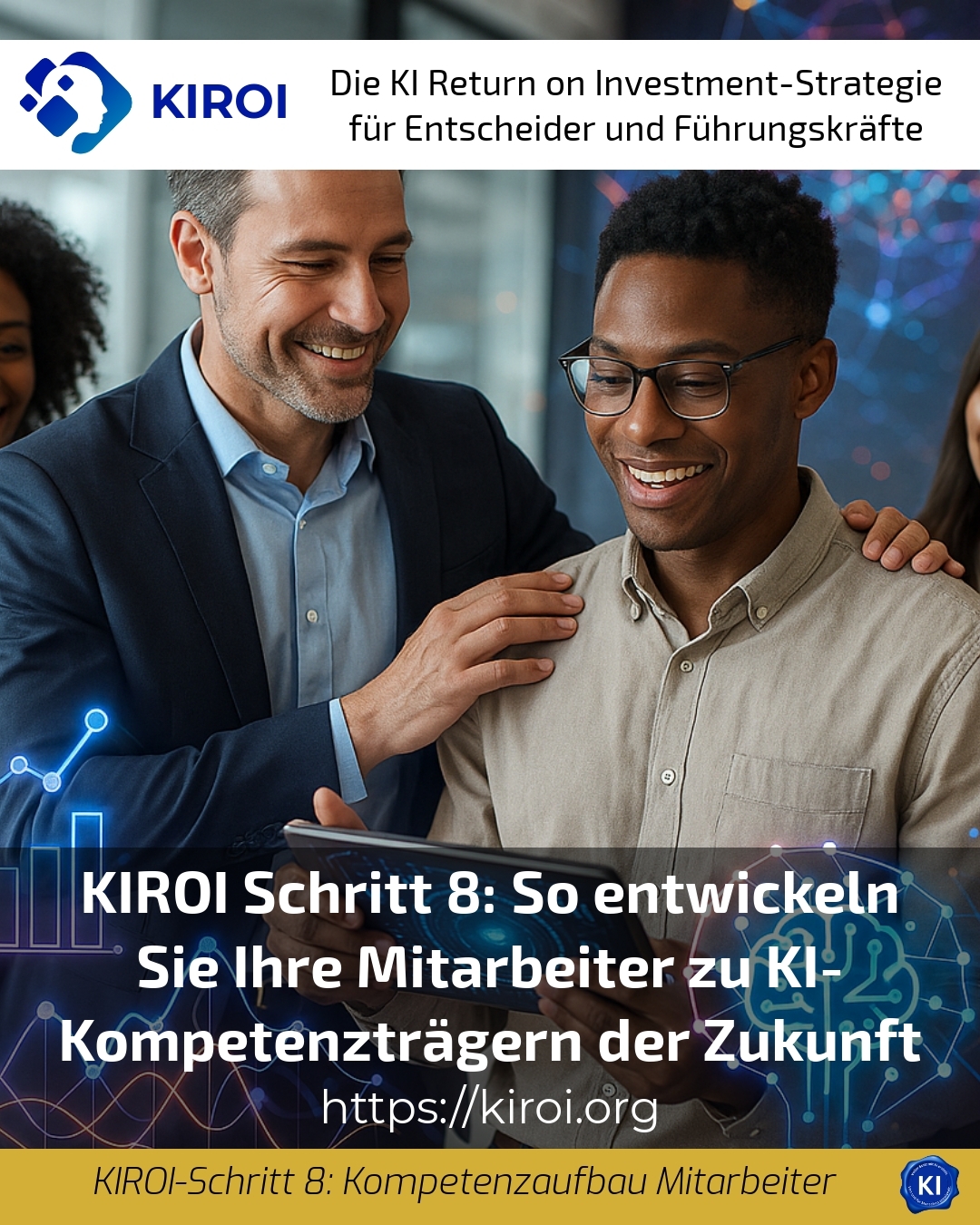
KIROI Step 8: How to develop your employees into future AI competence carriers

4.3
(1175)

Fostering AI competence in companies sustainably

The introduction of Artificial Intelligence into the world of work represents a profound change, presenting employees with new challenges. Companies, particularly in the manufacturing, service, and healthcare sectors, feel the need to equip their teams not only with technologies but also with suitable skills. Managers frequently report that their teams particularly seek support in the implementation and integration of AI projects. It is important here not only to impart technical knowledge but to guide employees holistically and provide impetus for practical applications.

Practical support instead of pure knowledge transfer

The development of AI expertise should be designed as a process that addresses the individual needs of employees. For example, in the manufacturing sector, this can be achieved by integrating learning incentives directly into the daily work routine: employees can try out typical AI applications through simulation-based exercises in virtual environments, thereby optimising their learning curve. For the service sector, regularly updated workshops that are based on current practical cases and thus reflect real-world challenges are sensible. In the healthcare sector, the combination of theoretical training and practical examples is central to strengthening employees in their use of AI-supported diagnostics and patient management.

Examples of successful competency development

KIROI BEST PRACTICE at company XYZ (name changed due to NDA contract) In the field of industrial manufacturing, a targeted coaching initiative enabled a team to independently implement AI-powered quality control measures. The practical approach and support during initial real-world applications led to a significant increase in employee acceptance and competence.

KIROI BEST PRACTICE at ABC (name changed due to NDA contract) In the service sector, a series of interdisciplinary workshops was initiated, where employees from IT, sales, and support collaborated to test AI tools. The result was not only better utilisation of the tools but also improved communication between departments.

KIROI BEST PRACTICE at DEF (name changed due to NDA contract) In the healthcare sector, employees were supported by a modular learning program that catered to their individual learning progress. Through supervised practical projects, for example in the documentation and analysis of patient data, the teams felt more confident in handling AI technologies.

To promote cultural change strategically

Alongside professional development, shaping corporate culture is a key lever. Many leaders report the necessity of fostering an open stance towards AI, rather than amplifying fears and reservations. This is particularly relevant in industries under significant pressure to change, such as retail or logistics, where AI is establishing new work methods and bases for decision-making. Promoting formats for exchange, like regular meetings or an AI-based chat channel, helps employees clarify questions and share experiences. Such formats not only bring advantages for dealing with AI tools but also strengthen the sense of team cohesion.

Long-term perspective and continuous learning

The continuous development of technologies and algorithms makes it necessary to understand learning as a lifelong task. In the automotive industry, for example, project teams report on the importance of regularly updating training courses and supplementing them with practical exercises in order to keep pace with change. A systematic approach that enables learning in everyday work life and incorporates different learning formats – from digital game scenarios to personal coaching – proves to be particularly effective.

My analysis

Building AI competencies among employees is a complex process that goes far beyond simply imparting knowledge. Companies that actively support and practically develop their teams create better conditions for the sustainable integration of AI. It is crucial to strengthen the human factor, shape cultural changes, and continuously enable learning processes. This fosters innovative strength that makes the potential of AI usable responsibly and effectively.

Further links from the text above:

[1] AI for leaders: AI demands new leadership skills

[2] Artificial Intelligence in Business Practice (Fraunhofer IAO)
[3] How employees become AI professionals | EU AI Act

How useful was this post?

Click on a star to rate it!

Average rating 4.3 / 5. Vote count: 1175

No votes so far! Be the first to rate this post.

Spread the love

transruption.org

The digital toolbox for
the digital winners of today and tomorrow

Business excellence for decision-makers & managers by and with Sanjay Sauldie

transruption
transruption

transruption: The digital toolbox for
the digital winners of today and tomorrow

Start » KIROI Step 8: How to develop your employees into future AI competence carriers
3 August 2025

KIROI Step 8: How to develop your employees into future AI competence carriers

4.3
(1175)

Fostering AI competence in companies sustainably

The introduction of Artificial Intelligence into the world of work represents a profound change, presenting employees with new challenges. Companies, particularly in the manufacturing, service, and healthcare sectors, feel the need to equip their teams not only with technologies but also with suitable skills. Managers frequently report that their teams particularly seek support in the implementation and integration of AI projects. It is important here not only to impart technical knowledge but to guide employees holistically and provide impetus for practical applications.

Practical support instead of pure knowledge transfer

The development of AI expertise should be designed as a process that addresses the individual needs of employees. For example, in the manufacturing sector, this can be achieved by integrating learning incentives directly into the daily work routine: employees can try out typical AI applications through simulation-based exercises in virtual environments, thereby optimising their learning curve. For the service sector, regularly updated workshops that are based on current practical cases and thus reflect real-world challenges are sensible. In the healthcare sector, the combination of theoretical training and practical examples is central to strengthening employees in their use of AI-supported diagnostics and patient management.

Examples of successful competency development

KIROI BEST PRACTICE at company XYZ (name changed due to NDA contract) In the field of industrial manufacturing, a targeted coaching initiative enabled a team to independently implement AI-powered quality control measures. The practical approach and support during initial real-world applications led to a significant increase in employee acceptance and competence.

KIROI BEST PRACTICE at ABC (name changed due to NDA contract) In the service sector, a series of interdisciplinary workshops was initiated, where employees from IT, sales, and support collaborated to test AI tools. The result was not only better utilisation of the tools but also improved communication between departments.

KIROI BEST PRACTICE at DEF (name changed due to NDA contract) In the healthcare sector, employees were supported by a modular learning program that catered to their individual learning progress. Through supervised practical projects, for example in the documentation and analysis of patient data, the teams felt more confident in handling AI technologies.

To promote cultural change strategically

Alongside professional development, shaping corporate culture is a key lever. Many leaders report the necessity of fostering an open stance towards AI, rather than amplifying fears and reservations. This is particularly relevant in industries under significant pressure to change, such as retail or logistics, where AI is establishing new work methods and bases for decision-making. Promoting formats for exchange, like regular meetings or an AI-based chat channel, helps employees clarify questions and share experiences. Such formats not only bring advantages for dealing with AI tools but also strengthen the sense of team cohesion.

Long-term perspective and continuous learning

The continuous development of technologies and algorithms makes it necessary to understand learning as a lifelong task. In the automotive industry, for example, project teams report on the importance of regularly updating training courses and supplementing them with practical exercises in order to keep pace with change. A systematic approach that enables learning in everyday work life and incorporates different learning formats – from digital game scenarios to personal coaching – proves to be particularly effective.

My analysis

Building AI competencies among employees is a complex process that goes far beyond simply imparting knowledge. Companies that actively support and practically develop their teams create better conditions for the sustainable integration of AI. It is crucial to strengthen the human factor, shape cultural changes, and continuously enable learning processes. This fosters innovative strength that makes the potential of AI usable responsibly and effectively.

Further links from the text above:

[1] AI for leaders: AI demands new leadership skills

[2] Artificial Intelligence in Business Practice (Fraunhofer IAO)

[3] How employees become AI professionals | EU AI Act

How useful was this post?

Click on a star to rate it!

Average rating 4.3 / 5. Vote count: 1175

No votes so far! Be the first to rate this post.

Spread the love

Other content worth reading:

KIROI Step 8: How to develop your employees into future AI competence carriers

written by:

Keywords:

#KIImUnternehmen #IT proficiency #Kompetenzentwicklung #Cultural change

Follow me on my channels:

Questions on the topic? Contact us now without obligation

Contact us

[wpforms id="331781" title="false"]

More articles worth reading

    Leave a comment











