
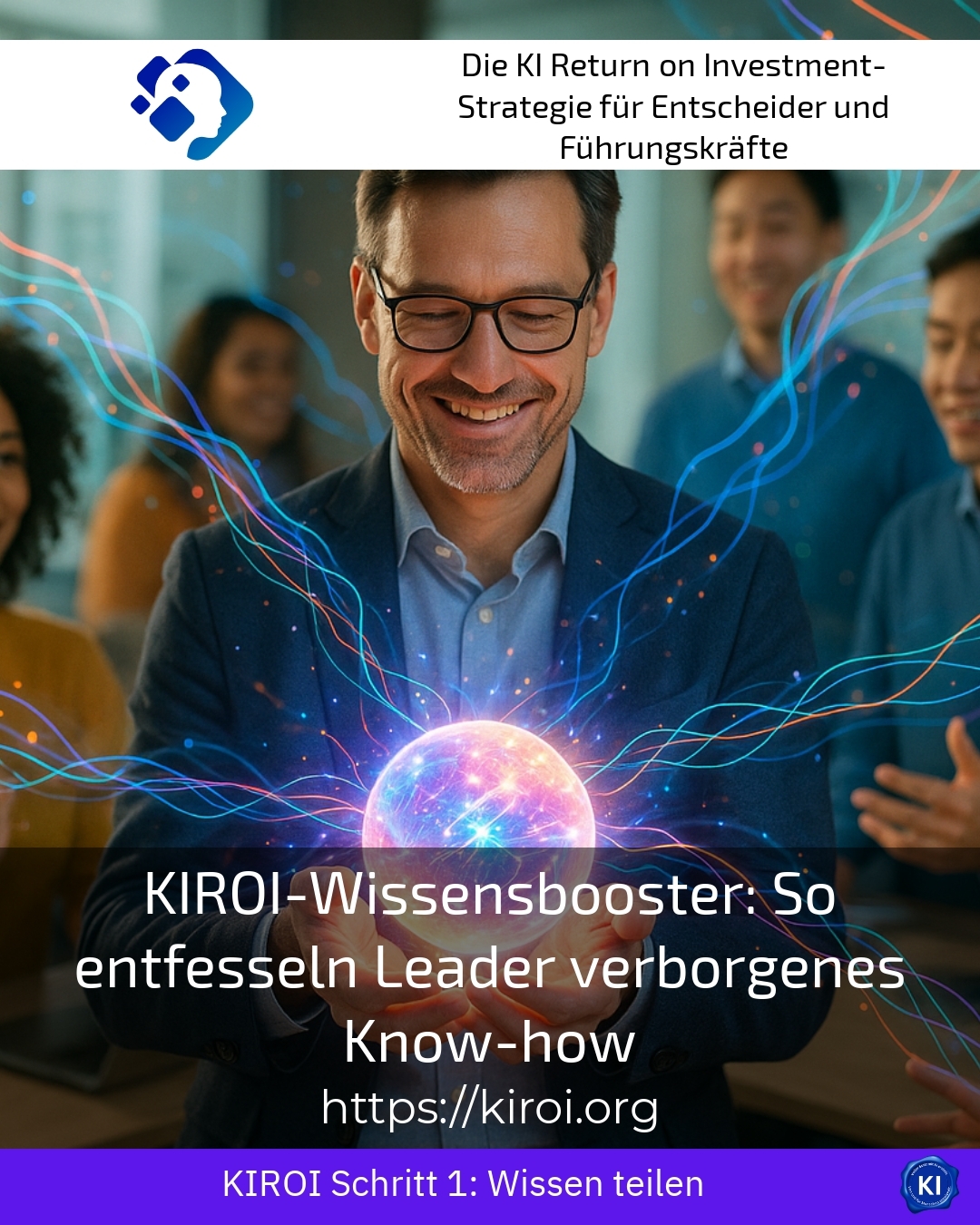
Imagine a treasure slumbering within your company, unseen by anyone because it’s hidden beneath layers of routine, siloed thinking, and unused databases. Leaders who are able to KIROI Knowledge Booster systematically use it, frequently report on how they finally activated this hidden know-how and turned it into measurable competitive advantages. In an era where technological upheavals are redefining entire markets, the ability to unleash implicit knowledge is becoming the decisive differentiator for sustainably successful organisations.
Why traditional knowledge management is no longer sufficient today
Many companies still rely on outdated knowledge management approaches. They archive documents in complex folder structures that hardly anyone searches. They create extensive manuals that are already outdated after a few months. The experience of long-serving employees often remains undocumented in their heads. When these individuals leave the company, valuable knowledge is irretrievably lost.
A medium-sized manufacturing company experienced precisely this scenario when three experienced shift managers retired simultaneously. Production efficiency fell by twelve percent within six weeks. No one had documented how these experts recognised machine malfunctions from subtle changes in sound. Similar situations occurred at a logistics provider whose most experienced dispatcher had never systematically passed on their knowledge of optimal route planning in difficult weather conditions. A pharmaceutical company lost important laboratory knowledge because the handover processes during staff changes were too superficial.
These examples highlight a fundamental problem in modern organisations. Knowledge exists in two forms that require different treatments. Explicit knowledge can be relatively easily documented and shared. Tacit knowledge, on the other hand, is deeply embedded in experience, intuition and routine actions. This is precisely where the KIROI Knowledge Booster by providing methods to systematically capture even these elusive knowledge bases.
The KIROI Knowledge Booster as a Catalyst for Leaders
Leaders face the challenging task of identifying and leveraging hidden expertise. KIROI Knowledge Booster It supports this with a structured framework that addresses various dimensions of knowledge transfer. First, it is about establishing a culture of openness where sharing insights is rewarded. Furthermore, technical infrastructures must be created to facilitate knowledge exchange.
An insurance group successfully implemented this approach in its claims management. Experienced claims handlers passed on their expert knowledge of fraud detection to younger colleagues. Documented case studies were created and served as learning material. A mechanical engineering company used similar methods to preserve the knowledge of its best designers. Their decades of experience with material behaviour under extreme conditions were systematically recorded. An energy supplier, in turn, focused on the knowledge of its maintenance technicians, who knew the power plant facilities better than any technical documentation.
Best practice with a KIROI customer
An internationally active trading company faced the challenge of securing the purchasing knowledge of its most experienced category managers. These experts possessed a keen sense for market trends and supplier relationships that could not easily be captured in process descriptions. As part of a transruption coaching process, we supported the organisation in developing structured knowledge transfer workshops. The experienced buyers were asked to describe their decision-making processes in particularly complex negotiation situations in detail. This brought aspects to light that had not even been fully realised by those involved. For instance, a purchasing manager only discovered during the coaching conversation that she unconsciously paid attention to subtle body language signals when evaluating suppliers. This implicit knowledge was subsequently incorporated into training materials, which helped junior employees sharpen their observation skills. The company reported that the onboarding time for new category managers was significantly reduced as a result. At the same time, the quality of supplier selection improved measurably, as even less experienced team members could now draw on proven evaluation criteria.
Practical Methods for Knowledge Extraction
Unlocking hidden know-how requires thoughtful methodological approaches. So-called knowledge maps help to gain an overview of existing competencies. These visual representations show which individuals possess what specialist knowledge. They also make visible where critical knowledge concentrations have emerged.
A chemical company used this method to reduce dependencies on individual laboratory specialists. A telecommunications provider used knowledge maps to identify synergies between different development teams. Through this visualisation, a financial services provider realised that crucial compliance knowledge was concentrated in only two individuals, and immediately initiated measures for wider dissemination of this expertise.
Storytelling methods are particularly well-suited for making implicit knowledge accessible. Experienced employees talk about critical situations and their solution strategies. These stories convey not only factual knowledge but also emotional and contextual information. An automotive supplier used this technique to document the knowledge of experienced quality inspectors. A food manufacturer collected experience reports from its product developers in this way. A construction company had project managers describe their most challenging construction site situations.
The role of the leader as a knowledge multiplier
Leaders who wish to successfully unleash hidden expertise must lead by example. They openly share their own knowledge and encourage others to do the same. They create psychological safety by admitting their own knowledge gaps. This attitude signals to the team that learning and knowledge sharing are valued behaviours.
A board member of a technology company began regularly sharing their insights from strategy discussions with the entire management team. This transparency led to other executives also being more open with information. A managing director of a family business established monthly knowledge-sharing meetings where department heads reported to each other on their project experiences. A clinic director initiated interdisciplinary case discussions to better link medical knowledge across specialised fields [1].
transruptions-Coaching helps leaders to take on this new role as knowledge multipliers. In individual coaching sessions, they reflect on their own knowledge management practices. They develop strategies to empower teams to share their expertise more actively. They learn to recognize resistance to knowledge transfer and to deal with it constructively.
Overcoming barriers with the KIROI knowledge booster
Organisations often encounter obstacles when trying to release hidden knowledge. Some employees fear becoming replaceable by sharing their knowledge. Others simply don't have time for additional documentation tasks. Still others see no personal benefit in revealing their experiential knowledge.
A software development company countered these resistances by integrating knowledge sharing into performance appraisals. A consultancy firm introduced incentive systems that rewarded active knowledge sharers. A medical technology manufacturer created dedicated periods where employees could focus exclusively on knowledge transfer. These varied approaches demonstrate that there is no one-size-fits-all solution, but rather context-specific strategies are required.
The KIROI Knowledge Booster offers a flexible toolkit from which managers can select suitable instruments. This modular structure allows the methodology to be adapted to different corporate cultures and industry requirements. Thus, a traditional manufacturing company can set different priorities than an agile start-up [2].
Best practice with a KIROI customer
A medium-sized company in plant engineering approached us because important project knowledge was regularly lost between assignments. Each new project essentially started from scratch, even though similar challenges had been overcome many times before. As part of our support, we jointly developed a system of structured project retrospectives and a searchable knowledge base. A particularly valuable insight was that formal documentation alone was not sufficient. The project teams needed low-threshold ways to share informal findings as well. We therefore implemented short video statements in which project managers summarised their most important learnings. These authentic reports were accessed far more frequently by colleagues than written reports. After the introduction of these measures, the organisation recorded a noticeable improvement in project quality. Problems that had previously occurred multiple times could now often be avoided in advance. Employees also reported higher job satisfaction because they felt their experiences were valued.
Technology as a supporter of knowledge transfer
Modern technologies can significantly support the process of knowledge liberation. Intelligent search systems help to find relevant knowledge faster. Collaboration platforms facilitate spontaneous exchange between employees. Analysis tools identify knowledge gaps and expert networks [3].
A logistics company used an intelligent expert system to automatically suggest the right internal specialists for complex customer inquiries. An engineering services provider implemented a knowledge platform where project teams documented their technical solutions and made them accessible to others. A retail group relied on mobile learning to continuously expand the product knowledge of its sales staff.
At the same time, it is important not to overestimate technology. The best tools are of little use if the cultural prerequisites for knowledge sharing are missing. A financial institution invested considerable sums in state-of-the-art knowledge management software that was barely used by employees. Only when supplementary change management measures were implemented did the system begin to realise its value.
Sustainable embedding of knowledge culture
The permanent integration of knowledge transfer into organisational culture requires consistent action over longer periods. Short-term initiatives often fizzle out as soon as the initial attention wanes. Leaders must therefore continuously emphasise and demonstrate the importance of knowledge sharing.
A publishing house established monthly innovation breakfasts where employees from different departments shared their latest insights. A sports equipment manufacturer integrated knowledge transfer firmly into the onboarding process for new employees. An energy company introduced mentoring programmes that explicitly promoted knowledge exchange between generations.
transruptions-Coaching helps organisations to build such sustainable structures. We support leadership teams over several months, helping them to firmly integrate knowledge management into their daily leadership routine. We address the specific challenges our clients come to us with, whether it is the upcoming retirement of key personnel, integration following company mergers, or the establishment of new business areas.
My KIROI Analysis
The systematic unlocking of hidden expertise represents one of the most significant leadership tasks of our time. Organisations that operate successfully here gain sustainable competitive advantages that are difficult to replicate. The KIROI Knowledge Booster provides leaders with a tried-and-tested framework that supports them in this complex task and offers inspiration.
From my experience working on numerous transformation projects, I repeatedly observe the same pattern. Companies consistently underestimate the value of their implicit knowledge until they painfully experience its loss. Proactive leaders, on the other hand, invest early in structures and cultures that promote knowledge transfer. They understand that the ability to mobilise knowledge will become even more important in the future than it is today.
Technological possibilities for supporting knowledge management are developing at a rapid pace. At the same time, human factors – trust, motivation, communication skills – remain the crucial drivers of success. Leaders who intelligently combine both dimensions will be able to position their organisations for the future.
I am increasingly observing that successful companies understand knowledge transfer not as an isolated project, but as an integral part of their leadership philosophy. This attitude permeates all levels of hierarchy and shapes the daily actions of every single team member. This is precisely where the key to sustainably unlocking hidden expertise lies, in a culture that understands knowledge sharing as a natural part of good collaboration.
Further links from the text above:
[1] Harvard Business Review: Insights on Knowledge Management
[2] McKinsey: Organisational Performance and Knowledge Sharing
[3] Gartner: Definition and Overview of Knowledge Management
For more information and if you have any questions, please contact Contact us or read more blog posts on the topic Artificial intelligence here.











 Deutsch
  English (UK)