
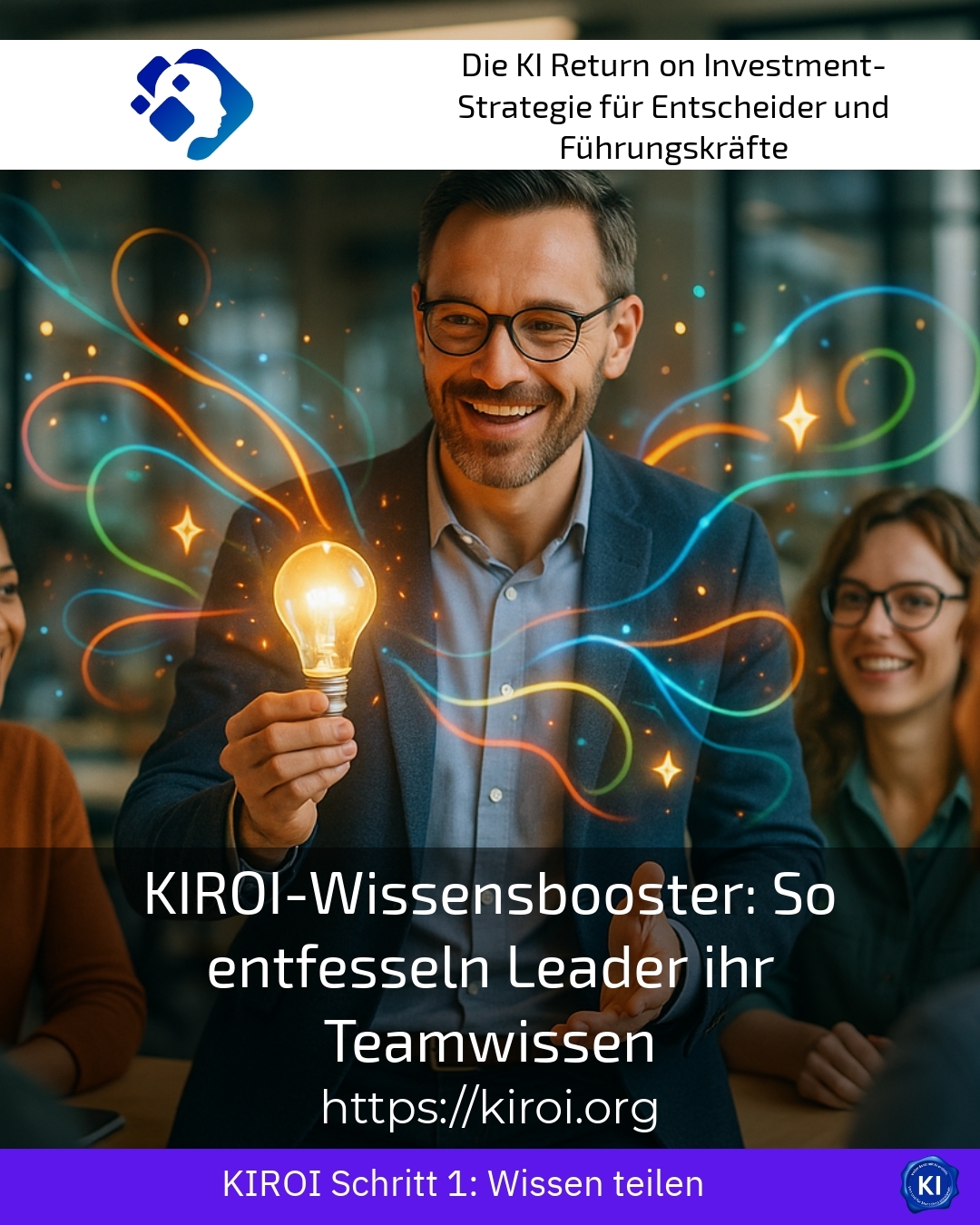
Imagine all of your team’s knowledge is scattered like unpolished diamonds, inaccessible to anyone. This is precisely where the AIROI Knowledge Booster and transforms hidden expertise into strategic strength. Today, leaders face the challenge of activating and sustainably leveraging collective intelligence. This article shows you practical, proven ways to fully unleash your team's potential as a leader.
The hidden resource: Why team knowledge often remains untapped
A vast amount of knowledge lies dormant in the minds of employees within many organisations. However, this knowledge is rarely systematically unlocked or shared. Leaders often report frustration because valuable insights disappear into silos. For instance, a sales representative may know their customers' objections intimately. Yet, this knowledge rarely reaches product development. At the same time, accounting possesses deep insights into payment flows. This information could assist sales in price negotiations. This results in knowledge islands that hinder company growth.
The causes of this fragmentation are manifold and often deeply rooted. A lack of time prevents employees from documenting their knowledge. Missing structures make systematic exchange between departments difficult. Added to this is a culture that rewards individual expertise rather than promoting sharing. In consulting firms, we frequently observe experienced consultants guarding their methodological knowledge. Younger colleagues must repeat the same mistakes, wasting valuable time. The AIROI Knowledge Booster offers concrete approaches to overcoming these barriers.
Practical examples from day-to-day business life
A medium-sized mechanical engineering company faced a typical problem. Its most experienced service technicians were retiring. Their knowledge of special machine configurations was at risk of being lost. Through structured knowledge transfer sessions, the company managed to preserve this knowledge. Another example comes from the logistics sector. There, warehouse workers knew about optimisation possibilities that management was unaware of. These ideas only came to light when a new team leader actively inquired. In the healthcare sector, nursing staff experience daily how patients react to treatments. However, this practical knowledge rarely reaches doctors in a systematic way.
Best practice with a AIROI customer
An international trading company with over two thousand employees approached us with an urgent concern. Management noticed that newly hired employees kept asking the same questions. Experienced colleagues felt increasingly burdened by constant onboarding. At the same time, valuable insights from customer conversations were regularly lost. As part of our support, we jointly developed a multi-stage knowledge management system. First, we identified the most important knowledge carriers in each department. Then, we conducted structured interviews to make tacit knowledge explicit. Subsequently, we established weekly exchange formats, which quickly became a popular routine. After six months, the HR department reported significantly shorter onboarding times. Employee satisfaction increased measurably because experts felt valued. Furthermore, the company was able to implement several process improvements that arose from the collected team knowledge.
The AIROI Knowledge Booster as a Management Tool
Leaders need concrete tools to activate and leverage team knowledge. The AIROI Knowledge Booster provides a structured framework for this process. It begins with analysing existing knowledge resources within the team. Both explicit and implicit knowledge are systematically captured. Explicit knowledge can be found in documents, databases, and manuals. Implicit knowledge, on the other hand, is embedded in experience, intuition, and habitual practices. It is precisely this hidden knowledge that often makes the crucial difference.
The next step involves creating suitable exchange formats. Regular retrospectives enable learning from completed projects. Peer learning groups promote horizontal knowledge exchange among equals. Mentoring programmes combine experience with fresh perspectives. In software companies, code reviews have proven to be knowledge multipliers. Here, junior developers learn from experienced colleagues through concrete examples. Architecture firms use similar formats to collectively reflect on design decisions. In the financial sector, case study sessions for complex consulting cases are increasingly becoming established.
Technological support for knowledge transfer
Modern technologies can significantly accelerate and simplify knowledge transfer. Knowledge management platforms enable the structured collection of insights and experiences. Intelligent search functions help to quickly find relevant knowledge. Chatbots can answer frequently asked questions automatically. In insurance companies, such systems support claims handlers with complex claims. The pharmaceutical industry uses knowledge bases to make research findings accessible. Retail companies digitally collect sales tips from their most successful employees.
Nevertheless, technology must not become an end in itself. It supports human interaction, but cannot replace it. Many companies invest in expensive software without creating the necessary cultural prerequisites. Employees will only share their knowledge if they feel secure and valued. Therefore, leaders must actively embody a culture of trust. This is particularly evident in the construction industry when it comes to the transfer of safety knowledge. Experienced craftspeople often only share their knowledge in trusting conversations. Digital platforms can initiate and document such conversations.
Cultural prerequisites for successful knowledge exchange
A learning organisation doesn't emerge through top-down directives. It develops through consistent role-modelling and the patient cultivation of specific behaviours. Leaders play a central role in this, setting the example. When they themselves openly discuss their own mistakes and learning processes, employees follow. In the gastronomy sector, successful head chefs share their recipes with the team. They understand that shared knowledge raises quality for everyone. In law firms, on the other hand, a competitive mindset often still prevails. There, knowledge is sometimes hoarded as a power base rather than shared.
Psychological safety forms the bedrock for open knowledge sharing. Employees must dare to ask questions and admit when they don't know something. In hospitals, this openness can literally save lives. When nursing staff can voice concerns, errors are identified early. In manufacturing companies, open communication leads to faster problem-solving. Machine operators often know their equipment better than engineers. Their practical knowledge can prevent breakdowns and optimise processes.
Best practice with a AIROI customer
A renewable energy technology company sought our guidance. The teams worked from various locations and communicated mainly via email. Valuable project knowledge was regularly lost when employees left the company. Management recognised that traditional knowledge management approaches weren't working. Together, we developed a concept based on storytelling and personal connections. We established monthly virtual "fireside chats" where project teams shared their experiences. These informal formats built trust and encouraged questions. Additionally, we introduced knowledge maps showing who possessed what expertise. Employees could then purposefully approach colleagues who had overcome similar challenges. The response exceeded all expectations, and staff turnover noticeably decreased. The company culture visibly shifted towards greater openness and collaboration.
Embedding the AIROI knowledge booster into daily leadership
Integrating knowledge management into everyday leadership requires conscious routines. Regular check-ins offer an opportunity to ask about new findings. Project retrospectives should be a firm part of every project completion. In consulting firms, debriefing sessions after client appointments have proven effective. In retail, branch managers use short morning meetings for the exchange of experience. Manufacturing companies establish shift handovers as knowledge transfer moments. These small rituals add up to a learning organisation.
Leaders can actively promote knowledge transfer through targeted questions. Instead of just asking for results, they should inquire about learning processes and obstacles. In the banking sector, advisors learn a great deal from difficult customer conversations. Systematically sharing these experiences improves overall advisory quality. Advertising agencies gather insights from pitches, regardless of the outcome. Even lost pitches offer valuable learning opportunities for future projects. In the automotive industry, production problems are meticulously analysed and documented.
My AIROI Analysis
The systematic development of team knowledge represents one of the greatest leadership challenges of our time. Technological possibilities alone are not sufficient to unlock this potential. Instead, a conscious combination of cultural transformation and structured processes is required. The AIROI Knowledge Booster offers a tried and tested framework for this, allowing for individual adaptation.
Our support programmes consistently show that small steps can have a big impact. A weekly exchange format can lay the foundation for sustainable change. Consistent implementation over a longer period is crucial. Leaders who actively share knowledge themselves inspire their teams to follow suit. Investing in a knowledge culture pays off through increased innovation. Employees feel valued and become more engaged.
For organisations wanting to go down this route, I recommend a step-by-step approach. Begin with an honest assessment of your current knowledge culture. Identify key knowledge carriers and how they are networked. Then, establish initial, low-threshold exchange formats and observe the resonance. Continuously adapt your measures to your team's needs. Transruption coaching can effectively support this process and provide impetus for implementation [1].
Further links from the text above:
[1] AIROI Methodology and Knowledge Management Approaches
For more information and if you have any questions, please contact Contact us or read more blog posts on the topic Artificial intelligence here.






 Deutsch
  English (UK)