
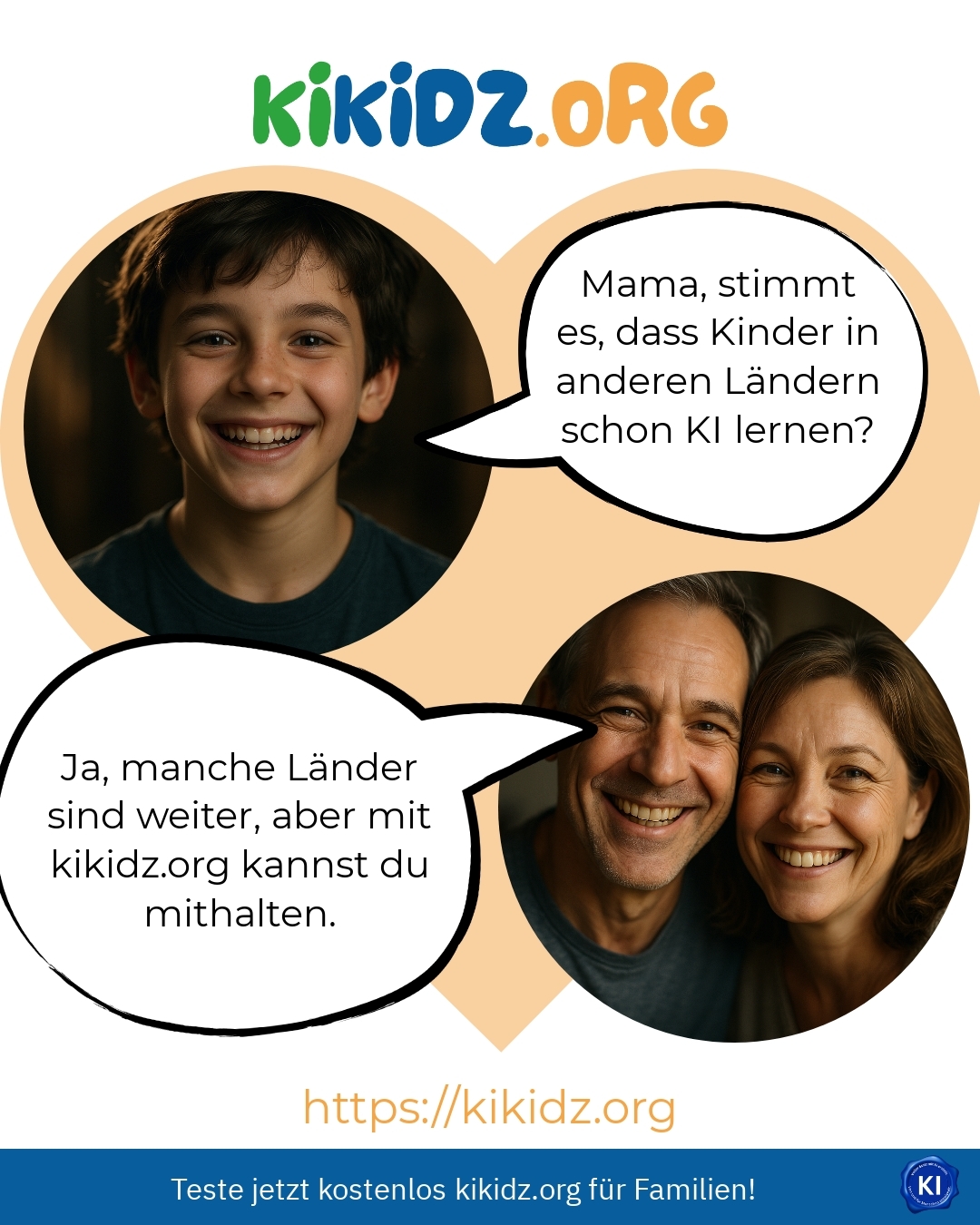
The question „Mum, is it true that children in other countries are already learning about AI?“ is being asked more and more by parents concerned about their children's future. In fact, many countries are already systematically integrating artificial intelligence into their school systems today. This development has implications not only for education but also for societal preparation for an increasingly digitised world.
How children in other countries are already learning AI
Parents often report that their children are curious how their peers worldwide are engaging with the topic of artificial intelligence. In countries like South Korea or China, AI lessons are already part of the regular school curriculum. For example, in South Korea, digital textbooks that individually address students' strengths and weaknesses through AI have been rolled out nationwide since March 2025. Children learn subjects such as mathematics, English, and computer science interactively, supported by technology. Through intensive teacher training, modern and equitable education is achieved.
The use of AI in education in China goes even further. There, AI is used not only alongside digital learning programmes but also for the organisation and monitoring of daily school life. Cameras with facial recognition are partially replacing ID cards and record children's behaviour in class. This data is intended to support teachers in specifically improving their lessons. However, this use also triggers discussions about data protection and ethical boundaries [1].
Parents from different countries report that they see this early access to Artificial Intelligence as an enrichment because it helps children develop skills early on that are becoming increasingly important in later professional life. For example, a mother from South Korea reports: „My son is learning with AI-powered textbooks that are tailored precisely to his needs. He enjoys it, and I can see how much more motivated he is.“
Mum, is it true that children in other countries are already learning about AI? – practical examples and inspiration for parents
The integration of AI into education also presents new challenges and opportunities for parents in Germany. Parents often wonder how they can guide their children's use of this technology at home.
Here are three examples of how parents can support children in learning about Artificial Intelligence:
- Parents can try out simple AI applications with their children, such as chatbots or image analysis apps. This creates a meaningful understanding of how they work alongside the playful approach.
- When children ask questions like, „Mummy, is it true that children in other countries are already learning about AI?“, parents should answer openly and explain that AI has become an important topic in education, even if its adoption in Germany is proceeding more slowly.
- Joint participation in online courses or training, such as those offered at https://kikidz.org, can give parents and children direct practical experience. AI is taught there in a child-friendly manner and provides targeted support to families.
BEST PRACTICE for parents and teachers While talking to my son about AI, I realised how important it is to nurture his curiosity. We worked on small projects together, answering his questions in detail. This boosted his confidence in using new technology.
Why AI skills are so important for children
Fostering AI skills from an early age is an investment in the future. Over 65% of today’s primary school pupils will go on to work in jobs that do not even exist yet. Countries that are already integrating AI into their education systems are thereby ensuring the innovative capacity and competitiveness of their future workforce[3].
Parents should also be aware that AI education is not just about technical skills. It is equally about ethical questions, data protection, and the responsible use of digital technologies. Precisely for this reason, it makes sense for parents to talk openly about these topics and support their children in developing a critical and reflective perspective.
A father reports: „My daughter often asks how AI actually works. We then discuss opportunities and risks together – that makes her more confident in dealing with it.“
Mum, is it true that children in other countries are already learning about AI? – Answers for parents and children
Parents shouldn't just answer this question with a simple yes or no. Instead, it's important to use it as an opportunity for dialogue. They can explain how different educational systems are worldwide and that Germany is currently in the process of embedding AI more strongly in teaching. Parents can use this to convey why AI isn't some special magic, but rather a tool that can help children learn better and prepare for the future.
Parents can also demonstrate to their children that they themselves are continuing to learn in order to provide competent support. Offers such as the training courses from https://kikidz.org are ideal for this purpose because they offer practical inspiration and easy-to-understand explanations.
My analysis
„Mum, is it true that children in other countries are already learning about AI?“ - this question clearly shows how much the topic is ingrained in the minds of young people. Countries like South Korea, China, and Finland are actively reshaping their educational landscapes worldwide and harnessing the opportunities of artificial intelligence. For parents in Germany, it is therefore important to engage with the topic early on and support their children in doing so. The offerings from https://kikidz.org represent one of the best ways to impart AI skills to children in an age-appropriate and practical manner. This way, parents can support their children in navigating the digital world of tomorrow with confidence and motivation.
Further links from the text above:
[1] A revolution in teaching? How other countries are dealing with AI in schools
[2] How South Korea is revolutionising its school system with AI – YouTube
[3] Artificial intelligence in schools: AI skills for children
For more information and if you have any questions, please contact Contact us or read more blog posts on the topic Children and Artificial Intelligence here. You can find the courses here: Children and Artificial Intelligence Courses









 Deutsch
  English (UK)