
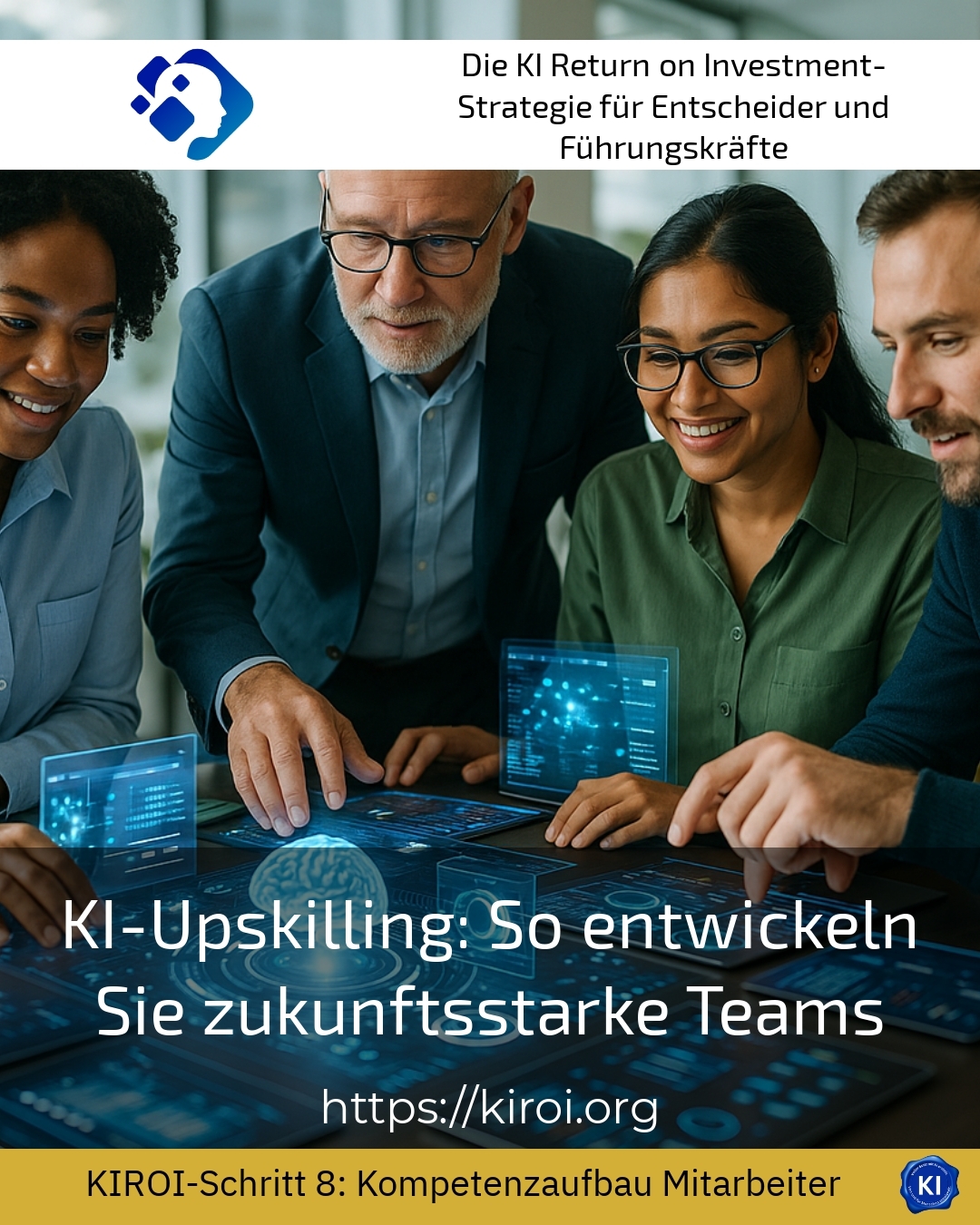
The digital transformation is changing our working world at an astonishing pace and presenting companies with completely new challenges. AI upskilling: How to develop future-proof teams – this question concerns both managers and human resources managers. While intelligent systems can take on more and more tasks, the need for employees who understand and creatively use these technologies is growing. Organizations that do not actively prepare their workforce for these changes risk losing their edge. But how specifically can people be empowered to collaborate with intelligent technologies? This article presents practical ways and explains why investing in skills development is more important today than ever before.
Why strategic development has become indispensable
The integration of intelligent systems into operational processes is progressing relentlessly and now affects almost every industry. Companies are increasingly realizing that technological progress alone is not enough. The qualification of employees determines success. Studies show that organizations with targeted training programs achieve significantly better results [1]. This realization leads to a change in mindset in many human resources departments worldwide.
The urgency of this development is particularly evident in the manufacturing sector. Production lines are increasingly being optimized through intelligent control systems and require entirely new skills from employees. A machine operator must not only master their craft but also understand digital interfaces. At the same time, the role of quality inspectors is changing fundamentally, as imaging methods automatically detect errors. And in logistics, autonomous systems are increasingly taking on transport tasks, requiring employees to assume new coordinating functions.
Transruptions coaching accompanies companies in precisely these transformation projects and helps them to design change processes in a human-centric way. Because technological change can only be successful if the people who are to implement it are actively involved and empowered. Clients often report initial resistance from the workforce, which can be transformed into constructive co-creation through targeted support.
The core competencies for a technology-based working world
At AI Upskilling It is not primarily about learning programming languages or technical special knowledge. Rather, cross-cutting skills come to the fore, enabling the confident use of new tools. Critical thinking forms an indispensable foundation here, because automated systems must not be blindly trusted. Communication skills are gaining in importance as complex issues must be explained in a comprehensible manner. And the willingness to learn throughout life becomes a key competence in an ever-changing environment.
In the financial sector, these requirements are particularly evident. Advisors need to understand how automated risk assessments are generated to provide competent advice to clients. Compliance employees work with systems that identify suspicious transactions and require judgment in dealing with borderline cases. And in portfolio management, algorithmic analysis complements human expertise without completely replacing it. These examples illustrate that humans and machines are becoming increasingly interconnected.
The healthcare sector is experiencing similarly profound changes through intelligent technologies. Medical professionals use diagnostic support systems and must be able to critically assess their recommendations. Caregivers work with monitoring solutions that monitor vital signs and alert them when deviations occur. And in medical research, automated analysis is accelerating the analysis of large data sets significantly. All of these developments require continuous competence development at all levels.
Best practice with a AIROI customer A medium-sized company in the mechanical engineering sector faced the challenge of preparing its workforce for the implementation of a comprehensive production control system. The management early recognized that technical training alone would not be sufficient to secure acceptance within the workforce. Therefore, a holistic development program was designed that addressed both technical and cross-functional competencies. First, we collaborated with the company to analyze the existing skills and identify specific development needs. Subsequently, learning paths were developed that took into account different roles and experience levels. Particular emphasis was placed on fostering multipliers who were able to pass on their knowledge to colleagues. The results significantly exceeded the initial expectations, as employees experienced themselves as active agents of change. Productivity increased measurably within a few months, while the error rate significantly decreased. Particularly noteworthy was the improved collaboration between different departments, which had been created through common learning formats. The project vividly demonstrates how competence development and technology implementation can go hand in hand when the human factor is consistently taken into account.
AI Upskilling: This is how you develop future-ready teams through individual learning paths
Each person learns differently and brings different prerequisites. This knowledge must be reflected in modern continuing education concepts. Standardized training often only truly reaches a portion of the target audience. Therefore, successful organizations rely on personalized development offerings that take individual strengths and gaps into account. Adaptive learning systems can support this by tracking progress and adapting content accordingly.
In retail, these approaches are already being implemented on a widespread basis. Sales staff are learning to use recommendation systems at their own pace. Branch managers are developing skills in analyzing sales forecasts and optimizing inventory levels. And in the e-commerce sector, training in interpreting customer analyses and personalization strategies is empowering employees. These differentiated offerings take into account the diversity of requirements and significantly increase the effectiveness of the measures.
The media and publishing industry also illustrates what individual learning can look like. Editors acquire skills in the use of automated research tools, while graphic designers experiment with generative image technologies. Marketing professionals deepen their understanding of automated campaign optimization and data-driven audience targeting. And executives develop strategic knowledge to make informed technological investment decisions. Thus, a competence portfolio is created that strengthens the entire organization.
Learning culture as the foundation of sustainable development
Individual training initiatives quickly fail if they are not embedded in a supportive learning culture. Organizations must create spaces where experimentation is allowed and mistakes are viewed as learning opportunities. Leadership plays a key role here because their own behavior sets the standards. When supervisors themselves actively learn and make this visible, they also motivate their teams to develop further.
The construction industry offers interesting examples of cultural change. Construction companies are establishing digital learning platforms where employees can exchange knowledge about new technologies. Regular Innovation Days allow for the testing of drones for surveying tasks or automated planning tools. And mentoring programs connect experienced professionals with digitally-savvy young talent, so that both parties benefit from each other. These initiatives signal that learning is valued and encouraged.
Similar developments are taking place in the energy sector. Grid operators are creating innovation labs where employees can experiment with predictive systems and intelligent controls. Wind farm operators are establishing communities of practice for the exchange of experience on predictive maintenance. And in energy consulting, new formats are emerging for knowledge transfer to automated analytical tools. All these measures contribute to fostering an open attitude towards technological change.
Transruptional coaching provides impetus for the development of such learning cultures and accompanies those responsible in their implementation. This is not about ready-made solutions, but about jointly developing more tailored concepts. Clients often report that the external perspective helps them identify blind spots and gain new perspectives.
Practical formats for effective learning in everyday work
Traditional seminars have their place, but they are not enough on their own. Learning needs to be more integrated into everyday work to have a lasting impact. Microlearning units of a few minutes can be flexibly incorporated into work breaks. Peer learning sessions enable the exchange between colleagues at an equal level. And project-based learning combines competence development with concrete challenges from day-to-day work.
The automotive industry is experimenting with a wide range of innovative learning formats. Workshops use augmented reality glasses that project instructions directly into the field of view, enabling learning in the process. Development departments organize hackathons where teams create prototypes for intelligent applications within a short time. And sales organizations are relying on role-playing sessions with simulated customer conversations, which are evaluated using analysis tools. These practical approaches significantly increase the transfer of knowledge.
In the legal field, new learning formats are also emerging for using technological tools. Law firms offer lunchtime sessions where employees can explore automated contract analysis. Corporate legal departments are establishing digital learning journeys with sequential modules. And professional associations are organizing webinars on the legal implications of algorithmic decision-making systems. Thus, continuous learning becomes an integral part of professional practice.
Best practice with a AIROI customer An international logistics company wanted to prepare its several thousand employees for the implementation of intelligent route planning and warehouse management. The particular challenge lay in the geographical distribution across numerous locations and the different levels of employee expertise. Together, we developed a multistage concept that meaningfully combined digital and face-to-face elements. A central learning platform provided basic knowledge in the form of short video modules that were available in multiple languages. In addition, regional workshops took place where employees completed practical exercises with the new systems. Particularly innovative was the approach of learning pairs, in which one technically more advanced colleague accompanied a less experienced colleague over several weeks. This peer-to-to-peer support proved to be exceptionally effective because it was low-key and available on a continuous basis. The implementation of the new systems proceeded much more smoothly than in previous projects without comparable support. Employee satisfaction with the transformation was significantly higher than expected in surveys. And the intended efficiency gains were achieved earlier than planned in the original project plan. This example illustrates how well-thought-out competence development significantly influences the success of technological investments.
The role of leadership in competence development
Leaders bear special responsibility for the AI Upskilling They are responsible for their teams and must actively take on this task. They create spaces for learning and protect them from the influence of day-to-day business. They recognize individual development needs and promote appropriate measures. And they convey the significance of change so that employees understand why new competencies are important.
In the hospitality industry, it becomes clear how crucial leadership behavior is for successful development. Hotel managers who work with automated revenue management systems can better support their teams. Chefs who understand intelligent ordering optimization integrate these tools more successfully into their workflows. And service managers who use data-driven guest preferences create convincing role models for their employees. Leading by example proves particularly effective.
The insurance industry offers further instructive examples. Sales managers who use automated needs analyses themselves and make their added value tangible convince their colleagues. Claims managers who competently use AI-based fraud detection qualify their teams through observation and exchange. And CEOs who explain technological expertise as a strategic priority and allocate corresponding resources set important signals. Leadership decisively determines the success of development initiatives.
My AIROI Analysis
The discussion on competence development for a technology-based working world reveals fundamental insights for organizations in all industries. AI upskilling: How to develop future-proof teams – this challenge requires a holistic approach that goes far beyond technical training. The most successful organizations view learning as a strategic investment, not a cost factor that can be trimmed as needed. They recognize that the combination of human creativity and technological capability creates critical competitive advantages. And they understand that sustainable competence development requires time, resources, and above all genuine appreciation.
From my consulting practice, I know that many companies come to us with similar challenges. They report uncertainties in their workforce in the face of rapid technological changes. They describe difficulties in finding suitable forms of further training that actually have an impact. And they seek guidance in a landscape characterized by exaggerated promises and uncertainty alike. Transruptive coaching accompanies these complex transformation projects and offers a protected space for reflection and development.
The crucial insight is this: Technology alone does not transform an organization. It is the people who shape change and bring it to life. Therefore, investments in technology must always be accompanied by corresponding investments in competence development. Companies that adhere to this principle will reap the rewards of their efforts. They will become more adaptable, innovative, and attractive to talents who want to continuously develop themselves. The path to achieving this requires perseverance and consistency, but the results justify the effort in a sustainable way.
Further links from the text above:
[1] McKinsey Global Institute – The Skill Shift: Automation and the Future of the Workforce
For more information and if you have any questions, please contact Contact us or read more blog posts on the topic Artificial intelligence here.










 Deutsch
  English (UK)