
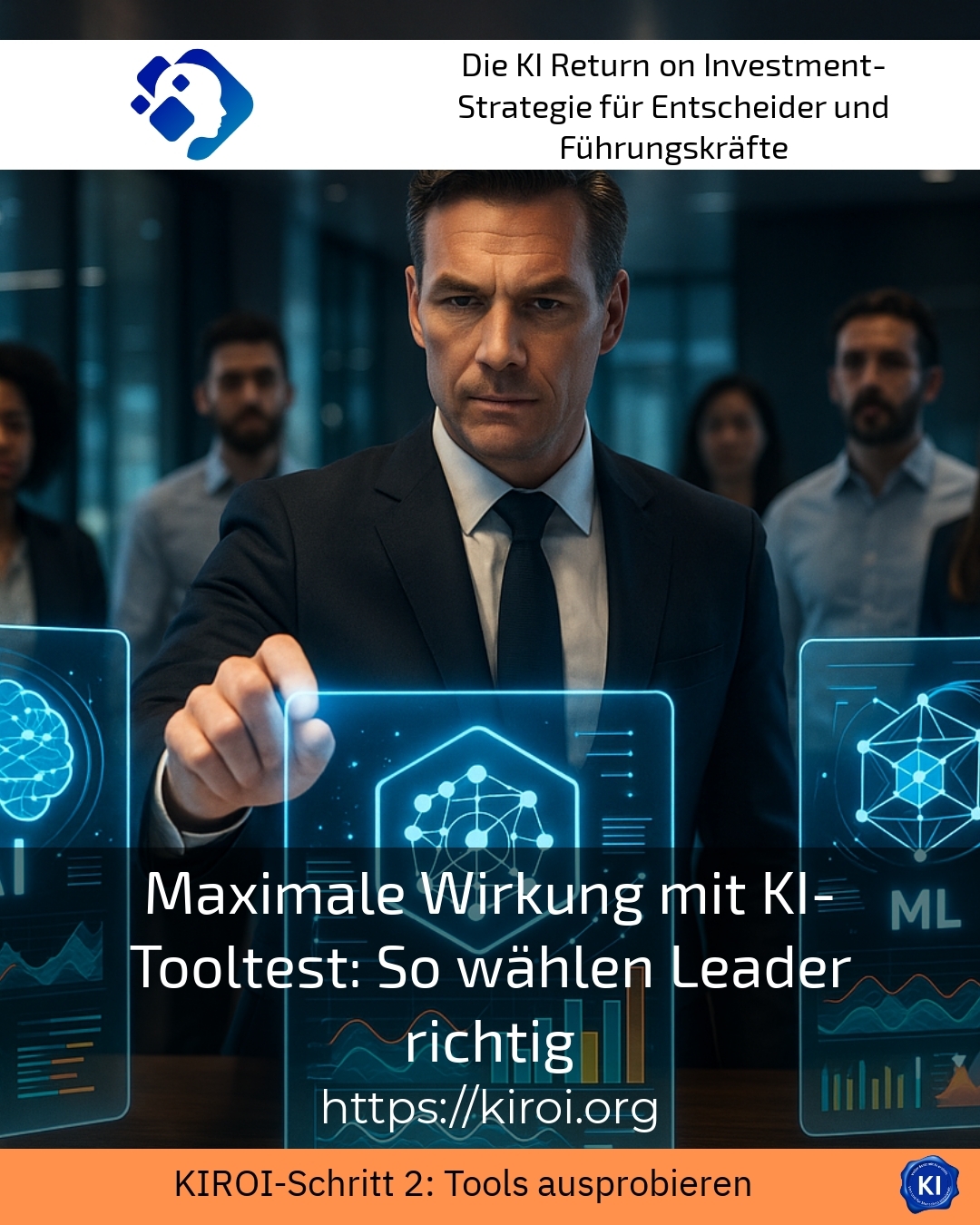
Digital transformation presents leaders with an unprecedented challenge, as the sheer number of available software solutions and intelligent systems regularly overwhelms even experienced decision-makers. While competitors are already implementing automated processes and making data-driven decisions, many companies remain stuck in analysis paralysis. The key to success does not lie in testing every available tool, but rather in strategic selection. This is precisely where the maximum impact with AI tool testing because structured evaluation methods distinguish successful digital pioneers from hesitant laggards. In this article, you will learn how leaders can systematically identify the right technologies while avoiding costly misjudgements.
The fundamentals of strategic technology assessment for decision-makers
Before managers even begin testing, they must first precisely analyse their initial situation. A medium-sized logistics company requires fundamentally different solutions than a financial services provider or a manufacturing business. Therefore, the stocktaking of existing processes, data structures and employee competencies forms the indispensable foundation of every successful implementation [1].
The textile industry, for example, uses intelligent systems primarily for demand forecasting and inventory optimisation. Fashion houses such as leading European brands rely on algorithms that predict trends and adjust production volumes accordingly. These use cases differ significantly from those in the automotive sector, where predictive maintenance and quality control are paramount. A Bavarian automotive supplier reduced its scrap rate by more than thirty percent through image-recognition systems. At the same time, a Scandinavian furniture manufacturer implemented chatbots that automatically process customer queries and relieve the workload on sales advisors.
Leaders must understand that technology assessment is not a one-off activity. Rather, it is evolving into a continuous process. The market is constantly changing and new solutions appear every month. Therefore, forward-looking companies are establishing dedicated innovation teams or commissioning external consultants with systematic market observation. This structured approach prevents both premature investments and dangerous hesitation [2].
Maximum impact with AI tool testing through structured evaluation criteria
The evaluation of technological solutions requires a multi-dimensional system of criteria. Technical performance alone is by no means sufficient, because factors such as integration capability, scalability and user-friendliness ultimately determine sustainable success. A pharmaceutical company from Switzerland failed with a state-of-the-art laboratory analysis solution because the software could not communicate with existing documentation systems. The system's technical brilliance was of no use because employees had to transfer data manually.
In contrast, a northern German port operator successfully implemented a container logistics solution. This success was largely due to the seamless connection to existing planning tools. Employees were able to work productively right away because familiar interfaces were retained. An Austrian energy supplier had a similar experience, as its network monitoring system integrated effortlessly into the existing IT landscape. These examples illustrate that compatibility is often more important than maximum performance [3].
Best practice with a AIROI customer
A medium-sized engineering company from southern Germany turned to our transruptions coaching team because the management was facing a far-reaching technology decision and felt uncertain. The company, which has around three hundred employees, had already been through several unsuccessful implementation attempts and was correspondingly frustrated. Together, we developed a structured evaluation framework that took technical, organisational and cultural factors equally into account. First, we identified the three most pressing business problems and then filtered the market for suitable solution approaches. Subsequently, we carried out pilot projects with two selected suppliers, specifically involving employees from various hierarchical levels. The production staff provided valuable assessments regarding practical usability, while management evaluated the strategic fit. After twelve weeks of intensive support, the company opted for a predictive maintenance solution that has since successfully predicted machine failures. Downtime was reduced by around forty percent within six months. Particularly pleasing was the high level of acceptance among the workforce, who felt valued through their involvement and actively helped shape the system. This project illustrates how transruptions coaching can support and guide complex digitalisation projects.
Practical test methods for different company sizes
Resource availability largely determines which evaluation methods are practicable. Large corporations have dedicated innovation departments and sufficient budgets for extensive pilot projects, whereas medium-sized enterprises have to take a more creative approach and deploy their limited funds in a targeted manner. A packaging manufacturer in Hesse solved this dilemma by using the vendors' sandbox environments, thereby gaining initial experience free of charge.
The food industry demonstrates impressively what sector-specific test scenarios can look like. A Bavarian dairy evaluated various quality control systems using real production data from past batches. This allowed the detection accuracy for contaminants to be compared objectively. At the same time, a large bakery from North Rhine-Westphalia tested planning algorithms for its delivery logistics. The simulation of various scenarios revealed significant differences between the provider solutions [4].
The healthcare sector is also increasingly developing standardised evaluation procedures. A hospital group from Lower Saxony established an evaluation committee made up of doctors, nursing staff and IT specialists. This interdisciplinary team assesses new technologies based on medical benefit, workload and data privacy compliance. This holistic perspective prevents technically impressive solutions from failing due to practical hurdles. The model has since found imitators in several other hospital groups.
How leaders choose correctly: Decision frameworks in practice
Successful managers use systematic decision-making frameworks rather than relying on intuitive gut feelings. The AIROI model offers a tried-and-tested approach to this, taking into account both quantitative and qualitative factors. A chemicals company based in Rhineland-Palatinate applied this framework when selecting a process optimisation solution. The structured assessment prevented superficial sales pitches from dominating the decision-making process.
The financial sector demonstrates particularly impressively how professional evaluation works. Banks and insurance companies subject potential solutions to rigorous stress tests and security audits. A direct bank from Frankfurt developed a proprietary evaluation catalog with over a hundred individual criteria. Every new technology goes through a multi-stage approval process before it enters production. This thoroughness takes time, but prevents costly misjudgements [5].
At the same time, the retail sector demonstrates that speed and thoroughness do not have to be mutually exclusive. An online retailer from Hamburg established sprint-based evaluation cycles of two weeks each. During this time, a small team tests new solutions under realistic conditions and systematically documents all findings. At the end of each sprint, a steering committee decides whether to continue or stop. This agile methodology enables rapid iteration without any loss of control.
Maximising impact with AI tool testing through workforce engagement
The choice of technology must under no circumstances take place exclusively in executive suites. Employees who will later work with the systems on a daily basis possess indispensable practical knowledge. An electronics manufacturer from Baden-Württemberg integrated production staff into the selection process at an early stage. They identified weak points that would have escaped the developers and management.
The construction industry shows similar patterns, as here acceptance on the building site determines the success or failure of digital tools. A construction group from Munich introduced test devices directly onto various building sites. Site foremen and construction managers evaluated their practical suitability under real conditions. Dust, noise and weather conditions quickly revealed which solutions were actually suitable for building sites. These field tests added a decisive dimension to the technical laboratory investigations.
Participatory technology assessment is also gaining importance in the education sector. A private university in Berlin had students and lecturers jointly test learning platforms. The different perspectives led to a selection decision that satisfied both user groups. Participants in such participatory processes frequently report that they identify more strongly with the introduced systems and use them more actively [6].
Best practice with a AIROI customer
A retail company with several hundred branches in German-speaking countries sought support in selecting an inventory management system with intelligent forecasting functions. The previous manual order planning regularly led to overstocks or delivery bottlenecks, which both tied up capital and annoyed customers. As part of our transruptions coaching accompaniment, we organised workshops with branch managers, buyers, and warehouse staff from various regions. This heterogeneous group jointly defined the most important requirements for a new system and weighted them according to their practical relevance. We then invited four pre-selected providers to presentations where the workshop participants could ask their questions directly. The practitioners' questions quickly revealed which providers had actually tested their solutions in comparable environments. Two providers dropped out after this round because their systems did not offer the required flexibility for seasonal fluctuations. With the remaining candidates, we carried out pilot projects in five representative branches each. After three months of parallel operation, a clear winner emerged in terms of forecast accuracy and user-friendliness. The subsequent company-wide rollout went almost smoothly because many employees already knew the system and acted as multipliers.
Avoiding pitfalls: Common mistakes in technology selection
The most common mistakes in technology decisions can be traced back to a few basic patterns. Overly ambitious targets lead to failure just as much as a lack of preparation or inadequate change management. A steel producer from the Ruhr region invested substantial sums in a comprehensive production control solution. The project failed because the organisation was not ready for such far-reaching changes.
The media industry provides further instructive examples of avoidable mistakes. A publishing house from Hamburg implemented an editorial system without sufficient training for the journalists. The dissatisfaction was so great that many experienced editors resigned. Another media group made the opposite mistake and trained staff for months without ever switching to live operation. Finding the balance between preparation and action represents one of the greatest challenges [7].
The tourism industry is also struggling with typical implementation errors. An Austrian hotel chain introduced a booking system that was designed for individual hotels. Scaling it to dozens of properties did not work because the system offered no central management functions. A Swiss tour operator, on the other hand, chose an oversized enterprise system whose complexity overwhelmed the small IT department. These examples underline how important it is to realistically assess one's own capacities.
Sustainable implementation and continuous optimisation
Successful technology selection does not end with the purchasing decision, as the actual work only begins afterwards. Implementation projects require dedicated resources, clear responsibilities and realistic schedules. A plant manufacturer from Saxony established a project management office that coordinates and monitors all digitalisation initiatives.
The insurance industry demonstrates exemplary how continuous optimisation can function. Several companies operate monitoring systems that record user behaviour and performance metrics. Irregularities are automatically reported and analysed. This data-driven approach enables early adjustments before small problems become major crises. A life insurer from Cologne thus gradually improved the efficiency of its claims handling by more than twenty-five percent [8].
At the same time, the transport sector demonstrates just how important regular reassessments are. Technologies that were state-of-the-art just a few years ago may now be obsolete. A freight forwarder based in Bremen carries out half-yearly reviews, during which existing systems are compared with the latest market offerings. This systematic self-assessment prevents technological stagnation and ensures long-term competitiveness.
My AIROI Analysis
The strategic selection of technological solutions is increasingly becoming a core competency of successful leaders, because in an era of exponential innovation, the ability to conduct informed technology assessment separates market-leading companies from lagging competitors. My analysis shows that systematic evaluation processes must feature three decisive success factors in order to achieve maximum impact with AI tool testing and deliver sustainable results.
Firstly, any successful technology selection requires an honest assessment of organisational maturity and readiness for change. Companies that overestimate their cultural and structural prerequisites regularly fail in the implementation of even perfectly suitable solutions. Secondly, I observe that participatory selection processes exhibit significantly higher success rates than top-down decisions. The involvement of various hierarchy levels and departments not only generates better evaluations, but also creates the necessary acceptance for subsequent changes.
Thirdly, my experience from numerous consultancy projects confirms that iterative testing cycles are significantly superior to traditional waterfall planning. Managers who dare to carry out rapid experiments with limited risk learn more quickly and ultimately make better decisions. Transruptions coaching can provide valuable impetus in this regard and support companies along this path by imparting structured methods and offering objective perspectives. The coming years will reveal which organisations can master the challenge of technology selection and thereby secure decisive competitive advantages.
Further links from the text above:
[1] McKinsey Digital Insights on Strategic Technology Assessment
[2] Gartner Information Technology Research
[3] Bitkom Digital Transformation
[4] Fraunhofer Research into Artificial Intelligence
[5] BaFin FinTech supervision and regulation
[6] Harvard University Artificial Intelligence Focus
[7] MIT Sloan Management Review on AI
[8] Accenture AI Insights
For more information and if you have any questions, please contact Contact us or read more blog posts on the topic Artificial intelligence here.







 Deutsch
 English (UK)