
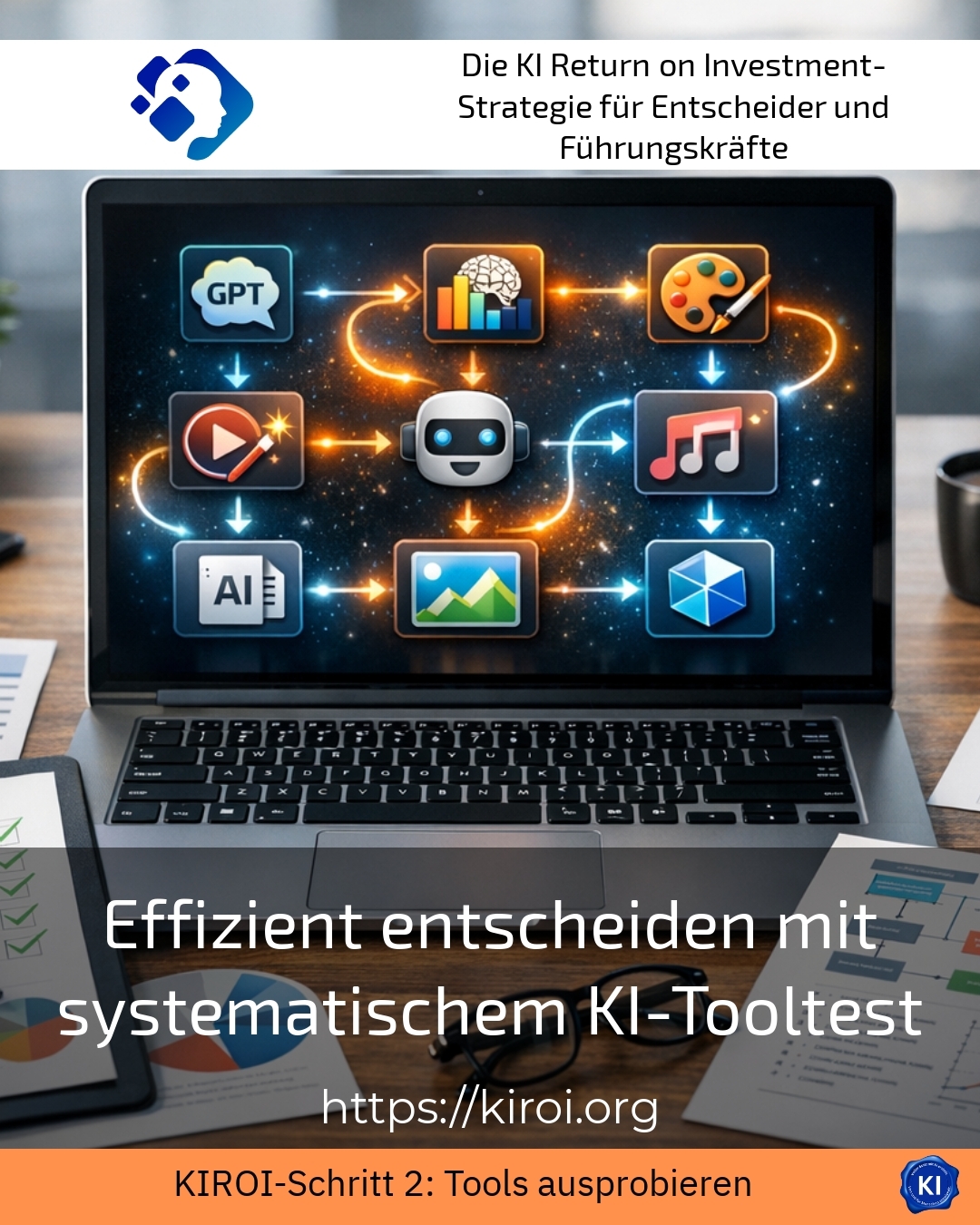
How do you make decisions when dozens of digital tools compete for your attention and each one promises to revolutionize your work processes?
This question currently concerns executives, project managers, and innovation managers alike, as the market for intelligent software solutions is growing exponentially and the selection is becoming increasingly complex every day. Efficient decision-making with systematic AI tool testing involves far more than simply trying out different applications. It involves a structured approach that aligns individual company requirements with technological capabilities, while saving both time and financial resources. Many decision-makers report being overwhelmed by the sheer number of options. They want clear criteria and comprehensible methods for their selection. This is where a well-thought-out testing strategy comes into play, providing guidance and creating sound decision-making foundations.
Why traditional selection methods are no longer sufficient today
The days when companies selected software based on glossy brochures and sales presentations are finally over. Modern technology solutions have become too complex to be judged superficially. For example, a financial services provider must consider completely different criteria when selecting an analytics solution than a manufacturing company or a healthcare provider. Compliance requirements differ significantly. Data protection aspects play a central role. Integration capabilities within existing systems determine the success or failure of the implementation.
Let’s take as an example a medium-sized logistics service provider that wants to optimize its route planning. They face the challenge of selecting the right one from more than fifty different providers. Each solution promises cost savings and increased efficiency. But which one actually fits the existing infrastructure? Which one can be connected to the existing ERP system? These questions can only be answered through systematic testing. Another example can be found in retail, where companies must evaluate predictive models for order quantities. Here too, it quickly becomes apparent that theoretical promises and practical performance often differ significantly.
The basic pillars of a structured testing procedure
A systematic approach to efficient decision-making using systematic AI tool testing is based on several pillars that interlock and reinforce each other. First and foremost, the precise definition of the requirements is at the center. What exactly should the solution provide? What problems is it intended to address? Who will use it? These questions must be answered before any testing even begins. This is followed by market research, which identifies potential candidates and enables an initial selection. Subsequently, the actual testing phase begins, ideally in several stages.
In the insurance industry, for example, a three-stage process has proven effective: first, basic technical functions are tested, then the integration into existing systems takes place, and finally a pilot run with real users takes place [1]. This methodology can be applied and adapted to other industries. In healthcare, for example, additional regulatory testing steps are added. In the manufacturing industry, real-time capabilities play a particularly important role. The testing methodology must therefore always be adapted to the specific industry.
Best practice with a AIROI customer
A medium-sized company in the field of technical building equipment faced the challenge of selecting the optimal from more than twenty different planning tools, while maintaining the existing CAD infrastructure absolutely necessary and simultaneously seeking new analysis capabilities. The transruptions coaching accompanied the entire selection process over a period of three months and helped to first capture the actual requirements of the various departments, which turned out to be significantly more complex than originally assumed. Together, we developed a criteria catalog with more than eighty individual points ranging from user-friendliness to interfaces and long-term license costs. Particularly important was the involvement of future users, who were able to contribute their practical experiences and needs. After a structured testing phase with three final candidates, the decision was made in favor of a solution that initially did not even appear on the list of favorites. This choice proved to be the right one, as it best supported the company’s specific workflows. The implementation proceeded smoothly because all involved parties supported the decision-making process and were convinced by the selection.
Make efficient decisions with systematic AI tool testing in practice
The transition from theory to practical implementation poses challenges for many organizations that should not be underestimated. Clients often report initial overwhelm due to the many aspects that need to be considered. transruptions-coaching provides valuable guidance and supports teams throughout the entire process. Experience shows that external perspectives can uncover blind spots and enable new solutions.
For example, a pharmaceutical company used the guidance to analyze its documentation processes and identify appropriate support tools [2]. The regulatory requirements in this industry are particularly strict. Every decision must be documented in a comprehensible manner. The selection of a new system can have far-reaching consequences. Therefore, a particularly careful approach was required. Another example comes from the energy sector, where a provider wanted to optimize its grid planning. Here, real-time data streams had to be processed, which brought with it special technical requirements.
Develop criteria for meaningful test scenarios
The quality of a testing procedure depends largely on the scenarios used, which should be as realistic as possible and at the same time provide comparable results. In the banking sector, for example, a testing scenario could involve the automated review of loan applications, using real historical data to compare the performance of different solutions. In mechanical engineering, on the other hand, predictive maintenance scenarios may be the focus, where maintenance needs are predicted based on sensor data.
Developing such scenarios requires deep expertise and an understanding of the specific challenges of the respective industry. A trading company will focus on different areas than a media conglomerate or a research institute. Therefore, collaboration between technology experts and specialist departments is so important. Only together can meaningful tests be designed. The results must then be carefully evaluated and interpreted. Standardized assessment tools and clear metrics help here.
Best practice with a AIROI customer
A company in the food industry was looking for a way to improve its quality control while reducing personnel costs, which was a pressing issue given the shortage of skilled labor. As part of the transruptive coaching, we developed a comprehensive testing procedure together that took into account various aspects such as image recognition accuracy, processing speed, and integration capabilities within the existing production line. Particularly challenging was the fact that the testing environment had to operate under real production conditions, which brought significant logistical requirements and required close coordination between the IT department and the production management team. We organized several workshops where all stakeholders were able to contribute their perspectives and jointly defined evaluation criteria that encompassed both technical and economic aspects. The result was a selection process that was perceived by all involved as fair and transparent and led to a decision that received widespread acceptance. The implemented solution now supports the quality control process and has measurably improved the error rate, with employees perceiving the technology as a helpful support rather than a threat.
Don't forget the human element
Despite all the systematics and methodology, one aspect must not be neglected that often determines the success or failure of an implementation: the acceptance by the people who will be working with the selected tools on a daily basis. A technically perfect system is of little use if it is rejected by the employees. Therefore, the involvement of the future users should be part of the selection process from the very beginning.
In the service sector, for example, it is regularly shown that user friendliness is a crucial success factor. Customer advisors in a call center have different requirements than analysts in a controlling department. Sales representatives in the field require mobile solutions with intuitive operation [3]. Administrative staff may place greater emphasis on comprehensive documentation functions. These different perspectives must be taken into account in the testing process. Only then can decisions be made that will be beneficial in the long term.
Long-term perspectives in efficiency are determined by systematic AI tool testing
A frequently underestimated dimension when selecting new technology solutions is the long-term development perspective, which extends far beyond the immediate context of use. How will the provider develop in the coming years? What roadmap does it follow? How is the company’s financial stability? These questions should be part of any systematic evaluation.
For example, an automotive supplier must consider when choosing its development tools that they will still need support in ten years. Product cycles in this industry are long. Investments in infrastructure take many years to amortize. A media company, however, operates in a more dynamic environment and must be able to react more flexibly to changes. Here, other selection criteria are relevant. Scalability plays an important role. The ability to easily switch between solutions should also be considered.
My AIROI Analysis
After intensive consideration of the various aspects of systematic selection procedures, a clear picture emerges: The success of technological investments depends significantly on the quality of the upstream decision-making process. Companies that invest time and resources in thorough evaluation achieve better results in the long term than those that act in a hasty manner or are guided by superficial criteria. The structured approach not only reduces the risk of misinvestments but also creates a common knowledge base within the company that is valuable for future decisions.
The balance between systematic methodology and pragmatic implementation seems particularly important to me. An overly complex testing process can slow down the process and cost valuable time. At the same time, superficial evaluations often lead to decisions that are later regretted. Transruptive coaching helps companies find this balance and develop individually adapted approaches that are both thorough and efficient. The support for such projects has proven to be a valuable investment because external perspectives reveal blind spots and bring experience that is often lacking internally. Ultimately, the goal is to make informed decisions that are supported by all involved parties and that yield lasting benefits.
Further links from the text above:
[1] Bitkom – Guide for implementing AI in companies
[2] Fraunhofer – Research on the application of intelligent systems
[3] acatech – Recommendations for the introduction of new technologies
For more information and if you have any questions, please contact Contact us or read more blog posts on the topic Artificial intelligence here.








 Deutsch
 English (UK)